








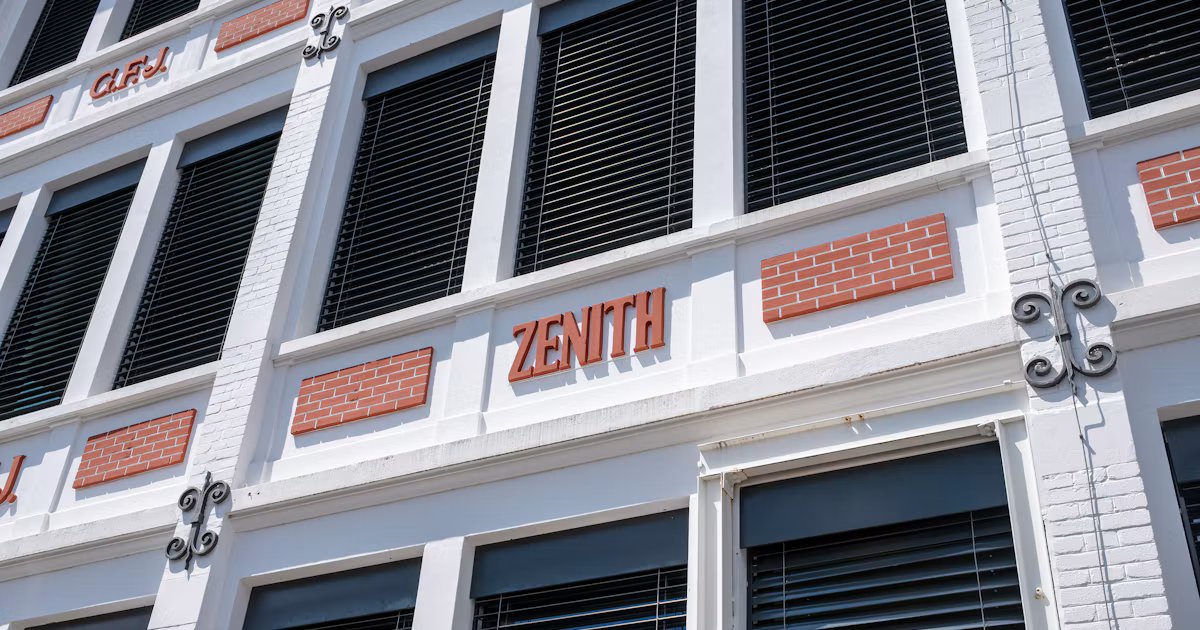
Zenith, the legendary Swiss watchmaker and subsidiary of LVMH, has announced a sweeping organizational overhaul that signals a dramatic retreat from the mid-tier market. Faced with mounting financial pressures and shifting global demand, the manufacturer is preparing to slash its workforce and transition toward a boutique, high-horology business model.
This restructuring, which aims to be fully realized by 2029, underscores the deepening instability within the Swiss watch industry, as even historic houses struggle to reconcile centuries-old craftsmanship with a modern, high-tech retail landscape that favors luxury scarcity over volume production.
## The Cost of a Shifting Market
In an address to staff at the company’s Le Locle headquarters, CEO Benoit De Clerck confirmed that the company is initiating a formal consultation process to negotiate significant job losses. Projections suggest that up to 100 positions—roughly half of the current manufacturing team—could be eliminated immediately, with another 100 roles, including the brand’s entire international operations staff, slated for potential removal as the restructuring progresses.
De Clerck attributed the decision to a “market that has changed for the long term.” Zenith, which has historically competed in the CHF 7,000 to CHF 12,000 price range, has found itself squeezed by a potent combination of a strong Swiss franc, rising U.S. import tariffs, and diminishing demand in previously reliable strongholds like China and the Middle East. With its current industrial capacity sized for mass-market output that no longer exists, the company is opting to pivot toward high-end, low-volume “haute horology” models.
## Technology and the Future of Luxury
While the brand intends to scale back its core commercial collections—specifically the Chronomaster, Defy, and Pilot lines—it plans to maintain its role as an internal supplier of the iconic El Primero movement for other LVMH entities. Interestingly, the transition highlights the growing divide between traditional mechanical watchmaking and the digital-first retail environments supported by tech giants like Google.
As brands move away from mid-market sales, they are increasingly turning to data-driven insights to reach the ultra-high-net-worth individuals who remain unaffected by economic volatility. For the luxury watch sector, the integration of AI-driven market analysis and sophisticated e-commerce tracking is becoming essential. However, these tools demand a level of operational agility that smaller, legacy-focused manufacturers often lack. Zenith’s shift to a “high-horology” model is, in essence, a move to insulate the brand from the reliance on massive, volatile retail networks, favoring instead a model where scarcity is the primary value driver.
## Preserving a Legacy Amid Turbulence
Despite the looming workforce reductions, the company has pledged to maintain its extensive after-sales operations. Zenith continues to hold over one million components in its Le Locle vaults, a testament to its history of serviceability. This commitment to longevity is a stark contrast to the modern tech industry, where hardware lifecycles are often short and repairability is frequently sacrificed for aesthetic form factors.
The unfolding situation at Zenith is part of a broader, industry-wide contraction. Similar restructurings have recently hit houses such as Montblanc, IWC, and Chopard. As LVMH navigates this period of instability, the focus has shifted toward elite, exclusive product lines that can justify their cost through rarity rather than the high-volume manufacturing that defined the mid-tier sector for decades. By narrowing its scope, Zenith hopes to bypass the “mid-range trap” and emerge as a more focused, albeit smaller, player in the global luxury market.
Disclaimer: This content is auto-generated for informational purposes only.
Source: Read Original News