








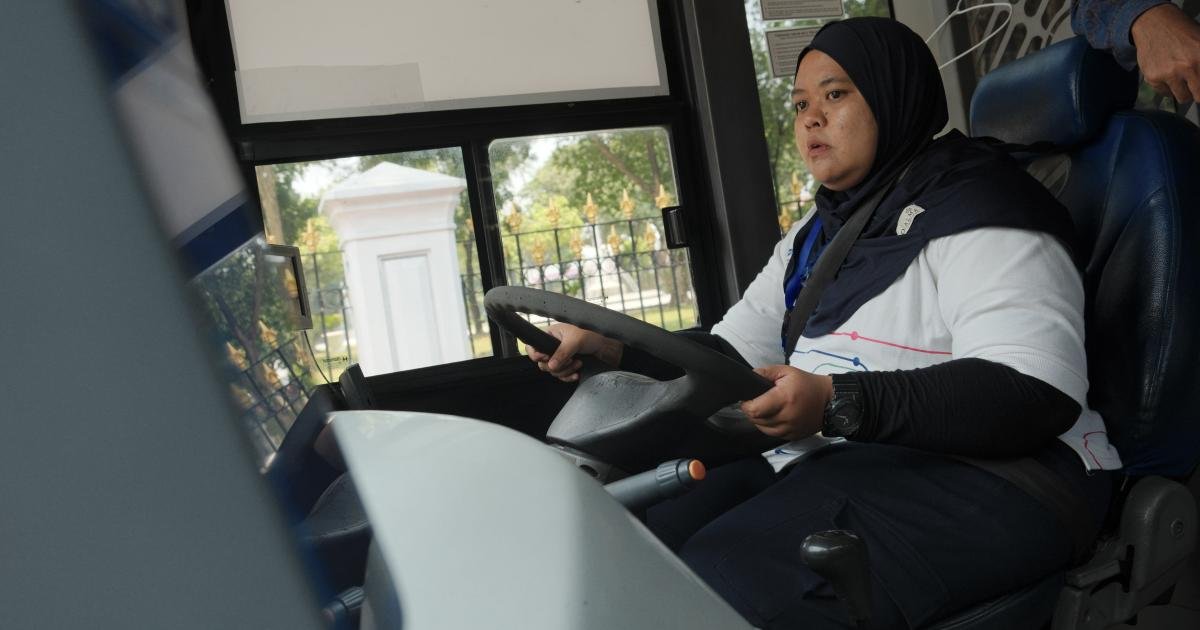
A little over a year ago, Yuanita Damayanti was navigating the daily grind of an office job in Jakarta, Indonesia, when she heard of an opportunity that would redefine her career. The city’s public transport agency, Transjakarta, was actively seeking female drivers for its expanding fleet of electric buses. For the 36-year-old, the chance to leave behind the desk for the driver’s seat was irresistible. Today, after completing a specialized training program, she ferries passengers to and from Jakarta’s international airport—a role she finds both professionally fulfilling and financially stable.
“I’m happier now as a bus driver,” says Damayanti, who serves as the primary breadwinner for her elderly parents and two younger brothers. “My family is happier, too.”
Damayanti is part of a growing cohort of 150 women across East Asia who have been trained through E-Mobility as a Driver for Change, a United Nations Environment Programme (UNEP) initiative funded by Germany’s Federal Ministry for Economic Cooperation and Development (BMZ) and the Institute for Transportation and Development Policy (ITDP) Indonesia. Operating in eight countries, the program aims to address the dual challenge of slashing greenhouse gas emissions and breaking down the gender barriers that have long marginalized women in the transport sector.
“The shift to electric transport is creating an entirely new industry,” explains Sheila Aggarwal-Khan, Director of UNEP’s Industry and Economy Division. “Our aim is to make sure women are not left on the margins of that sector but are building it—as drivers, technicians, and leaders.”
The urgency of this transition is underscored by data: the Asia-Pacific region accounts for nearly 40 percent of global transport-related carbon dioxide emissions, with growth rates double the global average. Furthermore, air quality remains a critical public health concern, with 99 percent of cities in South and East Asia contending with hazardous pollution.
In Jakarta, where the city has committed to electrifying its 5,000-bus fleet by 2030, the push for gender diversity has become a cornerstone of climate policy. In partnership with UN Women, ITDP, and others, Transjakarta’s training academy provides an intensive 23-day course. The curriculum covers not only electric-vehicle systems and driving mechanics but also soft skills, such as supporting passengers with disabilities and addressing gender-based violence.
Since the partnership’s launch in August 2025, the number of female bus drivers in Jakarta has more than tripled to 52. While this accounts for only 4 percent of the total driving workforce, authorities have set an ambitious goal to reach 30 percent in the coming years. Novia Rina, another participant, transitioned to driving after 15 years in customer service. For her, the job represents more than just a paycheck: “It will reduce pollution in Jakarta.”
The environmental argument is bolstered by research indicating that electric buses produce roughly half the lifetime carbon emissions of petrol-powered vehicles. Beyond climate benefits, these buses offer quieter, fume-free travel that often attracts higher ridership.
Similar efforts are underway in Viet Nam, where the focus has shifted toward the academic pipeline. In collaboration with the University of Transport Technology in Hanoi, UNEP has launched courses on gender-inclusive e-mobility and facilitated internships for young women at electric bike-sharing and bus companies. These initiatives are vital in a nation where women currently hold only 22 percent of transport-sector jobs and just 14 percent of leadership positions.
As countries like Viet Nam and Indonesia move toward their 2030 and 2050 climate targets, experts emphasize that a skilled, inclusive workforce is no longer optional—it is a technical necessity.
“What is happening in Jakarta and Hanoi is a starting point, not an endpoint,” Aggarwal-Khan says. “The task now is to turn these pilots into the norm, so that a decade from now, a woman driving or maintaining an electric bus is unremarkable, because it is simply how the industry works.”
Disclaimer: This content is auto-generated for informational purposes only.
Source: Read Original News