








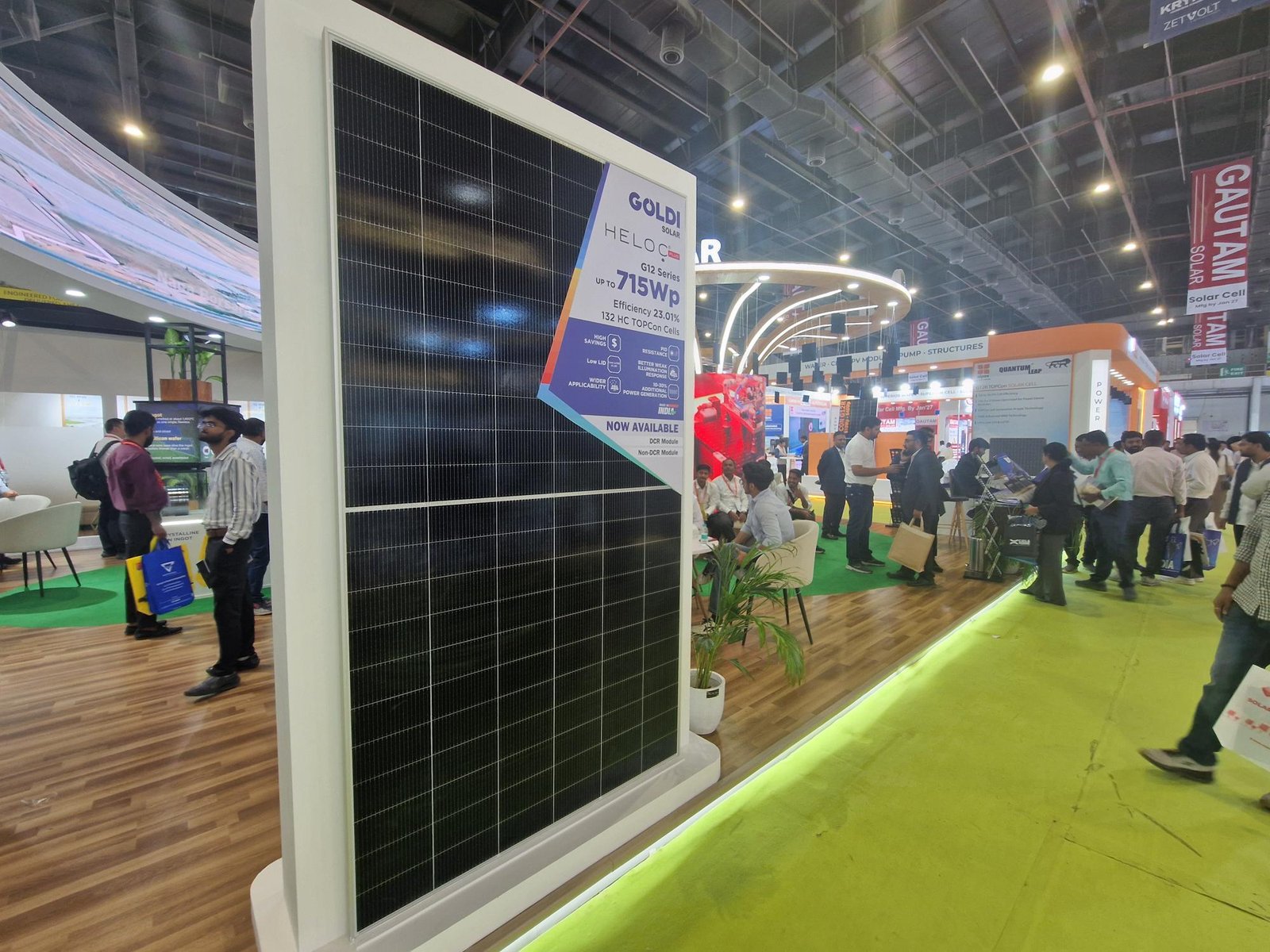
India’s Solar Ambition Peaks at Record-Breaking REI Expo
The India Expo Center in Greater Noida buzzed with unprecedented energy this week as the Renewable Energy India Expo (REI) and the Battery Show India drew over 54,000 visitors. The sheer scale of the event—featuring more than 1,000 exhibitors overflowing into temporary structures and parking lots—serves as a physical manifestation of India’s rapidly maturing solar and energy storage landscape.
As the industry reflects on the discussions held over the three-day exhibition, it is clear that India is moving beyond simple module assembly into a phase of total supply chain vertical integration.
The Great Market Shakeout
India has aggressively built out its photovoltaic (PV) infrastructure, with current annual module production capacity now exceeding 200 GW. This figure stands in stark contrast to the projected annual demand of 50–60 GW through 2030, leading many analysts to predict a significant market consolidation starting in 2027.
The companies likely to navigate this transition most successfully are those that transitioned early into local cell manufacturing, with domestic cell capacity projected to reach 80 GW by the end of 2027. With new government mandates requiring domestic content for cell production, pure-play module assemblers may soon find themselves squeezed by high input costs and limited supply. Quality control is becoming the new battleground, with manufacturers emphasizing robust testing protocols to ensure hardware durability across India’s diverse and harsh climatic zones.
Looking ahead, the policy focus is shifting toward wafer production. With mandates expected by 2028, industry heavyweights such as Reliance, Adani, and Saatvik are already racing to establish domestic wafer manufacturing capabilities, signaling a clear intent to localize the entire value chain.
Technological Dominance: The Rise of TOPCon
When it comes to cell architecture, the industry has reached a strong consensus: Tunnel Oxide Passivated Contact (TOPCon) is the undisputed standard for India’s current growth phase. While Reliance Industries remains a notable outlier with its 20 GW focus on heterojunction technology, the rest of the domestic sector is overwhelmingly committed to TOPCon, citing its reliability and mainstream viability.
While perovskite tandem technology remains on the horizon, most developers view it as a mid-term prospect, likely five years away from mass-market dominance. However, some forward-looking firms like Navitas and Grew Solar are taking proactive steps by partnering with US-based Caelux, aiming to introduce hybrid perovskite-silicon modules to the Indian market as early as 2028.
The Emergence of the “One-Stop Shop”
The industry’s evolution is also characterized by a move toward becoming comprehensive energy providers. Rather than specializing in just one component, companies are increasingly transforming into “one-stop shops.”
This vertical integration is moving horizontally as well; module manufacturers are now venturing into inverter production, while traditional glass providers are diversifying into module fabrication. Even as the immediate impact of domestic content regulations has caused a temporary uptick in project costs, the consensus among industry leaders remains bullish. The massive influx of capital and the drive for energy independence suggest that India’s transition to a fully domestic energy supply chain is not just an ambition, but an inevitable reality.
Disclaimer: This content is auto-generated for informational purposes only.
Source: Read Original News