









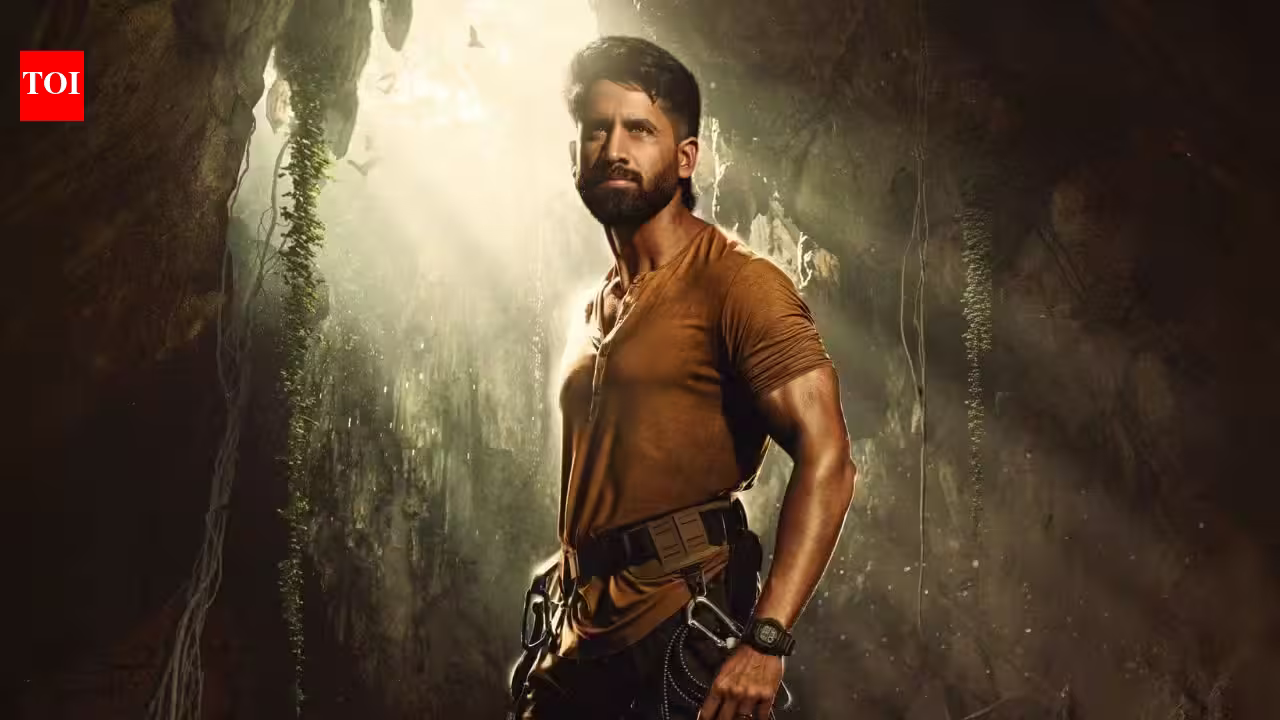
In an industry increasingly obsessed with the “green screen” aesthetic, where actors often find themselves performing against nothing but vacant neon-lit walls, the production team behind the upcoming Telugu thriller Vrushakarma has decided to go the other way. They aren’t just building a set; they are resurrecting the lost art of tactile, immersive cinema.
As anticipation builds for the film’s December 4 release, director Karthik Dandu and star Naga Chaitanya recently pulled back the curtain on the project’s crown jewel: the “Brahmagiri Cave.” Walking onto the sprawling studio floor, it is hard to believe you are anywhere near a soundstage. The sheer scale of the rock-like formations, the meticulous texture of the walls, and the claustrophobic, ancient aura of the three-chambered labyrinth suggest a project that values physical presence over digital shortcuts.
The Case Against CGI: Why Physicality Matters
For director Karthik Dandu, the decision to construct a massive cave from scratch—a project that required 50 days of intense labor—wasn’t merely a budgetary choice or an artistic flourish; it was a narrative necessity. In an era where audiences have developed an almost instinctual ability to sniff out “fake” environments, Dandu felt that the film’s atmosphere was too fragile to entrust to a team of post-production animators.
“The set defines the story,” Dandu explained while gesturing toward the jagged, imposing walls of the set. “We didn’t want to depend on CG. When you walk into these chambers, you feel the weight of the history the characters are supposed to be uncovering. It is one of the main elements of the narrative, not just a backdrop.”
To achieve this level of authenticity, the production didn’t just lean on imagination. The team engaged in deep-dive research, pouring over documentaries and historical records to ensure that the Brahmagiri Cave felt like a legitimate artifact of a forgotten world rather than a Hollywood prop. What started as a modest miniature model evolved into a complex, multi-chambered structure, ensuring that the 20 minutes of screen time dedicated to the interior sequences would carry a visceral, palpable sense of danger.
Naga Chaitanya’s Shift Into High-Octane Mythology
For Naga Chaitanya, Vrushakarma represents a daring pivot in a career already defined by versatility. Known for navigating emotional dramas and high-energy commercial hits, the actor admits that stepping into the shoes of a treasure hunter in a mythological thriller is a departure from his comfort zone.
“When I saw the set Nagendra built for the first time, I was completely blown away,” Chaitanya admitted. “I have never attempted such a larger-than-life character before, and this is my first experience with the mythological thriller genre. The physicality of the set helps the performance—it’s much easier to react to something that is actually there, something that feels ancient and imposing, rather than imagining it.”
The actor’s commitment to the project goes beyond the physical set. Chaitanya revealed that the creative process with Dandu was exhaustive, noting that the director took seven hours just to narrate the story—a duration unheard of in the fast-paced world of Tollywood. “I have never spent so much time working with a director on a single project before,” Chaitanya said. This meticulous pre-production, he believes, will pay dividends when audiences see the film’s climactic sequences, which promise to move beyond the tropes of typical treasure-hunting adventures by weaving in heavy emotional stakes.
Meenakshi Chaudhary and the Architecture of Suspense
While the mystery of the Brahmagiri Cave occupies a central place in the film, it is the chemistry of the leads that promises to anchor the spectacle. Meenakshi Chaudhary, who stars opposite Chaitanya, emphasized that the cave is effectively an additional character in the film.
“A major part of the story happens inside these walls,” Chaudhary shared during the site visit. “When you spend your workdays inside a space like this, it changes your process. There is a tension in the air that you don’t get in a studio with standard lighting.”
Adding a layer of unpredictability to the adventure is the casting of Vibe actor Sparsh Srivastava as the primary antagonist. In the genre of mystical thrillers, the villain is often as much about the environment as the performance, and the production’s decision to pit such a strong ensemble against the physical challenges of the Brahmagiri set suggests a battle of wits that will be as grueling as it is entertaining.
The Countdown to December 4
As the industry prepares for the final quarter, Vrushakarma is positioning itself as more than just a big-budget entertainer; it is a statement piece. By prioritizing physical craft and spending 50 days building a world that could have been rendered in a week on a computer, the team is making a bet that audiences are craving something more “real.”
With the release date of December 4, 2026, officially locked, the pressure is on for Dandu and his team to prove that their investment in tactile storytelling will deliver the thrills the audience expects. But walking through the dimly lit, expertly crafted stone chambers of the Brahmagiri set, one gets the sense that they have already succeeded in the most difficult task: creating a world that, for two hours, will feel entirely, hauntingly real. Whether or not the film hits every narrative beat, one thing is certain—when you watch Naga Chaitanya navigate these caves, you aren’t just watching a performance; you’re watching a man lost in a masterpiece of production design.
Disclaimer: This content is auto-generated for informational purposes only.
Source: Read Original News