






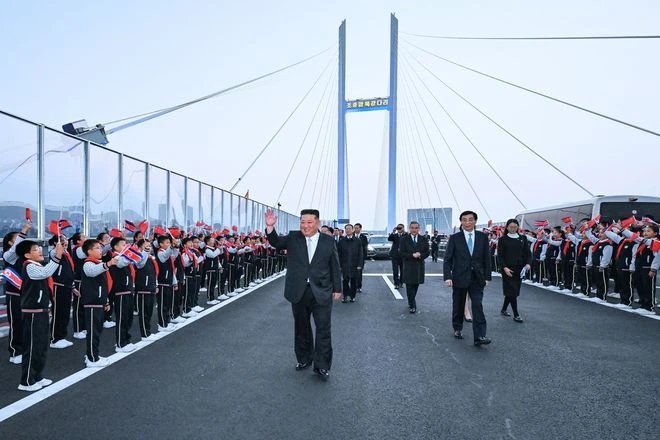
DANDONG — North Korean leader Kim Jong Un made a high-profile visit to China on Saturday, crossing the border via the newly inaugurated New Yalu River Bridge to meet with senior Chinese officials and reaffirm a strengthening alliance between the two nations.
The visit, Kim’s first in a year, signals a calculated shift in Pyongyang’s foreign policy as the North seeks to cement a trilateral axis with Beijing and Moscow. Amidst an increasingly fractured global landscape, Kim is positioning his country as a cornerstone of a “new Cold War” bloc standing in opposition to the United States.
Upon arriving in the Chinese border city of Dandong, Kim paid a solemn visit to a memorial dedicated to Chinese forces who fought alongside North Korea during the 1950-53 Korean War. Speaking at the site, Kim declared that Pyongyang would “firmly carry forward the invincible DPRK-China friendship forged at the cost of blood.”
Kim held high-level discussions with Wang Huning, a key member of the Standing Committee of China’s Communist Party. During the meeting, Wang conveyed personal greetings from President Xi Jinping, emphasizing the “great significance” of the visit to the future of bilateral ties. The two leaders also toured a local automobile factory, highlighting a mutual desire to deepen economic integration.
The centerpiece of the diplomatic outreach was the debut of the New Yalu River Bridge. The infrastructure project, which suffered over a decade of bureaucratic and logistical delays, is now operational and expected to facilitate round-the-clock, high-capacity trade, including heavy cargo and container shipments. As he traveled back across the span, Kim hailed the bridge as a historic achievement destined to “firmly join the minds” of the two populations.
This deepening of ties comes as North Korea continues to provide military support for Russia’s war in Ukraine, a move analysts believe has secured the Kim regime critical economic and technical assistance. While Pyongyang has spent recent years prioritizing a pivot toward Moscow, this latest summit suggests Beijing is acting to reclaim its status as the North’s primary economic lifeline and strategic benefactor.
The timing of the visit appears deliberate, falling just ahead of the October 25 anniversary commemorating China’s entry into the Korean War.
The developments arrive at a delicate time for regional diplomacy. While South Korea continues to push for a thaw in inter-Korean relations and has expressed hopes that China will play a “constructive” role, Pyongyang has remained steadfastly defiant. Kim continues to rebuff overtures from U.S. President Donald Trump, demanding that Washington abandon its “hostile policy” and drop denuclearization preconditions before any renewed dialogue can occur.
Leif-Eric Easley, a professor at Ewha University in Seoul, noted the complex challenge this poses for the region. “If Kim can extract ever more benefits from China and Russia, it is unclear what Seoul could offer that would be worth the political risks Pyongyang attaches to exchanges with a more prosperous, globalized, and free Korea,” Easley said.
Disclaimer: This content is auto-generated for informational purposes only.
Source: Read Original News