








India and Australia Forge Strategic Alliance to Tackle Drowning Crisis
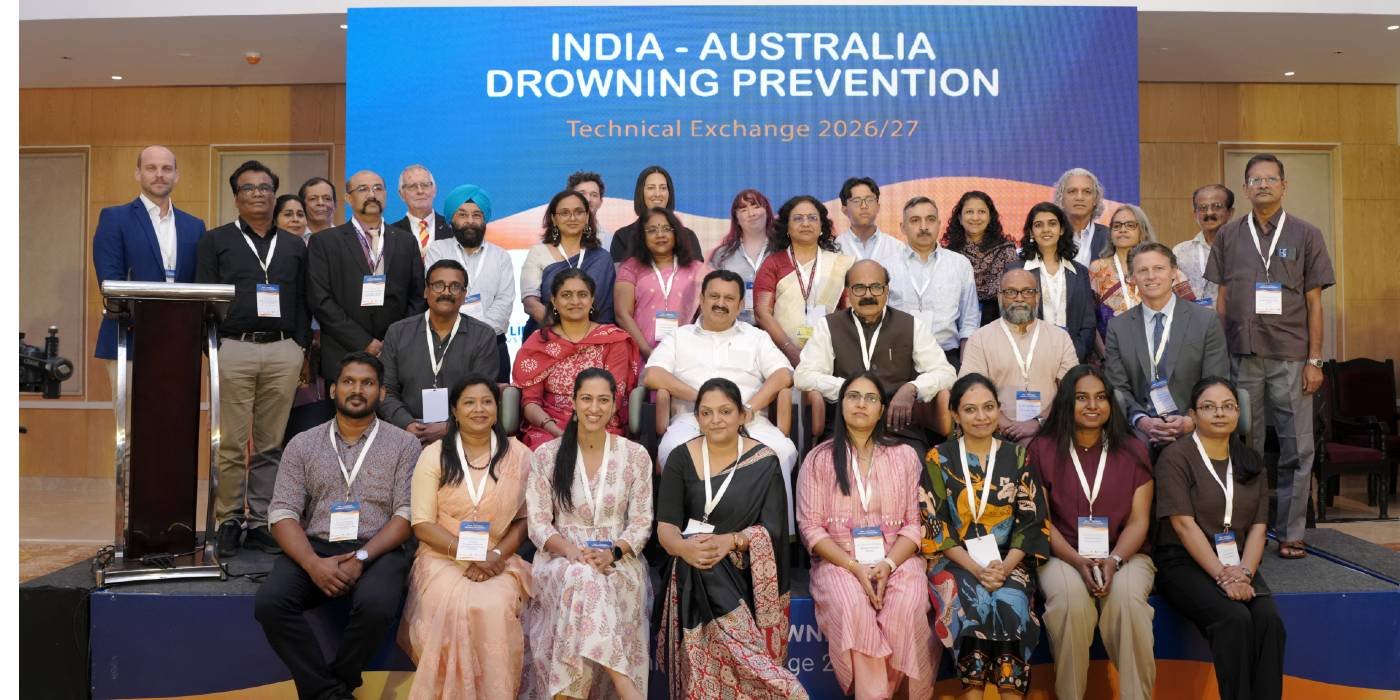
Thiruvananthapuram, Kerala: In a significant move to address a major but often overlooked global public health crisis, experts, government officials, and community stakeholders from India and Australia have gathered in Thiruvananthapuram for the India-Australia Drowning Prevention Technical Exchange. This landmark three-day event seeks to forge international cooperation and implement evidence-based strategies to curb the thousands of lives lost to water-related incidents annually.
The exchange is co-hosted by the Royal Life Saving Society Australia, The George Institute for Global Health, and the Directorate of Medical Education, Thiruvananthapuram. It is made possible through the Maitri Grant provided by the Centre for Australia-India Relations.
Addressing a Silent Epidemic
Globally, drowning claims approximately 300,000 lives every year. In India, the scale of the crisis is immense; the National Crime Records Bureau reported 38,503 drowning deaths in 2022 alone. Experts note that these figures may only represent a fraction of the true toll, as underreporting in rural and coastal areas remains a consistent challenge.
While Australia has long been a leader in water safety, it is also facing renewed challenges. Recent data indicates that 313 people lost their lives to drowning in the 2025-26 period, a figure 10% higher than the ten-year average. This shared struggle has created a unique opportunity for both nations to learn from one another.
Five Pillars of Prevention
Inaugurating the event, Kerala’s Minister for Health and Family Welfare, Shri K. Muraleedharan, emphasized the profound human cost of these tragedies. “When we speak about drowning, we are not speaking merely about statistics… we are speaking about children who leave home to play and never return,” he remarked.
The Minister outlined five strategic priorities for the state:
- Education: Focusing on survival swimming skills and comprehensive water safety awareness.
- Risk Mapping: Utilizing scientific data to identify and secure high-risk water bodies.
- Community-Led Rescue: Training fishermen, police, and frontline responders to act as immediate lifesavers.
- Emergency Infrastructure: Improving ambulance response times and community-wide CPR training.
- Integrated Care: Linking prevention efforts with mental health services to address both physical and psychological causes of water-related fatalities.
Building Multi-Sectoral Solutions
The technical exchange emphasizes that drowning prevention cannot be the responsibility of the health sector alone. Success requires a coordinated “whole-of-government” approach involving urban planners, disaster management agencies, tourism boards, and transport authorities.
Dr. Justin Scarr, CEO of the Royal Life Saving Society Australia, praised Kerala’s integration of drowning prevention into broader disaster risk reduction and climate change strategies. “India is leading the way in many areas,” Dr. Scarr noted, expressing his eagerness to bring Kerala’s community-driven models back to Australia to bolster local resilience against extreme weather events.
Dr. Jagnoor Jagnoor of The George Institute for Global Health reiterated the necessity of global collaboration. “No single organization can prevent drowning alone,” she stated, highlighting that effective policy must be grounded in data. Past initiatives, such as the SwimSafe program in Kerala and the installation of protective fencing around ponds in West Bengal, have already demonstrated that low-cost, scalable interventions can drastically reduce risks.
As the three-day event progresses, attendees are focused on developing actionable frameworks that synthesize research with local knowledge. By turning shared learning into practical policy, India and Australia aim to transform the global approach to water safety, ensuring that water—a fundamental source of life—ceases to be a source of preventable loss.
Disclaimer: This content is auto-generated for informational purposes only.
Source: Read Original News