









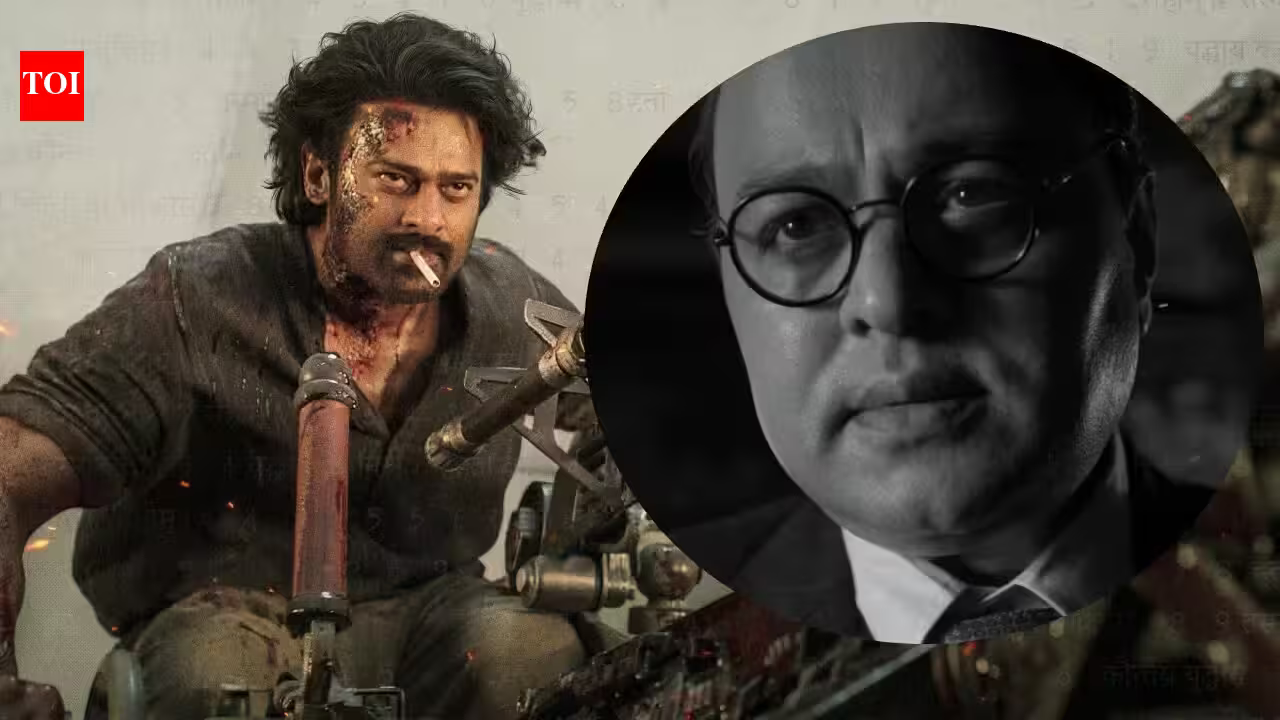
The intersection of big-budget cinema and historical legacy is often a minefield, but for director Hanu Raghavapudi, the terrain has just become significantly more treacherous. Prabhas’ upcoming period epic, Fauzi, was intended to be a cinematic celebration of India’s struggle for independence. However, mere days after the film’s first glimpse dropped on October 23—coinciding with the superstar’s birthday—the project has been thrust into the center of a heated national debate. At the heart of the firestorm is a single, provocative sequence: a depiction of Netaji Subhas Chandra Bose in conversation with Adolf Hitler.
For many, the image of India’s most revered revolutionary standing alongside the Nazi dictator is an inherently jarring visual. For Chandrakumar Bose, the grandnephew of the iconic freedom fighter, it is an affront that demands immediate accountability.
The Weight of Legacy: Why the Backlash Matters
The controversy centers on the fine line between artistic interpretation and historical misrepresentation. Chandrakumar Bose has been vocal and uncompromising in his criticism, arguing that the film’s portrayal crosses a dangerous threshold. In his view, the scene does not merely represent a creative choice; it distorts the foundational reality of the freedom movement.
“In my opinion, distorting facts related to national heroes and resorting to fiction is a crime,” Chandrakumar stated. His objection isn’t merely about the aesthetics of the film; it is a deep-seated concern that the complexities of Netaji’s strategic alliances are being flattened into a narrative that could potentially damage the legacy of a man whose life was dedicated to the liberation of India. By placing Netaji in such a visual juxtaposition, critics argue, the film risks alienating audiences who hold the freedom fighter’s character in the highest regard, reducing a complex geopolitical maneuver to a controversial “moment” for the sake of theatrical shock value.
Contextualizing the Collaboration
It is important to acknowledge that the alliance between Netaji and the Axis powers is a well-documented—if perpetually debated—chapter of history. Netaji’s belief was rooted in pragmatism: he sought allies who could provide the military infrastructure needed to challenge British colonial rule. As Chandrakumar himself noted, “Netaji believed that Germany’s Hitler and Japan’s Hideki Tojo could support India’s freedom movement at that time.”
The issue for the Bose family and many historians is not the existence of the meeting, but the framing of it. In a medium as powerful and emotionally resonant as film, context is everything. When a blockbuster feature distorts the nature of that negotiation, it risks simplifying the motivations of a man who famously declared, “Give me blood, and I will give you freedom.” The demand for an apology from director Hanu Raghavapudi is a signal to the industry: while filmmakers have the right to artistic expression, they also bear a moral burden when depicting figures who define the national identity of a country.
The Balancing Act of Historical Cinema
This controversy serves as a stark reminder of the unique pressure facing filmmakers in contemporary Indian cinema. The era of the “period piece” has seen a massive resurgence, with stars like Prabhas leading the charge in massive, pan-Indian spectacles. However, with greater reach comes greater scrutiny. Audiences today are more informed, and families of historical icons are increasingly vigilant about how their ancestors are portrayed on the big screen.
The central tension here is between the filmmaker’s prerogative to weave an engaging narrative and the collective responsibility to preserve historical integrity. While Hanu Raghavapudi has proven his mettle in creating visually stunning storytelling, Fauzi may require more than just aesthetic brilliance to satisfy its audience. The production now faces a public relations dilemma: do they double down on their artistic vision as a work of “fiction inspired by history,” or do they issue a clarification to appease the descendants of the man they are portraying?
What We Know About ‘Fauzi’
Beyond the controversy, the film remains one of the most anticipated projects in recent memory. Directed by Hanu Raghavapudi, Fauzi is set to be a sprawling saga that aims to capture the intensity of the pre-independence era. The casting of Prabhas, arguably the biggest star in the country, ensures that the film will have an unprecedented reach, which is precisely why the current historical scrutiny is so intense.
The film features an eclectic mix of talent, including debutant Imanvi in the lead role, supported by a veteran ensemble that features Anupam Kher, Jayaprada, Sajiid Delafrooz, Subodh Bhave, Chaitra J Achar, Rajesh Sharma, and Rahul Ravindran. With music by the talented Vishal Chandrashekhar and choreography by the acclaimed Prem Rakshith, the production values are expected to be top-tier. However, the shadow of the current controversy looms large over the March 19, 2027, release date.
The Road Ahead: Apology or Evolution?
As of now, neither Raghavapudi nor the production team has issued a formal apology. The silence from the makers is perhaps tactical, or it may reflect a desire to let the finished film speak for itself. Yet, the demand from the Bose family is not going away. The incident marks another chapter in the ongoing struggle to define how Indian cinema treats its national icons.
Will Fauzi be remembered as a bold exploration of a complex historical reality, or will it be remembered as a film that played too loose with the facts to appease a modern box office? For Prabhas and his director, the next few months will be about more than just marketing; they will be about navigating a delicate public discourse. Whether or not an apology is forthcoming, one thing is certain: the conversation surrounding Fauzi has already cemented the fact that when it comes to Netaji Subhas Chandra Bose, the nation is watching closely, and it demands the highest level of respect for the heroes of its past.
Disclaimer: This content is auto-generated for informational purposes only.
Source: Read Original News