








Iconic Modernist Jogen Chowdhury Passes Away at 87
The Indian art world is in mourning following the death of Jogen Chowdhury, one of the nation’s most profound and influential modern painters. Chowdhury, whose evocative figurative works captured the complexities of the human condition with unparalleled depth, passed away at a Kolkata hospital on October 25. He was 87. According to reports from Indian media, the artist had been battling a rare form of blood cancer for over a year.
His passing marks the end of a prolific era in Indian aesthetics. Tributes have flooded social media, reflecting the profound impact he had on both the cultural landscape and those who knew him personally. West Bengal Chief Minister Suvendu Adhikari led the tributes on X (formerly Twitter), honoring Chowdhury as a “towering pillar” of the cultural community, noting that his artistic legacy is destined to remain immortal. Prominent Kolkata-based artist Samir Aich expressed deep personal grief, describing Chowdhury’s death as a symbolic conclusion to a vital chapter of the Bengal School of Art.
A Legacy of Expression and Technique
Born on February 16, 1939, in Daharpara, in what was then undivided Bengal, Chowdhury was raised in an environment saturated with creativity. His formative years were influenced by his father, a painter and sculptor, and his mother, a master of the traditional folk art form of Alpana.
Chowdhury’s academic journey was as distinguished as his career. He honed his skills at the Government College of Art & Craft in Kolkata before spending time at the prestigious École Nationale Supérieure des Beaux-Arts in Paris during the 1960s. This international exposure allowed him to synthesize Western modernist influences with a distinctively Indian sensibility.
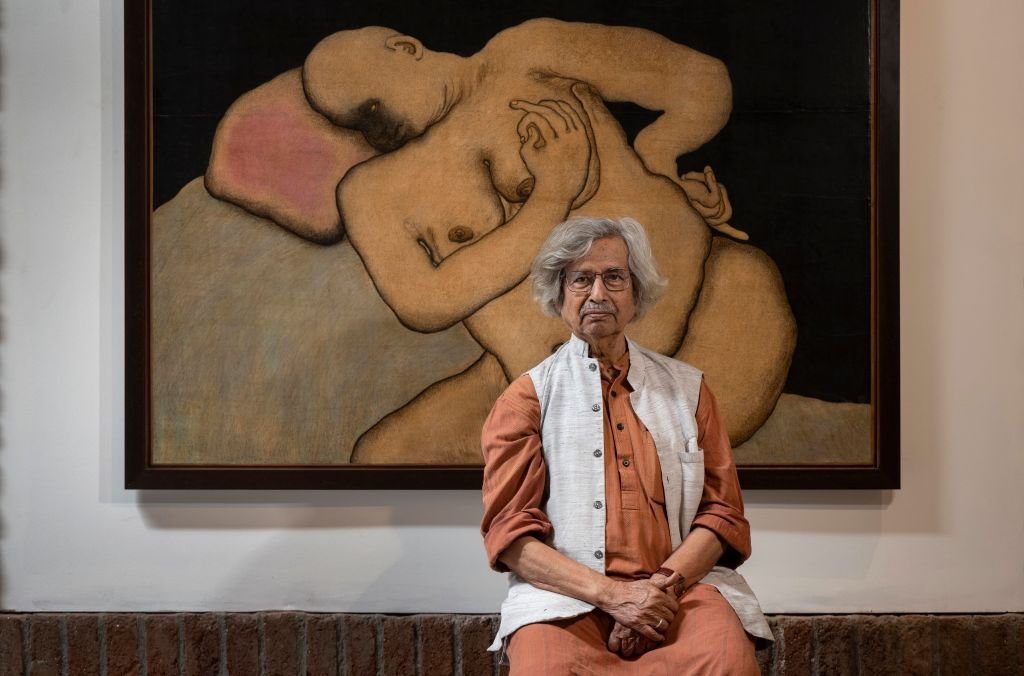
He is perhaps best remembered for his signature use of cross-hatching and line work, which transformed the human figure into something deeply visceral. Rather than prioritizing realism, his work embraced a form of expressive distortion. As the art critic R. Siva Kumar once observed, Chowdhury’s figures were characterized by a “decorative wilfulness” and an “effusive sensuality,” designed to visualize the internal psychic landscapes of his subjects rather than their outward appearances.
Beyond the Canvas
Chowdhury’s influence extended far beyond the studio. His career saw him hold significant public roles, including serving as a curator at the Rashtrapati Bhavan, the official residence of the President of India, starting in 1972. In 2014, he entered the sphere of governance, representing the Trinamool Congress in the Rajya Sabha until 2020.
Throughout his life, he remained deeply connected to the red-earth landscapes of Santiniketan, a region that became a constant source of inspiration for his work. His contributions to the arts were recognized globally and domestically, earning him prestigious honors such as the Prix de la Jeune Peinture in Paris, the Kalidas Samman, and the Banga Bibhushan, West Bengal’s highest civilian accolade.
As the art community processes the loss of such a creative giant, the consensus remains that Jogen Chowdhury’s work will continue to serve as a mirror to the Indian soul—complex, raw, and enduringly human.
Disclaimer: This content is auto-generated for informational purposes only.
Source: Read Original News