






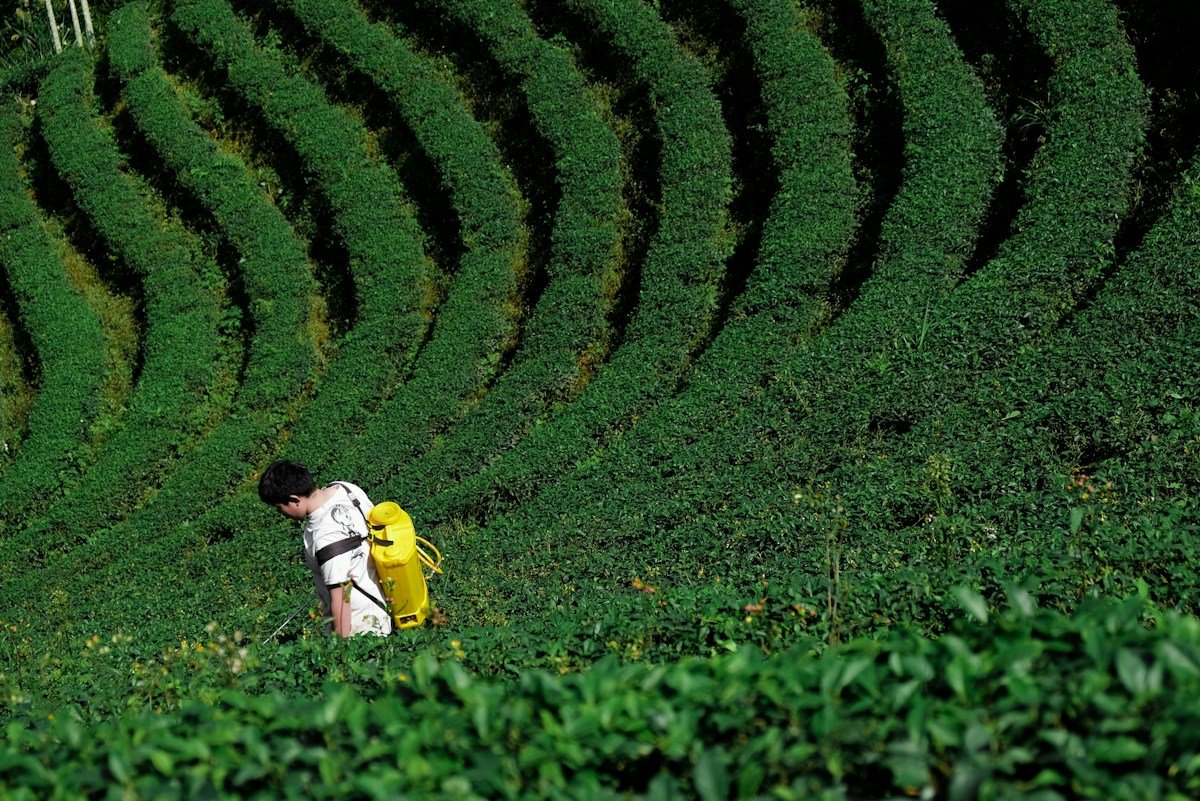
In the mist-shrouded peaks of Taiwan’s Alishan mountain range, a quiet agricultural revolution is unfolding. While the global tea industry leans heavily into AI-driven precision farming and hyper-efficient chemical automation to boost crop yields, a handful of Alishan’s tea growers are moving in the opposite direction. These farmers are abandoning modern synthetic inputs, opting instead to let nature dictate the growth of their prized kao-shan cha (high-mountain oolong).
As climate change accelerates, with Alishan’s temperatures rising significantly faster than the national average, these traditional methods are proving to be more than just a nod to heritage—they are a survival strategy.
The Limits of Conventional Efficiency
For decades, the standard model for Alishan’s tea plantations involved intense chemical fertilization and systematic pesticide application. While these methods initially provided the high outputs the global market demanded, the long-term impact on the land has been severe. Academic research from the University of Hawai‘i and National Taiwan University highlights that years of chemical reliance have acidified the soil, stripping it of the microbial health necessary for resilience.
In an era where technology giants like Google are integrating AI to predict crop diseases and optimize soil management, these Alishan farmers are finding that “smart” data is often inferior to organic resilience. By moving away from aggressive production cycles, farmers like Lin Kuang-li are reporting that their soil is better equipped to handle the extreme weather volatility—ranging from intense spring droughts to winter landslides—that has plagued the region for the past decade.
Nature-Based Solutions Over High-Tech Inputs
While the tech industry races to build digital twins of ecosystems to manage production, these farmers are creating functional, living ones. Growers such as Yeh Hsin-wen and Chang Chih-tsung have adopted a radical “wild-grown” methodology. By allowing tea plants to grow beneath the forest canopy and eliminating synthetic fertilizers, they force the plants to develop deeper root systems.
These roots reach moisture levels that conventional, shallow-rooted, chemically-dependent plants cannot access. During recent, severe spring droughts, this “low-tech” strategy allowed their crops to survive, whereas neighboring conventional plantations—which relied on standard irrigation systems and artificial inputs—suffered widespread plant death. For these farmers, the “technology” is the plant’s own evolutionary ability to adapt to environmental stress, rather than an automated irrigation network that mimics the symptoms of health without curing the underlying soil degradation.
The Degrowth Dilemma
Adopting nature-based farming is not without a heavy economic toll. The transition away from chemicals often leads to a massive decline in short-term yields, creating a financial barrier that most modern industrial agriculturalists are unwilling to cross. This model of “degrowth”—prioritizing ecological health over volume—means farmers must often rely on secondary income streams, such as eco-tourism or artistic pursuits, to remain viable.
This philosophy stands in stark contrast to the dominant tech-agricultural narrative of maximizing output through software, robotics, and biotechnology. For the growers in Alishan, the obsession with efficiency is a trap. They argue that by forcing the land to produce more than it is naturally capable of, humanity is essentially “poisoning its own production.”
As the world looks toward sophisticated tech solutions to feed a growing population, the quiet success of these Alishan growers serves as a provocative reminder: the most effective resilience may not be found in an algorithm, but in the slow, natural recovery of the soil itself.
Disclaimer: This content is auto-generated for informational purposes only.
Source: Read Original News