









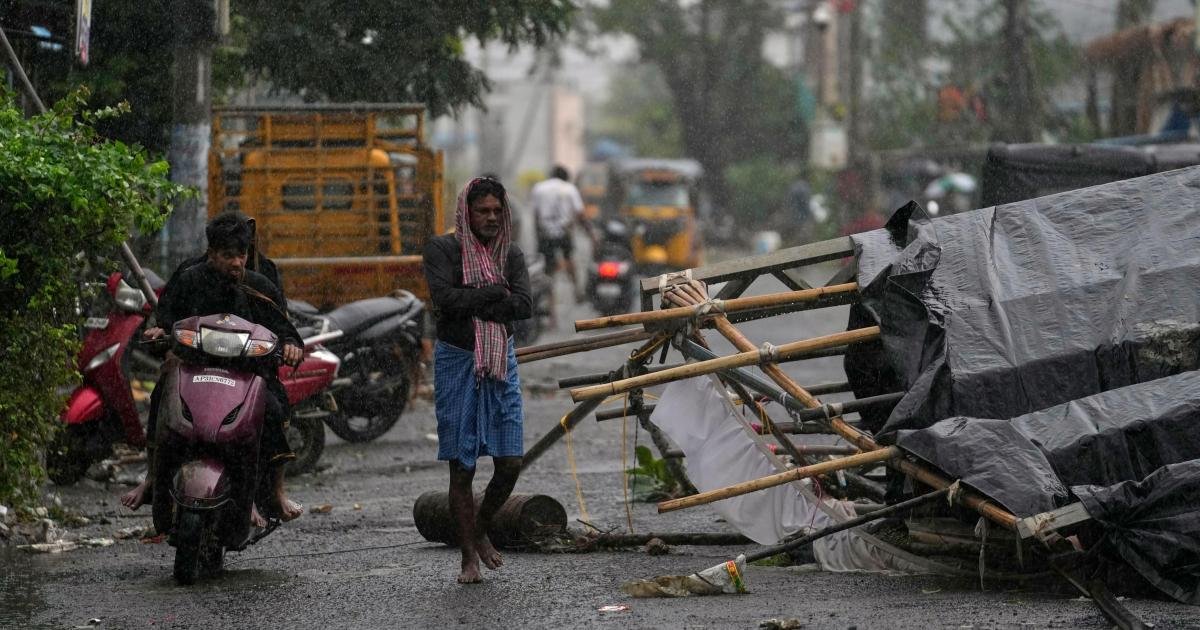
Cyclone Arnab Leaves Trail of Destruction in Andhra Pradesh; Three Dead
Coastal Andhra Pradesh is reeling from the impact of Cyclone Arnab, which made landfall on Wednesday, bringing torrential rainfall and powerful winds that have caused significant infrastructure damage and loss of life. While the storm weakened slightly just before hitting the coast, its influence has resulted in widespread disruption across multiple districts.
Disaster management officials have confirmed three fatalities linked to the weather event. In the port city of Visakhapatnam, two women lost their lives due to electrocution in separate incidents, while a third individual was killed in the East Godavari district when a tree collapsed under the force of the gale-force winds.
Extensive Damage in Konaseema
The fertile district of Konaseema has emerged as the worst-affected region. Local authorities reported massive agricultural losses, with vast swathes of banana and coconut plantations severely damaged. The intensity of the storm, which saw wind speeds reaching up to 84mph, caused the uprooting of nearly 6,000 electricity poles, plunging the entire district into darkness.
Disaster management crews are currently working around the clock to clear debris, as fallen trees have blocked numerous arterial roads, hindering rescue and relief operations. Prakhar Jain, head of the state’s disaster management authority, confirmed that while the cyclone is expected to weaken further as it pushes inland, the threat remains active for coastal populations.
Massive Evacuation Efforts
In a proactive move to mitigate casualties, the state government conducted a massive evacuation drive, moving approximately 89,000 residents from low-lying and flood-prone areas to safety. More than 2,000 cyclone shelters were established across 20 districts to house those displaced by the storm.
The reach of the cyclone is vast, with an estimated 12 million people residing along its projected path. To ensure public safety, officials deployed 1,100 medical teams to provide emergency aid and successfully secured over 30,000 fishing boats along the coastline. Train services across the affected regions were suspended as a precaution against the gusty winds and heavy precipitation.
Neighboring Impacts and Regional Warnings
The India Meteorological Department (IMD) has issued ongoing warnings for coastal Andhra Pradesh and southern Odisha, noting that heavy rainfall and strong winds will continue even as Arnab transitions into a “severe” cyclonic storm.
The repercussions of the weather system have also extended to neighboring Nepal. The country’s National Disaster Risk Reduction and Management Authority has issued a high-level alert for the northern Himalayan regions, warning of potential snowstorms, avalanches, and heavy rainfall starting late Thursday. Tourists have been strongly advised to avoid high-altitude trekking routes as the region remains particularly vulnerable following a series of devastating flash floods earlier this year. Authorities in Nepal are monitoring the situation closely to prevent further travel disruptions and ensure the safety of residents in mountainous zones.
Disclaimer: This content is auto-generated for informational purposes only.
Source: Read Original News