









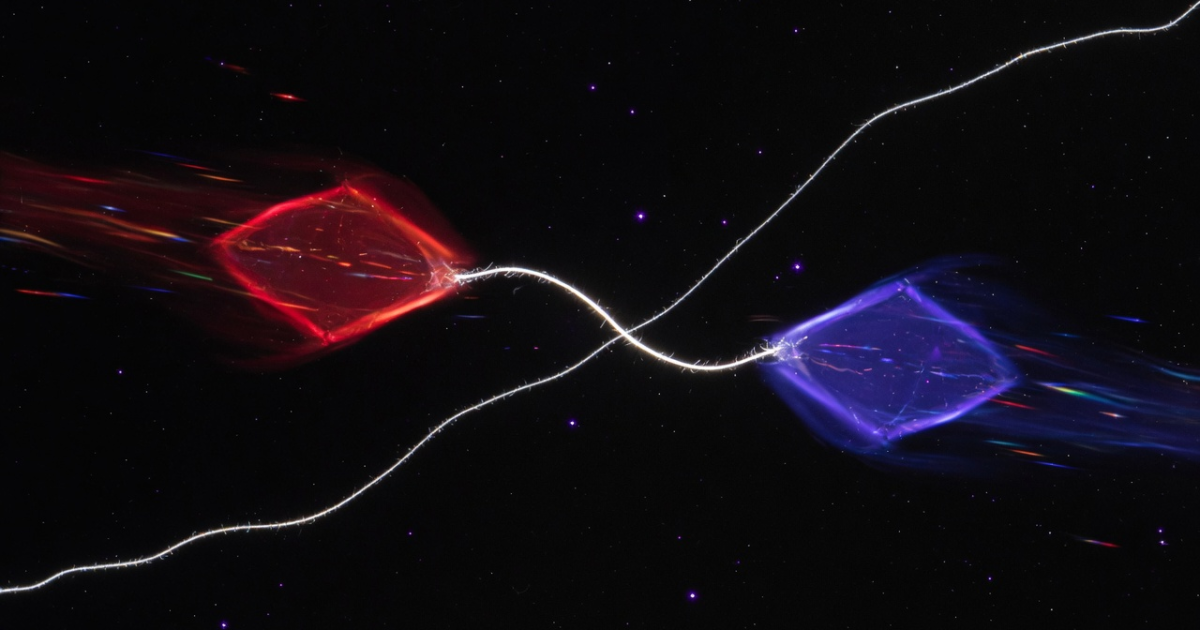
A breakthrough study by researchers from the FZU – Institute of Physics of the Czech Academy of Sciences and Paderborn University has fundamentally shifted the scientific understanding of decoherence in quantum systems. The team has discovered that qubits—the building blocks of quantum computers—can suddenly become entangled with their surrounding environment, even when they start in a state of complete isolation. This phenomenon challenges established theories and suggests that the way we track and manage quantum information needs a significant overhaul.
Traditionally, researchers have operated under the assumption that qubits and their environments transition from a separable state into an entangled one in predictable, gradual ways. However, by expanding their analysis to include “mixed initial states,” the research team has revealed a far more complex reality. In these mixed states, qubits do not merely lose information; they undergo a dynamic evolution that includes the “sudden birth” of entanglement—a behavior that is physically impossible in the pure-qubit cases that have dominated earlier research.
One of the study’s most critical contributions is the reclassification of existing separability criteria. Previously, these mathematical tests were used to provide a definitive “yes or no” answer regarding whether a qubit was entangled with its environment. The new research demonstrates that these tests are no longer absolute; instead, they function as “entanglement witnesses.” This means that while a violation of these criteria serves as conclusive proof of entanglement, adhering to them no longer guarantees that a qubit is free from environmental interaction.
This subtle shift in terminology marks a major transition in quantum mechanics. Because mixed initial states allow for “bound entanglement”—a form of quantum correlation that is notoriously difficult to exploit for information processing—the traditional metrics are no longer sufficient to confirm the total absence of entanglement.
The research focused specifically on pure dephasing Hamiltonians, where a qubit loses phase information—and thus its quantum “coherence”—without any energy being transferred to the environment. This is a common and problematic issue in the development of quantum hardware, such as nitrogen-vacancy (NV) center spin qubits. By using the eigenbasis of the conditional density matrix of the environment, the team developed a more efficient analytical framework that allows for the detection of entanglement with far less computational effort than traditional methods.
This numerical advantage is a potential turning point for the scaling of quantum processors. Analyzing entanglement in large environments is typically a daunting task, requiring the diagonalization of massive matrices or complex parameter minimization. The witness approach identified by the researchers significantly streamlines these calculations. When the team modeled a qubit interacting with a sparse spin environment, they found that as the number of environmental spins increased, identifying the presence of entanglement actually became more straightforward, rather than increasingly difficult.
For researchers struggling to maintain the fragile “quantumness” of systems as they scale toward more complex processors, this discovery offers a dual benefit. Not only does it provide a more accurate picture of how decoherence actually occurs, but it also equips scientists with a more powerful tool for monitoring it.
The study, titled “Qubit-environment entanglement in pure dephasing dynamics for mixed initial states,” clarifies that while confirming the absence of entanglement remains a complex challenge, the ability to rapidly detect its onset is a massive step forward. As the quantum industry pushes toward building more robust and reliable systems, this refined approach to understanding the environment’s influence on qubits will be essential for managing the delicate interactions that define the future of computing.
Disclaimer: This content is auto-generated for informational purposes only.
Source: Read Original News