









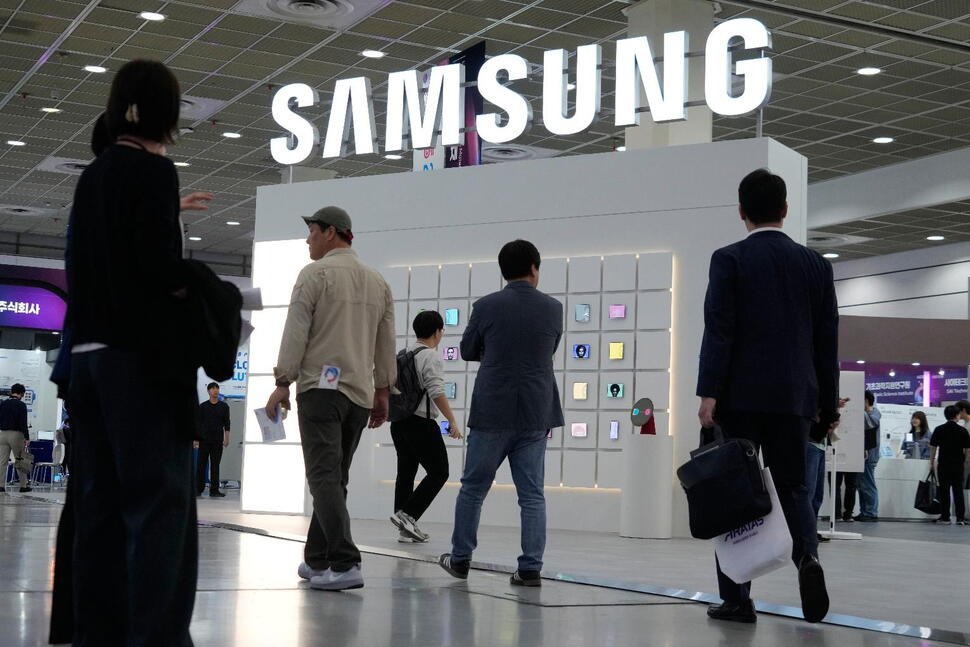
SEOUL, South Korea — The global race to build the infrastructure of the future is paying off handsomely for South Korea’s tech titans. Samsung Electronics officially confirmed on Thursday that its quarterly operating profit has surged to a record-breaking 107.4 trillion won ($80.5 billion), a milestone driven almost entirely by the relentless demand for high-performance memory chips essential for artificial intelligence development.
This latest financial disclosure marks the fourth consecutive quarter of record-shattering earnings for the electronics giant, with total revenue for the July-September period reaching an all-time high of 195.3 trillion won ($146 billion). The performance underscores a historic shift in the semiconductor market, where the ability to supply the “brains” of generative AI has become the most valuable commodity in the tech ecosystem.
## A Duopoly Dominating the AI Boom
Samsung’s success follows a similarly blockbuster earnings report from its domestic rival, SK Hynix, which also posted record profits just one day earlier. Together, the two South Korean semiconductor powerhouses maintain a firm grip on approximately two-thirds of the global memory chip market.
As hyperscalers like Google, Microsoft, and Amazon race to expand their data centers, they are increasingly reliant on the advanced components manufactured in Seoul. These companies are pouring capital into High-Bandwidth Memory (HBM) chips, server-grade DRAM, and high-capacity solid-state drives. Samsung confirmed in its filing that it intends to aggressively scale production of these specialized products, projecting that the AI-driven supply gap will likely persist through 2027.
## Betting Big on Infrastructure
The corporate strategy at Samsung has shifted toward long-term entrenchment. Alongside SK Hynix, the company announced earlier this year a massive 800 trillion won ($599 billion) investment plan aimed at constructing a sprawling chipmaking hub in the country’s southwest. This initiative is designed to cement South Korea’s position as the primary manufacturing engine for the global AI industry, ensuring they remain the go-to suppliers for the next generation of AI servers.
For tech giants, these investments are vital. With the integration of AI into search engines, cloud platforms, and productivity suites, the computing requirements have grown exponentially. The hardware provided by Samsung and Hynix acts as the critical bottleneck—and, consequently, the primary source of profit—in the hardware supply chain.
## The Clouds on the Horizon
Despite the current euphoria surrounding semiconductor stocks and record-breaking revenue, some economists are urging caution. The Bank of Korea has recently sounded alarms regarding the country’s intense reliance on the semiconductor sector.
Analysts point to the inherent volatility of the chip market, noting that if the current AI frenzy were to cool or if corporate IT spending were to pivot, the South Korean economy could be uniquely vulnerable. There is a lingering concern that the massive capital expenditures currently being funneled into manufacturing facilities could lead to an oversupply if market demand suddenly shifts.
Furthermore, while Samsung and Hynix enjoy current market dominance, they operate in a highly competitive geopolitical landscape. Trade tensions and the drive for technological self-sufficiency in the United States, Europe, and China mean that the giants of Seoul must not only out-innovate each other but also navigate an increasingly complex global regulatory environment.
For now, however, the numbers tell a story of unmitigated success. As the world continues to integrate AI into every facet of daily business, Samsung stands at the center of the transformation, converting the demand for silicon intelligence into record-shattering financial growth. Whether this momentum can be sustained in a landscape defined by rapid technological turnover remains the most critical question for investors and policymakers alike.
Disclaimer: This content is auto-generated for informational purposes only.
Source: Read Original News