






Looming Deadline: Bangladesh Seeks Urgent Negotiations on Ganges Water-Sharing Treaty
As the December 12 expiration date for the historic 1996 Ganges Water-Sharing Treaty approaches, diplomatic pressure is mounting. The Bangladesh government has officially reached out to New Delhi to initiate formal negotiations for a successor agreement, citing critical concerns over water security and the livelihoods of millions of people who depend on the river’s flow during the dry season.
The original 30-year pact, which centers on the regulation of water near the Farakka Barrage, lacks an automatic renewal clause. With the clock ticking, Dhaka is eager to establish a new framework that addresses contemporary environmental challenges, though reports suggest that a formal response from the Indian side has yet to materialize.
A Need for Modernized Cooperation
Rashed Al Mahmud Titumir, an adviser to the Prime Minister of Bangladesh and head of the technical committee on water sharing, emphasized that any future arrangement must be grounded in the principles of mutual benefit and respect.
From New Delhi’s perspective, the Ministry of External Affairs maintains that such matters are managed through the bilateral Joint Rivers Commission. While technical-level discussions occurred as recently as May, the lack of a ministerial-level meeting since 2022 has prompted concerns in Dhaka. The two nations share 54 transboundary rivers, and the inability to reach a consensus—exemplified by the long-stalled Teesta River agreement—has historically served as a point of friction in regional diplomacy.
Environmental and Economic Stakes
The urgency from the Bangladeshi side is fueled by visible environmental degradation. Experts and local stakeholders argue that the existing treaty is no longer sufficient to combat the realities of climate change and shifting hydrological patterns.
Malik Fida A. Khan, a former member of the Joint Rivers Commission, highlighted that India’s expansion of barrages in the upper reaches of the Ganges has significantly altered flow dynamics. He advocates for a more holistic approach that encompasses the entire Ganges basin rather than focusing solely on a single point of diversion.
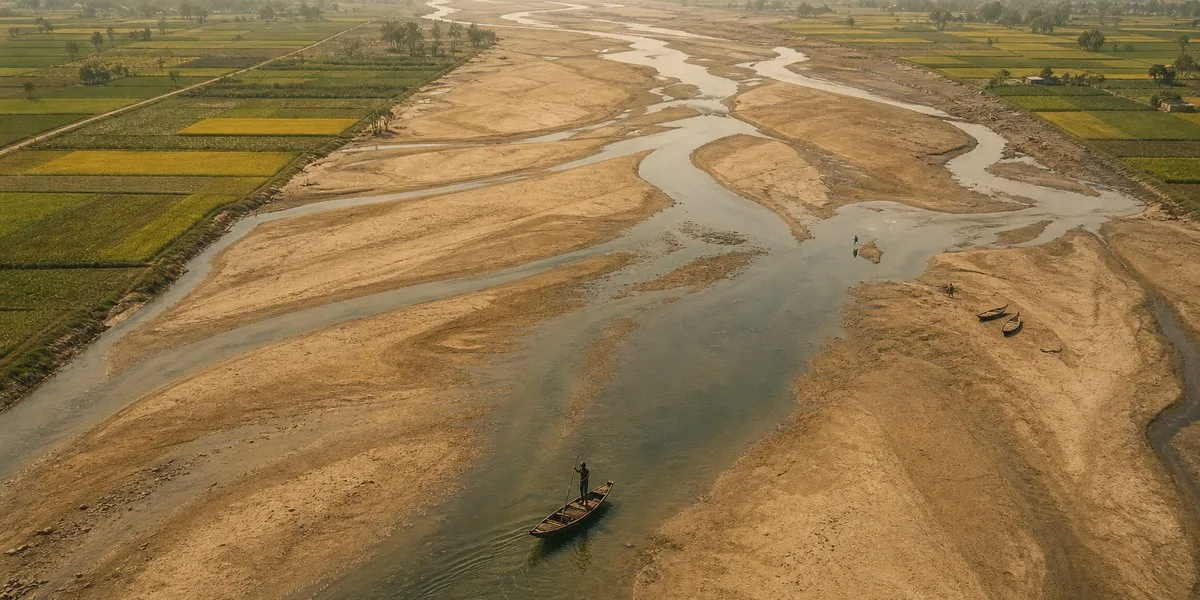
In the arid Barind region, the consequences are already severe. Local residents report that for nearly three months every year, the Padma—the name for the Ganges in Bangladesh—flows at a trickle. This reduction has devastated the agricultural sector, causing widespread damage to rice and wheat crops, while simultaneously shrinking fish populations.
Environmental activists, including representatives from the group Riverine People, have warned that the absence of a robust, long-term agreement could lead to ecological collapse. They point to the historical drying of the Gorai River as a cautionary tale; reduced freshwater flow to the Gorai has threatened the delicate ecosystem of the Sundarbans mangrove forests, a UNESCO World Heritage site.
Future Projections
To mitigate these risks, the state has begun investing in large-scale infrastructure, including a $2.8 billion dam project on the Padma, which aims to improve water management and generate 113 megawatts of hydroelectric power. However, internal projects cannot fully replace the need for an equitable cross-border treaty.
As December approaches, the diplomatic spotlight remains fixed on whether New Delhi and Dhaka can find a path forward to ensure the sustainable management of their shared water resources, safeguarding both the environment and the economic stability of the Ganges delta region.
Disclaimer: This content is auto-generated for informational purposes only.
Source: Read Original News