







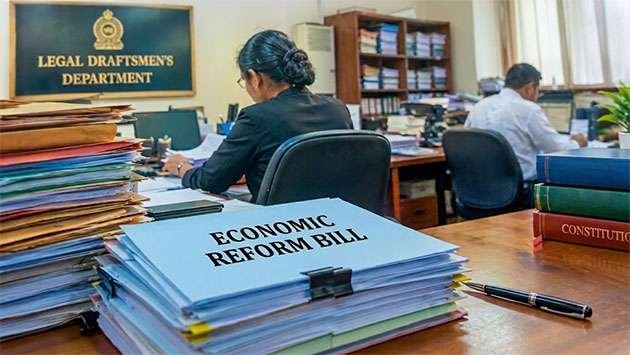
A critical logjam in the government’s legislative agenda has emerged as essential economic reform bills remain indefinitely stalled at the Legal Draftsmen’s Department. Sources close to the administration have confirmed that a chronic shortage of specialized legal drafters is preventing the finalization of policies vital to the nation’s economic recovery and fiscal restructuring.
The Legal Draftsmen’s Department, the primary body responsible for translating government policy into formal legislation, is reportedly operating with a skeleton crew. This understaffing has created a massive backlog, with several high-priority reform bills—some of which are linked to international commitments and debt sustainability programs—languishing in a state of limbo.
“The department is currently overwhelmed,” a government official speaking on condition of anonymity stated. “While the Cabinet may approve a policy framework in principle, the actual process of drafting the legal language is an intricate, time-consuming task. Without adequate personnel, even the most urgent economic reforms are hitting a procedural wall.”
The delays are sending tremors of concern through business and investor circles. Economic analysts warn that the sluggish pace of legislative approval could hamper the country’s ability to meet critical benchmarks required by international financial institutions. “These reforms are not merely administrative procedures; they are the bedrock of investor confidence and economic stability,” noted senior economist Dr. Ananda Perera. “When the legislative pipeline is clogged, the signal sent to the international community is that of stagnation, which we simply cannot afford in our current financial climate.”
Industry leaders have also expressed frustration, noting that private sector growth is being stifled by outdated regulations that were slated for repeal or amendment months ago. The stalled bills cover a broad spectrum, ranging from tax administration improvements to trade facilitation measures, all intended to stimulate domestic growth and improve the ease of doing business.
Attempts to address the crisis through temporary recruitment have reportedly failed to bridge the gap. The specialized nature of legislative drafting requires experts with both extensive legal knowledge and an understanding of policy implementation, making it difficult to fill positions quickly.
The Ministry of Justice is reportedly under pressure to expedite the recruitment process and explore structural changes to the department to handle the increased workload. However, observers remain skeptical, noting that even if recruitment efforts were to begin immediately, the training and transition period for new staff would mean the bottleneck could persist for months.
As the backlog continues to grow, the government faces a precarious situation: either find an immediate solution to bolster the department’s capacity or watch as its marquee economic reform agenda continues to erode. For now, the bills remain in the hands of a department that has become an inadvertent, yet powerful, gatekeeper of the nation’s economic future.
Disclaimer: This content is auto-generated for informational purposes only.
Source: Read Original News