





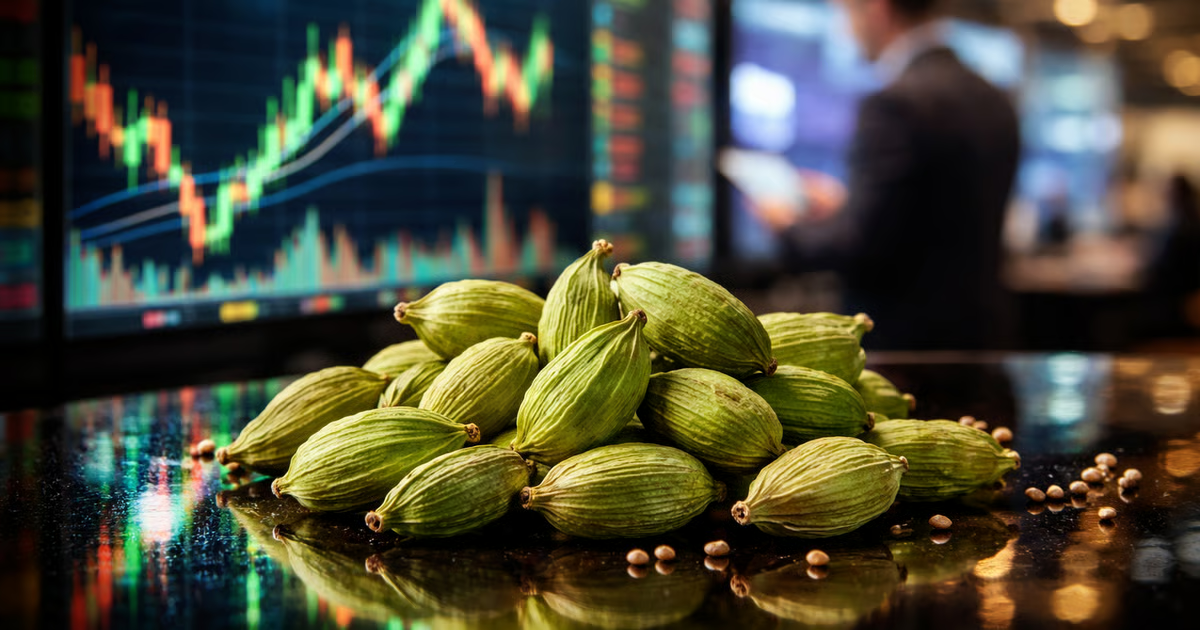
Small Cardamom Prices Surge as Tight Supply and Weather Risks Shake Market
The Indian small cardamom market is currently gripped by a pronounced bullish trend, driven by a confluence of supply-side constraints and robust seasonal demand. With domestic production failing to meet expectations and carryover stocks from the previous season hitting historical lows, the spice is witnessing a significant rally that experts suggest may extend well into early 2027.
A Substantial Shift in Price Fundamentals
The upward trajectory of cardamom prices is not merely a seasonal fluctuation but a reflection of a tightened fundamental landscape. Compared to the previous year, when average-quality cardamom traded between US$21.68 and US$22.21 per kg, prices have surged to a range of US$30.67–31.73 per kg.
Current FOB (Free on Board) offers from New Delhi underscore this price firmness. Conventional whole green cardamom (7.5 mm) is now pegged at EUR 27.60 per kg, while medium-sized grains (7–7.2 mm) are attracting quotes around EUR 25.75 per kg. Organic varieties and processed powders are following the same upward path, as processors struggle to source raw materials at affordable replacement costs.
Supply Bottlenecks and Seasonal Consumption
The primary catalyst for this rally is the lack of availability at major auction centers. Production numbers for the current Indian crop have been revised downward, and the scarcity of “old-crop” inventory has left traders with little buffer.
Simultaneously, the market is entering a peak consumption cycle. As India prepares for the winter months and a high-volume wedding season—where cardamom is a staple in festive sweets, confectionery, and traditional beverages—domestic demand is exerting immense pressure on available supplies. Exporters are also actively securing shipments, fearing that waiting for a price correction could lead to physical shortfalls.
Global Uncertainty: The Guatemala Factor
Compounding the supply issue is the situation in Guatemala, the world’s other major exporter of small cardamom. Initial estimates suggest a potential output decline from a previous range of 20,000–24,000 tonnes down to roughly 19,000–20,000 tonnes. This uncertainty among global origins has discouraged importers from delaying their procurement, effectively keeping a floor under prices even as they reach multi-year highs.
Weather Risks to the Second Picking
Market participants are currently focused on the crucial second picking season, which takes place throughout November and December. Agriculture experts have warned that any incidence of adverse or erratic weather during this window could severely damage crop yields and compromise quality.
Given the already precarious supply-demand balance, any further shortfall in the second harvest is expected to trigger another sharp escalation in prices. While the Guatemalan harvest is currently underway, the anticipated lower volumes mean the global market cannot rely on foreign supply to bridge the shortfall in India.
Outlook for Early 2027
As the industry looks toward the first quarter of 2027, the market sentiment remains firmly bullish. Traders anticipate that if the current supply constraints persist, prices could see an additional increase of US$4.23–5.29 per kg post-January.
For importers and industrial users, the advice is to move away from a “wait-and-see” approach. With the market showing little sign of a significant correction, procurement teams are encouraged to layer in coverage for the coming months rather than risking deeper shortages. While price-sensitive buyers may look toward partial substitution strategies, the combination of tight stocks and climate vulnerability suggests that elevated pricing will likely remain the industry norm for the foreseeable future.
Disclaimer: This content is auto-generated for informational purposes only.
Source: Read Original News