








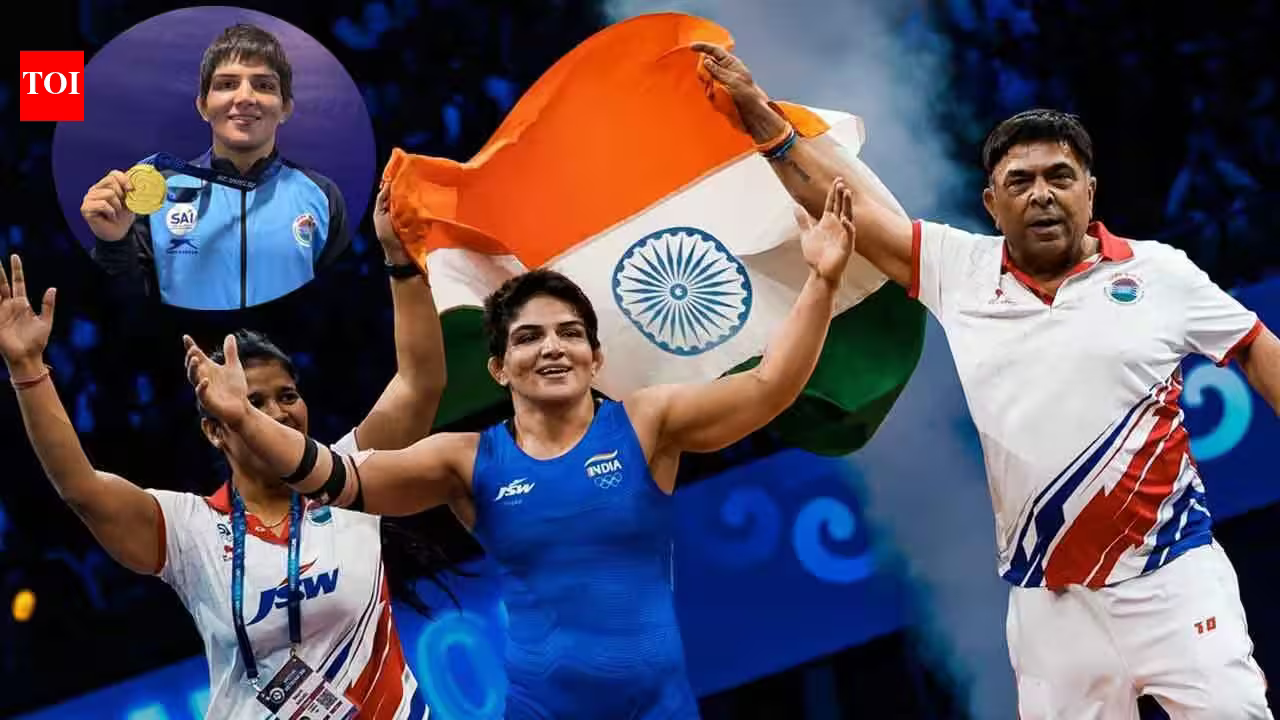
ASTANA – History was rewritten on the wrestling mats of Kazakhstan this week, as Manisha Bhanwala etched her name into the annals of Indian sports by becoming the first Indian woman to secure a gold medal at the World Wrestling Championships. In a stunning display of grit and tactical brilliance, the 59kg wrestler from Jind, Haryana, mounted a spectacular comeback to claim victory, turning a six-point deficit into an 8-6 win against American challenger Abigail Nette.
While the magnitude of her achievement marks a watershed moment for Indian wrestling—placing her alongside the legendary Sushil Kumar as the only other Indian to capture a world title—for Bhanwala, the gold medal represents something far more profound. It is the culmination of a promise made to her late father, a man who traded his life as a farmer to ensure his daughter could chase a dream beyond the boundaries of their small village.
A Triumph Forged in Resilience
The final in Astana was a masterclass in mental fortitude. Trailing early and facing a rejected challenge that could have broken a lesser athlete, Bhanwala chose to lean on the philosophy that has defined her life: the teachings of the Bhagavad Gita imparted to her by her father.
“Doubts were coming into my mind. Was my practice wrong? But I believed that I could do it,” Bhanwala told TimesofIndia.com shortly after her victory. “I felt it from within that I could turn things around.”
Her success, she explains, is rooted in a rigorous, unconventional training style. Adopting techniques often seen in Iranian wrestling—a discipline requiring immense physical force and endurance—Bhanwala has spent the last five years honing a style that prioritizes explosive starts in the first three minutes, followed by a tactical war of patience and analysis. “If you dominate the first two to three minutes, the bout is yours,” she noted.
The Spirit of Jind
Bhanwala’s victory comes just a month after fellow Jind native Neeru Dhanda claimed gold in trap shooting at the Asian Games. There is a palpable sense of pride in the region, with locals often citing the town’s legendary association with the Pandavas of the Mahabharata.
“Jind is the land of the Pandavas. There must be something special about it,” Bhanwala remarked with a smile, echoing the local sentiment that the town’s soil breeds a unique brand of warrior spirit.
For Bhanwala, however, that spirit is inextricably linked to her father. A man of humble means and little formal education, he served as her primary motivator. When she required professional-grade wrestling shoes as a teenager, he did not hesitate, providing the expensive equipment without ever letting his daughter feel the burden of their financial struggles.
A Promise to Keep
The most poignant moment of the championships occurred behind closed doors. After securing her title, Bhanwala did not head to a party or a victory parade. Instead, she retreated to her room, placing the gold medal and a photograph of her father beside her pillow.
Her father passed away suddenly in 2022, on the very night she was selected for the Asian Championships. Heartbroken and in shock, she was urged by her mother to continue toward the mat. She would go on to win a bronze in Mongolia that year, a performance fueled by grief and a desperate need to honor her father’s legacy.
“I don’t know how to explain that night,” she said. “I lost the person whom I loved more than anything. But my mother said, ‘If you don’t fulfill his dream, who will?'”
The Road to Los Angeles
With the World Championships and Asian Championships now firmly on her resume, Bhanwala has her eyes set on the ultimate summit: an Olympic gold medal.
Her childhood ambition, expressed to her father years ago, was never to settle for a podium finish. When her father would tell her they would win an Olympic medal one day, she famously corrected him: “Pitaji, Olympics medal nahi, Olympics gold.”
As she continues her journey, supported by her family and hardened by years of training against elite male sparring partners to sharpen her strength, Bhanwala remains grounded in the principle of karma—focusing solely on the labor and leaving the results to the divine.
“My entire life is dedicated to my father sahab,” she says with conviction. “I will win Olympic gold for him. That is what remains.”
For the girl from Jind who fought her way out of poverty to the top of the world, the gold in Astana is not the end of the story—it is merely the prologue to her greatest promise yet.
Disclaimer: This content is auto-generated for informational purposes only.
Source: Read Original News