








The Discovery of Valve’s Lost Prototype
For over fifteen years, the gaming community has whispered about a mythical project known as F-Stop. It was the internal codename for a canceled 2007 prequel to the seminal puzzle game Portal. While fragments of its existence appeared in subsequent titles, the project itself remained confined to the internal archives of Valve Corporation. This silence has finally been broken. Through a combination of massive data leaks and the diligent efforts of digital archivists, F-Stop has surfaced online in a fully playable state.
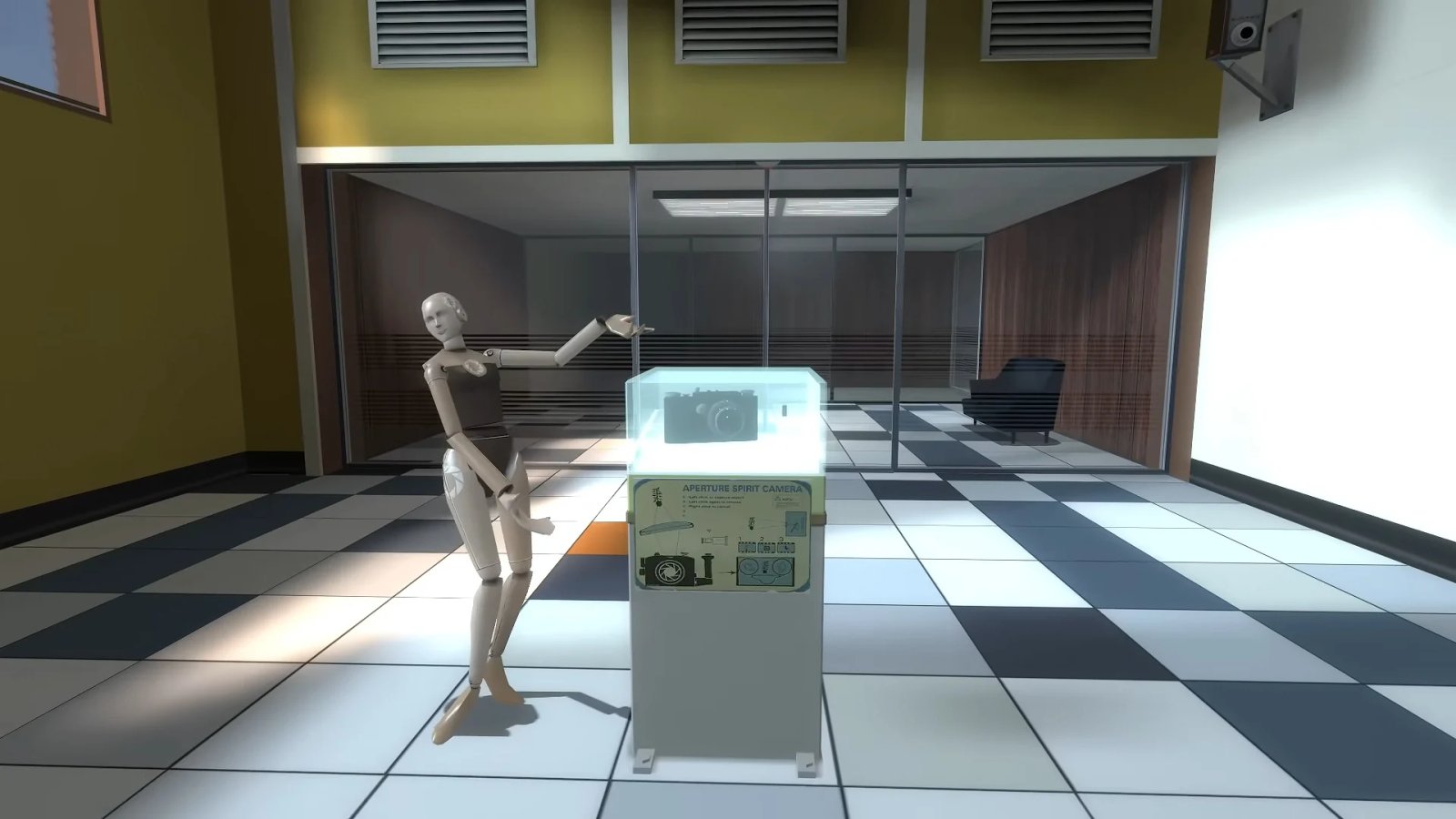
This project originated during an internal period of creative exploration known as the Directed Design Experiments. During this three-month phase in 2007, Valve partitioned its staff into five teams to foster innovation and explore mechanics that deviated from their established franchises. F-Stop was the fifth experiment, designed as a narrative and mechanical precursor to the Portal universe. Unlike the portal-gun-centric gameplay that defined the franchise, F-Stop utilized a unique perspective-based mechanic centered on an experimental Aperture Science camera.
The Mechanics of Perspective Manipulation
The core technical appeal of F-Stop lies in its primary interaction mechanic: the camera. In modern game design, perspective-based puzzles are often associated with games like Superliminal or Viewfinder. F-Stop pioneered this concept within the Aperture Science setting long before those mechanics became industry standards. Players would use the in-game camera to photograph objects in the environment. Once captured, these objects could be manipulated, resized, or moved, effectively altering the player’s spatial reality.
This forced-perspective system allowed for complex problem-solving that required players to think about geometry differently than in standard first-person titles. For example, a small prop could be photographed and then placed back into the world as a massive version of itself, allowing the player to climb it or use it as a bridge. This interaction model was the technical backbone of the project, serving as the differentiator that would have distinguished it from the gravity-defying platforming of Portal. However, during development, playtesters struggled with the transition from the fluid, physics-driven movement of the Source engine to these more cerebral, static puzzle-solving requirements.
The Anatomy of a Massive Data Leak
The emergence of F-Stop is not the result of a single discovery but rather a convergence of three distinct information leaks. The most significant of these occurred in late August, when a staggering 13 terabytes of internal Steam depot data were exposed online. This leak, widely referred to as Steam2, provided the historical context for a decade of development at Valve, covering the years 2003 to 2013. Within this vast cache of assets were the model files, textures, and foundational data for the F-Stop experiment.
While the Steam2 leak provided the graphical and audio components, it lacked the logical architecture necessary to execute the game. The crucial missing elements were the source code and the map source files, known as mapsrc, which dictate how the levels function and interact with the game engine. These components emerged unexpectedly on a community-run server dedicated to restoring cut Valve content. Reports indicate that an individual holding these files initially sought monetary compensation before eventually releasing them to the public. The Valve Cut Content team subsequently verified the files, allowing developers and enthusiasts to stitch the project back together into a functional build.
Impact on Game Preservation and Development
The restoration of F-Stop represents a milestone for game preservation. Historically, canceled projects from major studios often remain inaccessible, leading to a permanent loss of institutional knowledge and developmental history. By making this build playable, the community has provided an unprecedented look at how a highly influential studio experiments with new technologies. It serves as a study in “fail-fast” development methodologies; while the game was ultimately scrapped, the lessons learned regarding perspective and spatial awareness were clearly integrated into the design language of later titles, most notably the narrative flow and environmental design of Portal 2.
From a technical perspective, the availability of these files provides a masterclass in the capabilities and limitations of the Source engine during the mid-2000s. Developers and hobbyists now have the ability to inspect the underlying logic and scripting that Valve utilized to manipulate object scales and perspectives. This serves as a valuable resource for those studying how specific, custom-coded tools were implemented to overcome engine limitations during that era of development.
Refining the Unfinished Build
Current assessments from those who have accessed the build suggest that it is roughly 99 percent complete. While some minor assets are missing and certain dialogue sequences remain unpolished or absent, the game is entirely traversable from start to finish. It is not an unoptimized prototype or a collection of broken rooms; it is a coherent experience that reflects the high standards Valve holds for its internal projects, even those meant for the cutting room floor.
For the average user, the release of F-Stop is a rare opportunity to play a “lost” chapter of gaming history. For the development community, it is a treasure trove of design documentation and engine implementation techniques. As the files circulate and the community begins to document the inner workings of the game, F-Stop will likely move from being a mysterious legend of the Source engine era to a standard point of reference in discussions regarding experimental mechanics, puzzle design, and the complex process of turning innovative concepts into final, polished products.
Disclaimer: This content is auto-generated for informational purposes only.
Source: Read Original News