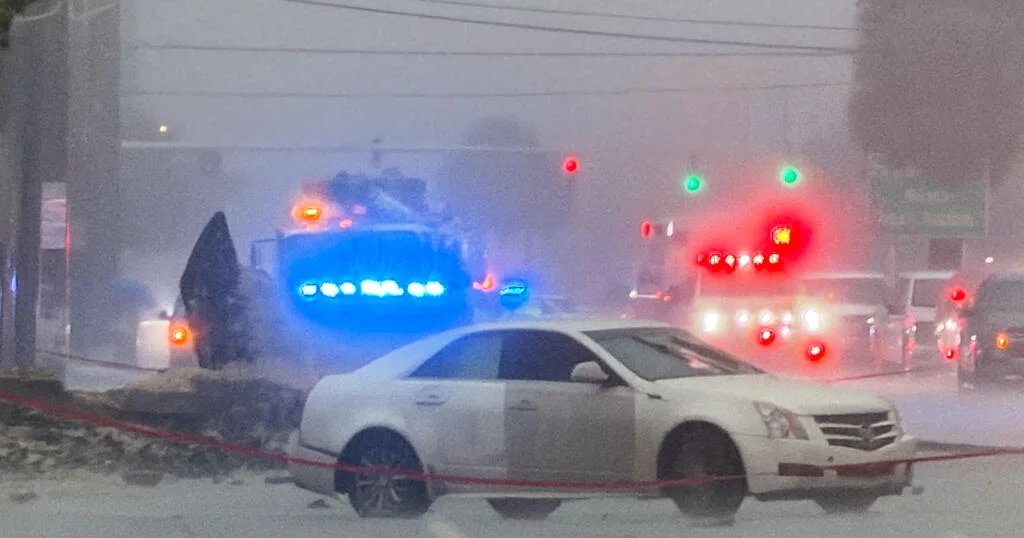









WEST PALM BEACH, Fla. — A catastrophic aviation disaster unfolded in a residential area of Palm Beach County on Sunday, leaving nine people dead after a private business jet plummeted from the sky and detonated in a massive fireball. The Learjet 60, which had departed from Austin-Bergstrom International Airport in Texas, was en route to the Bahamas when it entered a violent, rapid descent, narrowly avoiding nearby homes and a busy roadway before impact.
U.S. Transportation Secretary Sean Duffy confirmed the fatalities in a post on X, describing the incident as a “horrific tragedy.” Florida Governor Ron DeSantis, who arrived at the scene, noted that the impact was so severe it left a massive crater near the road. Remarkably, officials reported no injuries or casualties among those on the ground, though authorities have initiated the evacuation of approximately 600 residents from a neighboring mobile home community as a precaution.
A Final Descent Captured in Data and Audio
Air traffic control recordings and flight tracking data have provided a harrowing timeline of the final minutes of the flight. Cruising at an altitude of 35,000 feet, the pilots initially reported manageable icing and moderate turbulence. However, conditions escalated rapidly. Records indicate the crew requested a climb to 37,000 feet to escape the weather, but moments later, the situation turned critical.
The jet began a terrifying, unchecked descent. Audio captured from LiveATC.net reveals the pilot’s desperate struggle, reporting sink rates that escalated from 10,000 feet per minute to a catastrophic 30,000 feet per minute. The final transmission from the cockpit was a chilling acknowledgment of the inevitable: “We’re going to crash into the ground.”
Investigating the Role of Weather and Aviation Tech
As the National Transportation Safety Board (NTSB) and the Federal Aviation Administration (FAA) begin their formal investigation, aviation safety experts are pointing to the combination of icing and extreme turbulence as a potential catalyst for the stall. While the specific mechanical cause remains under review, experts noted that the aircraft appears to have exceeded its design structural limits during the uncontrolled dive.
The investigation will likely lean heavily on advanced diagnostic tools. Modern business jets are equipped with flight data recorders—often referred to as “black boxes”—that utilize sophisticated sensors to log thousands of parameters, from engine performance to control surface positioning. These datasets, often processed through AI-driven analytical platforms, help investigators reconstruct the final seconds of a flight with pinpoint accuracy. In the coming days, NTSB investigators will leverage digital simulation software to model the flight path, comparing the telemetry against historical data of similar incidents to determine if a combination of icing-induced performance loss and pilot reaction times contributed to the tragedy.
Tech Integration in NTSB Recovery Efforts
The recovery phase of this investigation highlights the evolving intersection of emergency management and technology. Beyond the physical investigation of the wreckage, the NTSB will utilize drone technology to map the debris field in high-resolution 3D, allowing them to visualize the impact pattern without disrupting the site.
Furthermore, cloud-based coordination platforms have become standard for inter-agency communication between the FAA, local law enforcement, and federal investigators. As digital evidence becomes central to aviation safety, these tools allow for the rapid collation of radar imagery, satellite weather data, and real-time flight tracking feeds.
For the residents of Greenacres, the community remains cordoned off as investigators work through the night to secure evidence. While the cause of this disaster remains the subject of intense scrutiny, the data retrieved from the jet’s flight management system will be instrumental in ensuring such a rapid, catastrophic failure is better understood and, ideally, prevented in the future.
Disclaimer: This content is auto-generated for informational purposes only.
Source: Read Original News