









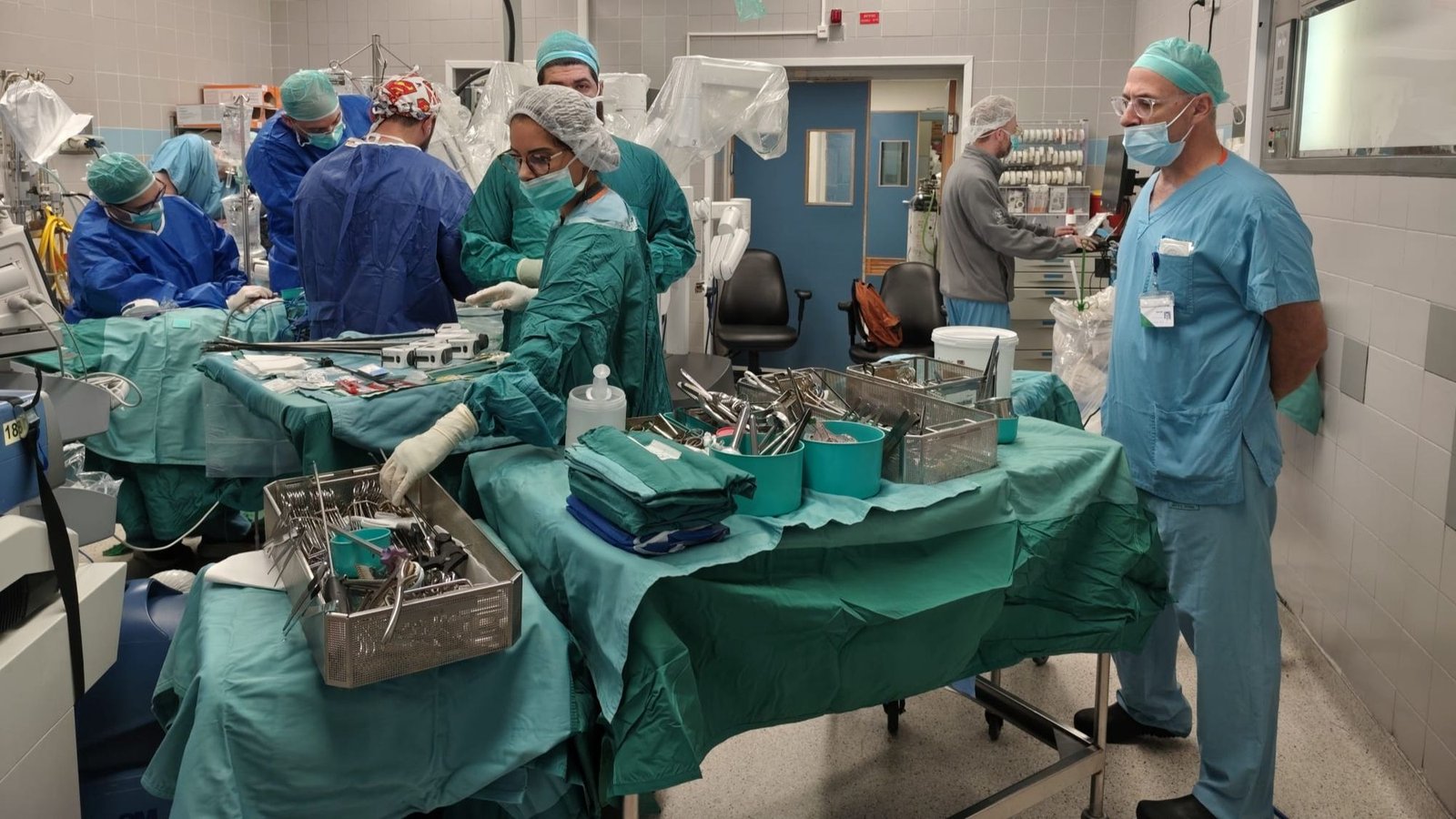
PETAH TIKVA — Beilinson Hospital has officially joined an elite circle of global medical centers after successfully performing a robotic-assisted lung transplant. The procedure, conducted last month, represents a major technological leap for Israeli medicine and sets a new benchmark for how organ transplantation may be performed in the coming decade.
Utilizing the advanced da Vinci surgical system, surgeons were able to connect a donor lung to a patient’s airway and blood vessels through small, precise incisions. This minimally invasive technique stands in stark contrast to traditional lung transplantation, which typically requires a large chest opening and the spreading of ribs—a process known to be physically traumatic and painful for patients.
Dr. Yuri Peisakhovich, the hospital’s director of thoracic surgery, led the operation and hailed it as a turning point for the field. “Our goal is to make robotic transplantation without a large chest opening standard practice within five years,” he stated. While the procedure is still rare, with only approximately 20 such robotic transplants documented worldwide since the first was performed in Spain three years ago, Beilinson’s success signals a growing international shift toward this approach.
The complexity of the surgery required months of extensive preparation. A multidisciplinary team—comprising surgeons, anesthesiologists, pulmonologists, and intensive care specialists—spent time rehearsing in dedicated simulations. Dr. Shai Fine, director of anesthesiology and operating rooms, noted that the robotic arms created unique challenges regarding immediate access to the patient. To mitigate risk, the team planned intensive circulation monitoring and kept the patient connected to a heart-lung machine as a safeguard.
The hospital’s path to this breakthrough was paved by a recent history of surgical innovation; a month prior, the team performed a minimally invasive transplant using two small incisions, providing the essential experience needed to transition to the robotic system.
The clinical results from the recent surgery have been highly encouraging. Dr. Dan Gurfiel, director of the cardiac and thoracic surgery intensive care unit, reported that the patient’s recovery was faster than anticipated. By avoiding the trauma of traditional chest-opening surgery, the patient required almost no pain medication beyond paracetamol and experienced a shortened stay in the intensive care unit. While the hospital noted that this initial success is based on a single patient’s experience, the potential for reduced postoperative pain and improved lung function—such as the ability to cough and clear secretions more effectively—is significant.
Dr. Osnat Livne-Straichman, director of the Institute of Pulmonary Diseases and Allergy, attributed the success to the hospital’s deep institutional expertise, noting that Beilinson has performed more than 1,000 lung transplants. This extensive background provided the foundation for the team to push the boundaries of modern surgery, offering a more comfortable and efficient recovery path for eligible patients in Israel.
Disclaimer: This content is auto-generated for informational purposes only.
Source: Read Original News