





Redefining the Automotive Interface with Holographic Projection
The automotive industry has long sought to bridge the gap between human perception and vehicle data, typically relying on dashboard clusters and traditional head-up displays (HUDs). Mercedes-Benz is now pushing the boundaries of this interaction with a new holographic projection technology that promises to transform the windshield from a simple safety barrier into a high-definition information and entertainment hub. Unlike traditional glass-based screens that occupy physical space, this solution utilizes light-field technology to project imagery directly into the line of sight without the need for bulky equipment.
Recent developments in the research labs at Mercedes-Benz reveal a prototype that effectively shrinks the hardware footprint required for high-resolution projection. Manual Holstein, a lead manager in the company’s display research division, confirmed that the production trajectory for this technology focuses on miniaturization. By reducing the projector opening to a fraction of its current prototype size, the system could eventually be concealed entirely behind interior surfaces such as wood, leather, or metallic trim. This integration addresses a common aesthetic criticism of current HUD systems, which often require large, intrusive housing units atop the dashboard. Furthermore, the shift toward silent, fan-less cooling systems ensures that the hardware remains unobtrusive in both sight and sound.
Advanced Optical Performance and Resolution
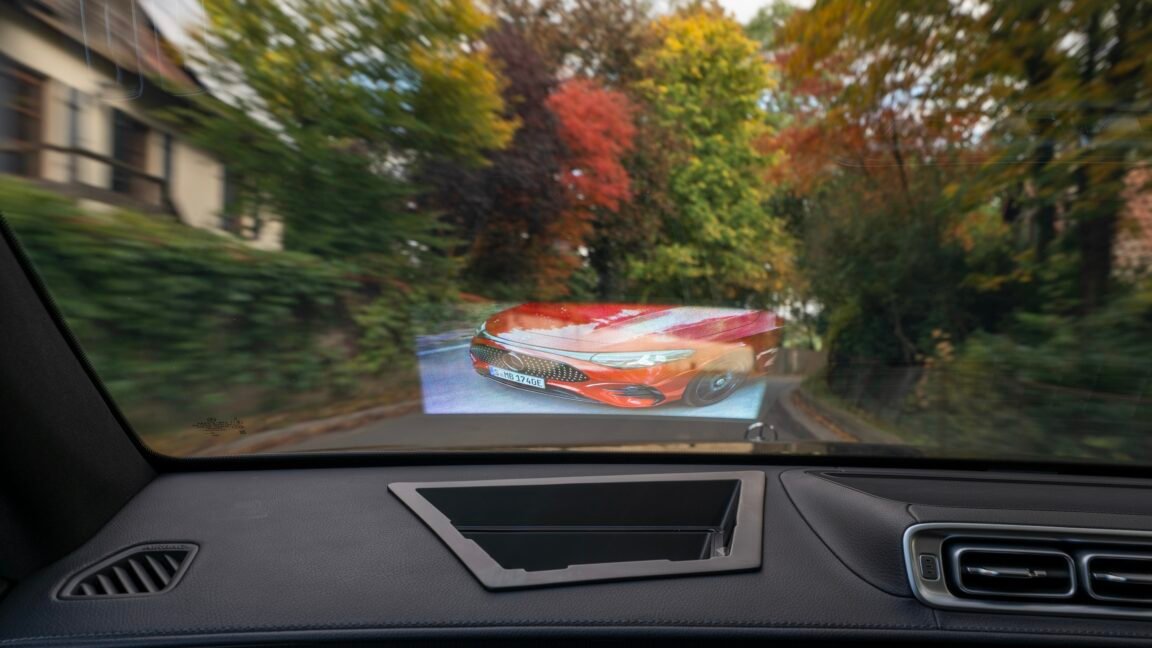
The optical performance of this holographic system represents a significant leap forward compared to existing augmented reality HUDs. While current market leaders provide basic navigation overlays—such as directional arrows and speed readouts—the new Mercedes system offers a fidelity that approaches commercial display standards. During controlled demonstrations, the prototype projected full-color, high-motion video content of the C-Class Electric onto the windshield.
Perhaps most impressive is the brightness capability of the unit. During testing, the display operated at a mere 20 percent of its total potential brightness, yet remained clearly visible and sharp. This overhead in luminance is critical for automotive environments, where the intense glare of direct sunlight or high-contrast shadows can easily wash out standard screens. By utilizing sophisticated light-field algorithms, the system creates a crisp image that holds its own against the brightness of the external environment, setting a foundation for a display that remains legible under diverse lighting conditions.
Addressing Prototypes and Technical Obstacles
Despite the impressive initial performance, the technology remains in a state of refinement. Current resolution levels, while superior to traditional HUD graphics, do not yet rival the density of high-end passenger touchscreens found in modern cabins. Observers have noted that the contrast levels currently produce a high-intensity output that can feel overly harsh, and the physical shape of the windshield creates geometric distortions that the software must actively compensate for.
However, these technical hurdles are common within the prototype phase of optical engineering. Holstein noted that the “eyebox”—the specific spatial window where the viewer sees the holographic image—is currently limited but can be expanded significantly through advancements in the proprietary holographic film integrated into the glass. The spatial distortion seen in early models is categorized by the development team as a calibration issue rather than a structural limitation of the light-field projection method. As the development cycle continues, the focus remains on perfecting the alignment between the projector and the specific curvature of the vehicle’s glass, ensuring that the image appears uniform regardless of the viewer’s perspective.
Expanding the Horizon for Passengers and Drivers
The implementation of this technology is not restricted to the driver’s side. Mercedes-Benz envisions a future where nearly half of the windshield serves as a private, high-definition screen for the front-seat passenger. This provides a unique form of entertainment that does not require the installation of a permanent, fragile glass screen that could interfere with crash safety requirements. Because holographic projection is inherently directional, these displays can be tuned to be visible only to the individual sitting in the passenger seat, preventing driver distraction while allowing for a tailored infotainment experience.
For the driver, the potential shifts from entertainment to safety-centric situational awareness. By highlighting points of interest—such as businesses, architectural landmarks, or hidden hazards—directly onto the real-world environment, the display serves as an intelligent guide. Furthermore, as the industry moves toward Level 3 autonomous driving, the purpose of the cockpit will inevitably shift. When the vehicle’s automated systems are engaged, the driver will be free to consume media, participate in video conferences, or monitor deep-level telemetry. In this scenario, a wide-format holographic display provides a more natural viewing experience than looking down at a center console, keeping the driver’s head in an upright, attentive posture.
The Future of Integrated Cabin Architecture
Looking ahead, this holographic approach acts as a catalyst for a broader design evolution in vehicle interiors. By eliminating the necessity for a dedicated high-resolution screen in the center stack, designers are granted newfound freedom to create cleaner, more minimalist cabin environments. If the display hardware can be hidden behind traditional materials, the vehicle interior can maintain a classic luxury appearance until the exact moment a digital interface is required.
The transition from current HUDs to this holographic standard represents a move toward a more integrated, digital-first cabin architecture. While the technology requires further refinement in resolution and image geometry, the foundation is established. The capability to transform any portion of the windshield into an interactive interface bridges the gap between digital utility and physical presence. As Mercedes-Benz continues to refine the hardware, the windshield will likely evolve from a passive piece of safety glass into the primary interface through which occupants experience their journey, fundamentally altering the relationship between the vehicle and the user.
Disclaimer: This content is auto-generated for informational purposes only.
Source: Read Original News