






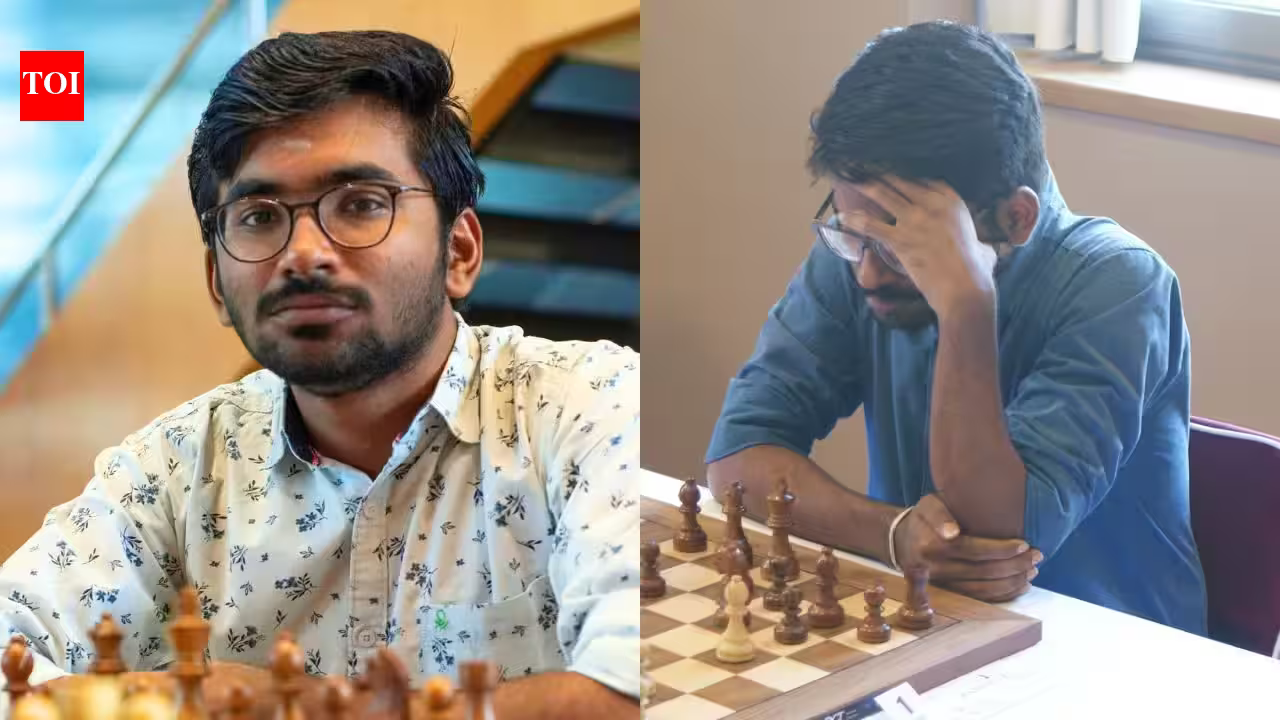
CONGRATULATIONS arrived in a tidal wave last July for VS Rathanvel, the 25-year-old chess prodigy from Coimbatore. Headlines across the Indian media landscape declared that the long wait was finally over: Rathanvel had breached the 2500-rating threshold at the Guwahati Smart City International Open and officially become India’s 99th Grandmaster. It was the culmination of a grueling four-year pursuit, a period defined by agonizingly close calls and the perpetual frustration of hovering in the high 2490s.
“You know that feel where you know you’re worthy of it, but somehow you’re not still getting there,” Rathanvel had remarked following that tournament. But the celebration was premature. When the August FIDE rating list was published, the expected ascent never materialized. Rathanvel remained stranded just beneath the 2500 mark, and the title he thought he had secured suddenly evaporated into a bureaucratic void.
What went wrong?
The mystery surrounding Rathanvel’s “missing” Grandmaster status stems from his strategic, albeit ultimately flawed, approach during two tournaments in Assam last summer. Rated 2492 at the time, Rathanvel required eight rating points to hit the magical 2500. He participated in the Ayodhana International and the Guwahati Smart City Open, but he did so with a peculiar tactical choice: he took zero-point byes in multiple rounds.
By opting out of several games, Rathanvel avoided tougher competition, ensuring that the Swiss-system pairings matched him against lower-rated opponents. He won all 11 of the games he actually played against these lower-ranked players, gaining the necessary eight points to reach 2500. His tournament finishes—77th and 246th respectively—were irrelevant to him; his singular focus was the arithmetic required for the title.
However, the statistical reality did not translate to official recognition. When the FIDE rating lists updated for the rest of the field, Rathanvel’s rating remained frozen. It became clear that while his opponents’ records were updated, the games involving Rathanvel had been completely excluded from the calculations.
“I have no idea why it happened,” Rathanvel admitted in an exclusive interview. “FIDE and the Indian Chess Federation may have had some discussion. I am not sure what happened. I was not able to get satisfactory responses.”
The Strange World of FIDE Regulations
The absence of a clear explanation lies in the complex, often opaque, nature of FIDE’s Title Regulations. Under Clause 1.4.2 of the International Title Regulations, FIDE reserves the right to exclude games or even disqualify an entire tournament if it determines that structural irregularities—such as providing specific opponents or altering tournament conditions—benefit a particular player.
While Rathanvel followed the letter of the rules regarding eligibility, the “final judging unit”—the Qualification Commission—has the authority to act as the ultimate arbiter. For a player who had already been publicly crowned, the realization that his performance had been effectively wiped from the record was devastating. The social pressure of being the “99th GM” only for that title to be stripped away created a mental burden that made his subsequent professional life on the board incredibly difficult.
“If people say that you achieved something, and suddenly they also say that it’s not yours,” Rathanvel recalled, “the pressure was obviously there, probably even much more considering the circumstances.”
Doing It Again: The Road to Redemption
Staring down the barrel of a public perception crisis, Rathanvel faced a binary choice: wither under the scrutiny or prove his caliber on the board beyond any shadow of a doubt. He chose the latter. He sought counsel from a mentor—a figure he keeps anonymous to this day—who helped him recalibrate his mindset and steer his focus back toward competitive mastery rather than just rating mathematics.
In October, Rathanvel traveled to the 22nd Chefchaouen International Open in Morocco. This time, he didn’t leave it to the margins. He secured the title by finishing undefeated with 7/9, delivering crushing victories over established Grandmasters like Deep Sengupta and David Larino Nieto.
Even then, the journey wasn’t finished. After a win against Larino Nieto, his live rating reached 2499.7—a point of contention regarding whether such a figure qualifies as 2500. Determined to leave no room for debate, Rathanvel pushed forward. Last week, at the Dr. Kantor Sandor Memorial in Debrecen, Hungary, he dispatched two more formidable opponents in the opening rounds. These wins pushed his live rating to a definitive 2501.1, a number that finally silenced the calculators and the critics.
With his norms long secured and his rating now firmly above the threshold, Rathanvel has at last earned his place as India’s 99th Grandmaster. But when asked about the feeling of finally crossing the line for the second time, he didn’t erupt with unbridled joy. Instead, he expressed a profound sense of relief.
“Eventually things went well, and I’m kind of relieved more than a celebration, I would say,” he shared. After four years of near-misses, a phantom celebration, and an administrative exile, Rathanvel’s victory is not just in the rating points—it is in the quiet satisfaction of knowing that the title is finally, indisputably, his.
Disclaimer: This content is auto-generated for informational purposes only.
Source: Read Original News