







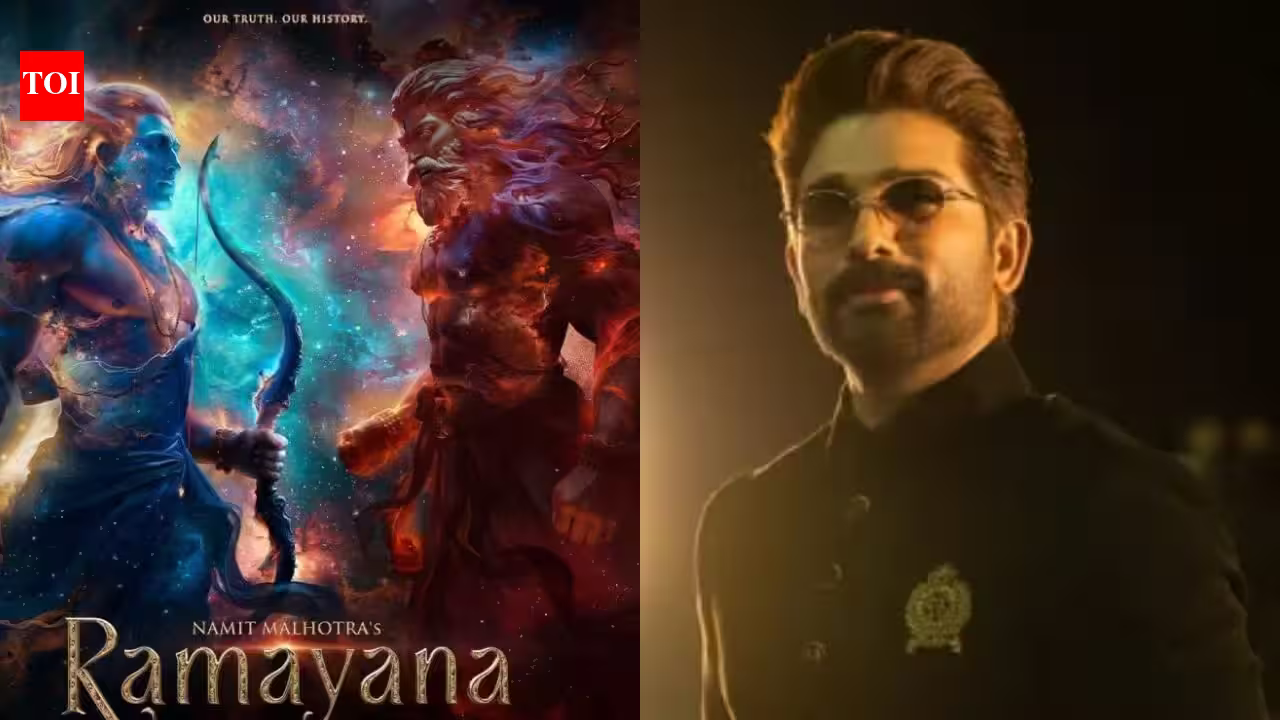
In an industry often defined by intense box-office rivalries and regional silos, it is rare to see the biggest titans of Indian cinema pause to champion a project outside their own immediate sphere. Yet, as the clock ticks down toward the much-anticipated release of Nitesh Tiwari’s Ramayana, the Tollywood superstar Allu Arjun has stepped into the spotlight—not to promote his own work, but to extend a bridge of support to the team behind what is arguably the most ambitious mythological adaptation in modern Indian history.
With a massive digital footprint and a dedicated global fanbase, Allu Arjun’s recent endorsement has sent ripples through the entertainment circuit. As Ranbir Kapoor, Sai Pallavi, and Yash prepare for the monumental task of bringing an ancient epic to the big screen, the “Pushpa” star has made it clear that this isn’t just another high-budget blockbuster—it’s a cultural touchstone.
Allu Arjun’s Call for Solidarity
The Tollywood icon took to his official X (formerly Twitter) handle to share a poster of the film, accompanying it with a message that transcended the typical perfunctory well-wishes. Arjun’s statement was heavy with intent, framing Ramayana as a significant milestone for Indian storytelling on the global stage.
“My best wishes to the entire #Ramayana team. It’s not just a movie. It’s a representation of our culture and an attempt to raise the bar of Indian films,” Arjun wrote. He didn’t stop at professional praise; he framed the viewing experience as a collective national endeavor. By urging audiences to “unite and come forward to support a pure attempt,” he signaled that the film is being viewed by his peers as a benchmark project—a litmus test for how Indian mythology can be packaged for a modern, global audience without sacrificing its inherent soul. Ending his note with a rallying “Jai Sri Ram,” Arjun aligned himself with the film’s thematic core, effectively giving it a massive, cross-industry seal of approval.
A Cast That Breaks Boundaries
The sheer scale of the production is reflected in a cast list that reads like a who’s who of Indian cinema. Directed by the visionary Nitesh Tiwari, whose track record for handling emotional gravitas (notably in Dangal) is well-documented, the casting choices suggest a deliberate effort to balance pan-Indian appeal with acting pedigree.
Ranbir Kapoor steps into the shoes of Lord Rama, a role that demands a delicate balance of stoic divinity and human empathy—a challenge for even the most seasoned of performers. Opposite him, Sai Pallavi is set to portray Sita, bringing a raw, authentic vulnerability that has made her a powerhouse in South Indian cinema. Perhaps the most intriguing casting choice is Yash, the KGF sensation, who steps into the role of Ravana. Having built a career on anti-hero magnetism, seeing Yash explore the complex, antagonistic layers of the legendary King of Lanka is arguably the most talked-about aspect of the casting.
The film’s depth doesn’t end there. By including veterans like Arun Govil—who etched his name in history as the definitive Rama in the classic 80s television series—alongside modern stalwarts like Lara Dutta as Kaikeyi and Sunny Deol as Hanuman, the production is clearly attempting to bridge the gap between traditional storytelling and contemporary spectacle.
Global Ambitions and Technical Grandeur
Ramayana is not merely a drama; it is a technical feat. The production has spared no effort in assembling a dream team of international and local talent. With the music score being helmed by the legendary A.R. Rahman alongside Hans Zimmer, the expectations for the auditory experience have reached a fever pitch. This collaboration represents a marriage of Eastern soul and Western cinematic grandeur, aiming to elevate the narrative’s emotional beats to operatic levels.
Visual effects, a make-or-break element for any mythological epic, are being spearheaded by DNEG, a studio that has set the gold standard in Hollywood blockbusters. By tapping into this level of technical expertise, the producers are aiming to move past the aesthetic limitations that have historically plagued Indian mythological films. This is a project designed for premium-format screens, meant to be consumed in IMAX and large-format theaters where the scale of the CGI-rendered Ayodhya and the battlefield can truly shine.
The Strategy of the Two-Part Epic
The decision to split the narrative into a two-part saga—marketed internationally as Ramayana: Rise of a Legend—is a strategic masterstroke. It allows the filmmakers the breathing room to delve into the nuances of the epic without rushing the character arcs, a pitfall that has doomed shorter adaptations in the past.
The first installment is set to hit theaters on November 5, 2026. While the second chapter was initially slotted for Diwali 2027, recent industry whispers suggest a shift to 2028. While fans might be disappointed by a longer wait, the shift is likely a reflection of the producers’ commitment to quality, ensuring that the conclusion of the epic receives the same, if not more, attention to detail as the first half.
A Look at Allu Arjun’s Future
While Arjun is currently in the role of the supporter, his own pipeline remains one of the most exciting in the industry. As the dust settles on the Pushpa phenomenon, he is hard at work on Raaka, an ambitious sci-fi project under the direction of Atlee. Known for his explosive, high-octane hits like Jawan, Atlee’s collaboration with Arjun is expected to push the boundaries of the star’s typical genre repertoire. With Deepika Padukone attached as the female lead and Rashmika Mandanna playing a pivotal role, Raaka is already being positioned as another massive, potential pan-Indian event.
For now, however, the spotlight remains firmly on the Ramayana team. In an era where Indian cinema is finally stepping out from the shadows and demanding a seat at the global table, endorsements like those from Allu Arjun serve as a reminder that the industry is at its best when it moves as a unified front. If Ramayana succeeds in the way it promises to, it will likely be remembered not just as a blockbuster, but as the moment the scale of Indian storytelling changed forever.
Disclaimer: This content is auto-generated for informational purposes only.
Source: Read Original News