







The Competitive Race for Launcher Performance
The digital distribution landscape for PC gaming is undergoing a significant shift as industry leaders engage in a quiet but consequential arms race regarding software performance. For years, the user experience on major game launchers has been criticized for becoming increasingly bloated, with heavy reliance on web-based frameworks that often result in sluggish interface responses and extended startup times. This trend recently reached a breaking point when Epic Games announced a substantial overhaul to its launcher, leveraging new code architecture to achieve drastically reduced load times.
This move prompted an immediate reaction from Valve, which deployed a precision update to Steam to reclaim its position as a performance leader. Caught in the middle of this competition, Microsoft has now signaled that it is no longer willing to let its Xbox app for PC remain a point of friction for its subscribers. By promising a faster, more responsive environment, Microsoft is clearly attempting to align its desktop software with the high-performance expectations set by its competitors. This industry-wide push signifies a return to technical efficiency, prioritizing the speed at which a user can go from powering on their machine to actively playing a game.
Quantifying the Xbox App Improvements
Microsoft’s latest announcement regarding the Xbox app is grounded in ambitious, if precise, performance metrics. While the company has not provided a transparent dataset or benchmarking methodology to support its claims, the stated targets indicate a complete restructuring of how the application handles data requests. Specifically, the company claims that the core application will now launch up to 60% faster, a critical change for users who find frequent, slow startup processes to be a barrier to casual play.
Beyond the initial handshake between the operating system and the application, Microsoft is targeting the internal latency of the user interface. Navigating through high-traffic hubs such as the Home, Store, and Game Pass library pages is expected to be 50% faster, effectively halving the time users spend waiting for assets and metadata to populate. Furthermore, Microsoft highlights that in-app secondary windows—such as profile settings, achievement lists, and social notifications—will load 65% faster. These granular improvements suggest that the underlying communication between the client and Microsoft’s backend servers has been heavily optimized, likely through more aggressive caching protocols and a more streamlined rendering pipeline for the application’s web-based components.
UX Overhaul and Streamlined Navigation
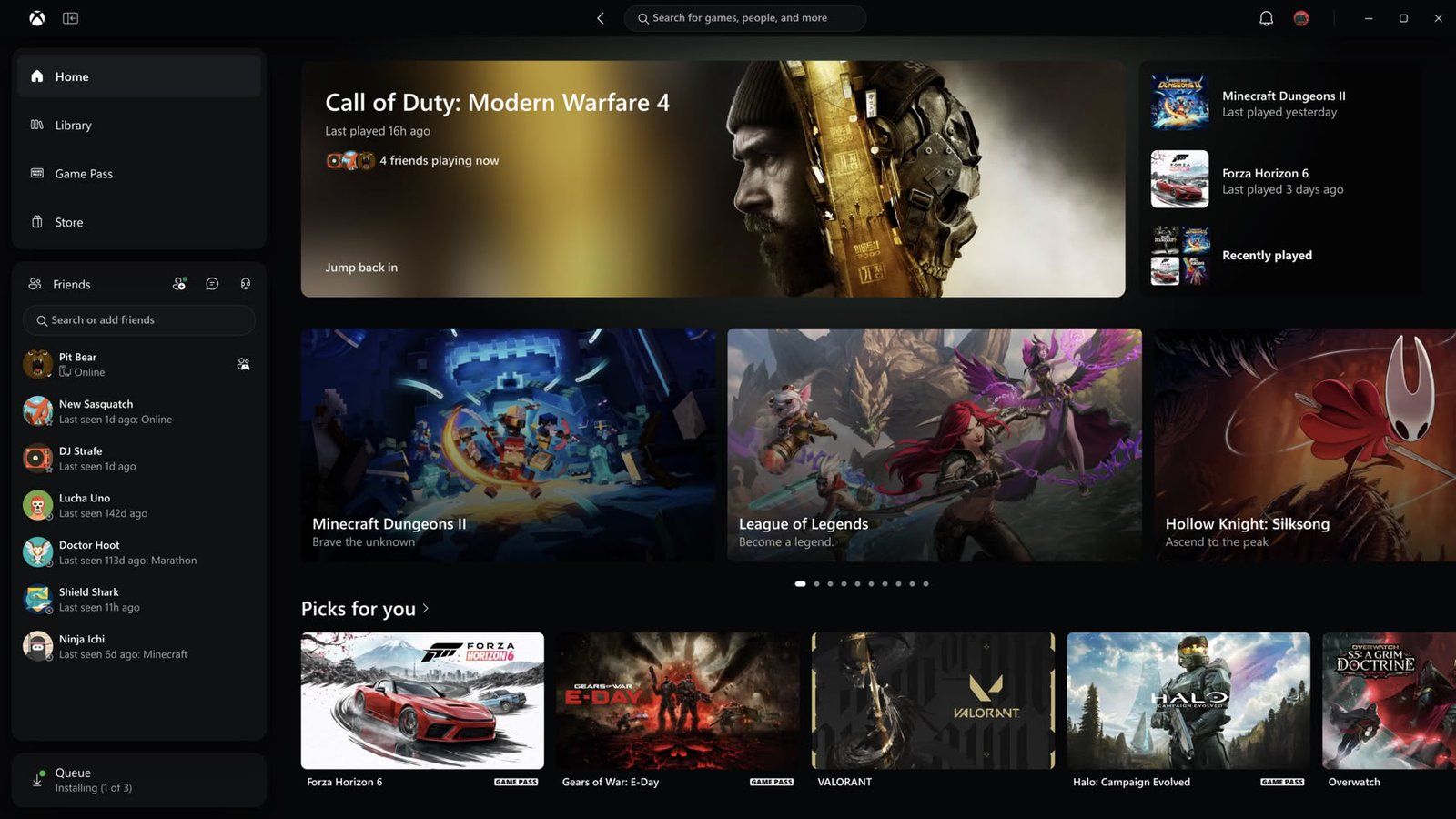
Speed is only one component of the user experience; the logic of the interface is equally important to player retention. The updated Xbox app features a design philosophy focused on reducing the number of clicks required to complete standard tasks. Microsoft has introduced a revamped navigation system that prioritizes clarity over density. Users will encounter updated filters that simplify the process of browsing massive catalogs, such as the extensive Game Pass library.
The organization of personal gaming collections has also seen a significant upgrade. By refining how games are categorized and sorted, the app aims to eliminate the clutter that often plagues users with large digital libraries. Additionally, the Friends tab has been granted more prominent placement, signaling a stronger focus on the social connectivity of the platform. The search functionality has been broadened as well; it now provides a unified experience that aggregates results from installed software, available downloadable content (DLC), and the community directory. By consolidating these disparate elements into a single search query, the interface becomes more scan-friendly, allowing users to find content or colleagues without navigating through multiple sub-menus.
The Role of the Xbox Insiders Program
To ensure these backend and frontend changes do not negatively impact system stability, Microsoft has opted to deploy these updates via the Xbox Insiders program. This controlled rollout serves as a crucial testing ground where power users can provide telemetry and feedback on the responsiveness of the new architecture. By isolating the rollout to this group, the development team can identify edge cases where the software might hang or exhibit compatibility issues with specific hardware configurations, such as custom display drivers or anti-virus software that often interferes with game launchers.
The Insider phase is expected to be a short-term gateway before a public release. The focus of this testing is not only on performance but also on consistency across different hardware profiles. Because the Xbox app relies heavily on server-side rendering, it is prone to variations in speed based on network conditions and local hardware acceleration. The data gathered during this phase will determine whether these performance gains are reproducible for the broader user base or if further optimization is required for lower-end hardware configurations.
Unified Design Across Ecosystems
One of the most ambitious aspects of this update is that it serves as a pilot for a broader design language intended to unify the Xbox experience across various hardware targets. Microsoft has confirmed that these visual and UX changes are intended to migrate beyond the PC. Future updates will incorporate these design principles into the Xbox web portal, as well as the native applications used on smart TVs and dedicated cloud-streaming devices.
By standardizing the interface across platforms, Microsoft is laying the groundwork for a more cohesive cloud-gaming environment. Whether a player is accessing a game through a high-end desktop, a television app, or a mobile-tethered VR headset, the intent is for the navigation logic and loading performance to remain consistent. This creates a predictable environment where, regardless of the entry point, the user knows exactly where their saved progress, social tools, and library access points reside. If the performance gains observed on the PC app can be successfully translated to these other devices, it will represent a significant milestone in Microsoft’s strategy to position Xbox as a platform-agnostic service rather than just a localized software application. As the testing phase progresses, the industry will be watching closely to see if Microsoft can deliver on these performance promises without sacrificing the reliability required by a global gaming audience.
Disclaimer: This content is auto-generated for informational purposes only.
Source: Read Original News