








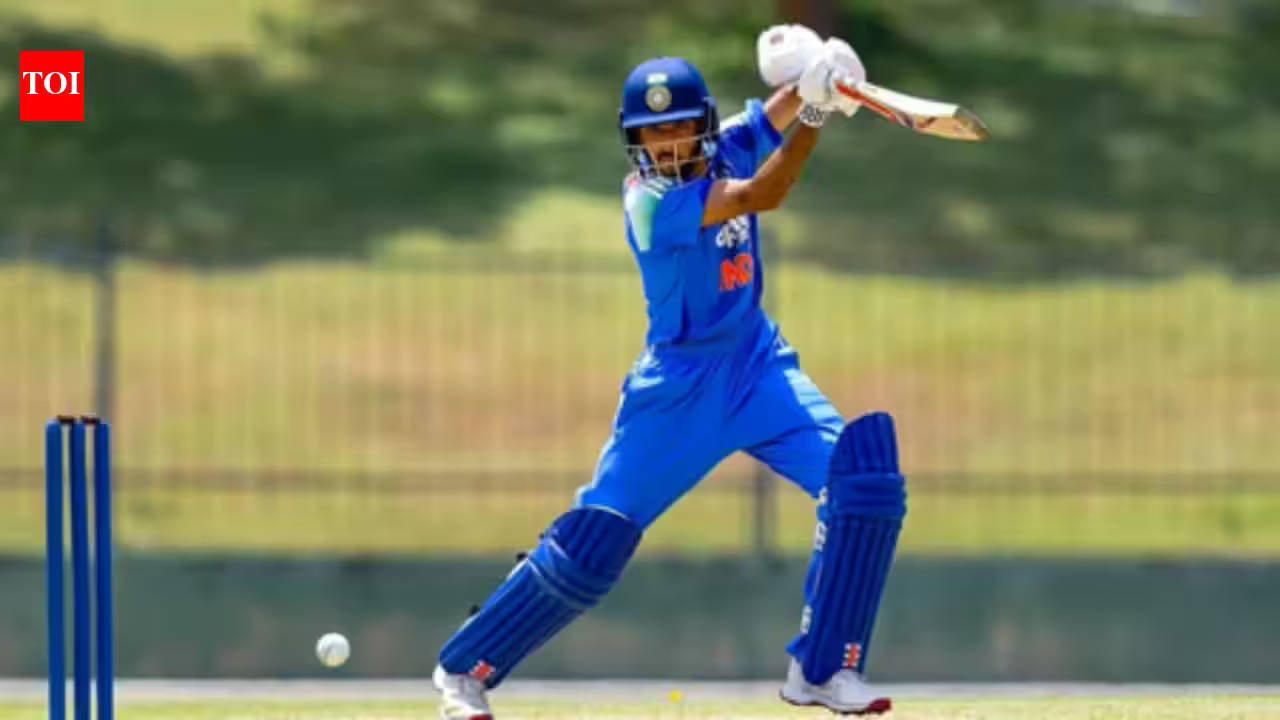
CRUSHING DEFEAT for the Indian Under-19 side unfolded in Muscat this Sunday as Pakistan orchestrated a stunning comeback to secure a three-wicket victory in their ACC Men’s U19 Asia Cup Group A clash. In a match defined by momentum shifts and individual brilliance, the Indian squad found themselves on the losing side, failing to defend a total that skipper Lakshya Raichandani openly admitted was far from sufficient.
The contest, held in the sweltering conditions of Oman, served as a stark reminder of the volatile nature of junior international cricket. While India displayed flashes of immense resilience, particularly through a heroic individual century, they ultimately lacked the collective synergy required to close out a high-stakes encounter against their arch-rivals.
A Lone Warrior Against the Tide
After winning the toss and electing to bat first, India’s innings got off to a disastrous start. The Pakistani new-ball attack moved the ball with precision and intent, dismantling the Indian top order in rapid succession. Within the blink of an eye, the scoreboard read a precarious 42/4, leaving the Indian dugout in a state of panic.
It was at this critical juncture that Arjun Rajput emerged as the anchor the team desperately needed. Rajput played a masterclass of an innings, shielding the tail and accumulating runs with surgical accuracy. His knock of 107—a composed, fighting century—provided the backbone of the Indian total. Despite his heroics, the lack of sustained support proved to be the team’s undoing. The wickets continued to tumble at the other end, preventing any momentum-building partnerships that could have propelled India toward a more imposing score.
By the time India were bowled out for 208 in 46.3 overs, it was clear that the target was modest. Post-match, a disappointed Raichandani was quick to acknowledge the missed opportunity. “Yeah, they weren’t enough. We were 20-30 runs short,” the captain conceded. “Overall there were some good innings from Arjun and a good contribution from Kavya Patel, but if someone had stayed there with him, it could have been a much better total.”
The Pakistan Turnaround
The second half of the match provided one of the most dramatic turnarounds of the tournament thus far. India’s bowlers began their defense with fire in their eyes, reducing Pakistan to a dire 61/5. At that point, a comfortable Indian victory seemed like a formality. However, cricket is a game of fine margins, and the Indian attack failed to deliver the final blow when it mattered most.
Pakistan’s recovery was spearheaded by Hamza Zahoor, who produced a match-winning, unbeaten 100 off 108 deliveries. Playing with maturity beyond his years, Zahoor combined with Hasnain Abbas Dar, who contributed a vital 38, to build a partnership that systematically deflated the Indian bowling attack. As the duo settled into their groove, the pressure evaporated, and the required run rate became increasingly manageable.
Pakistan ultimately chased down the 209-run target with 11 balls to spare, handing them their second consecutive victory and securing a firm foothold at the top of the Group A standings.
Reflections on a Missed Opportunity
Speaking in the aftermath of the defeat, Raichandani did not shy away from critiquing his side’s performance, particularly regarding the middle phase of the bowling innings. While he lauded the effort of the group, he was candid about the lack of clinical execution.
“We will try to rectify it,” Raichandani noted regarding the failure to clean up the Pakistani tail. “There was a lot of positive from this game, and we will try to take that forward. They were 60 for 5. We could have bowled a little bit better, but overall, it was really good.”
The loss leaves India in a position where they must regroup rapidly. In tournament play, the margin for error is razor-thin, and as Raichandani pointed out, the inability to close out a game from a position of dominance is a lesson that needs to be learned quickly if they hope to progress deep into the Asia Cup.
For India, the focus now shifts to their next fixture, where they will look to erase the memory of the Muscat collapse. For Pakistan, this victory is a statement of intent—a demonstration that even from the brink of defeat, their unit possesses the mental fortitude to fight back and claim the win. As the U19 Asia Cup progresses, the performance of Hamza Zahoor will undoubtedly be highlighted as one of the standout individual efforts of the tournament, while India’s management will be left pondering how to turn those “20-30 runs” into a winning cushion.
Disclaimer: This content is auto-generated for informational purposes only.
Source: Read Original News