








Delhi’s Toxic Diwali: Worst Pollution Levels in Five Years
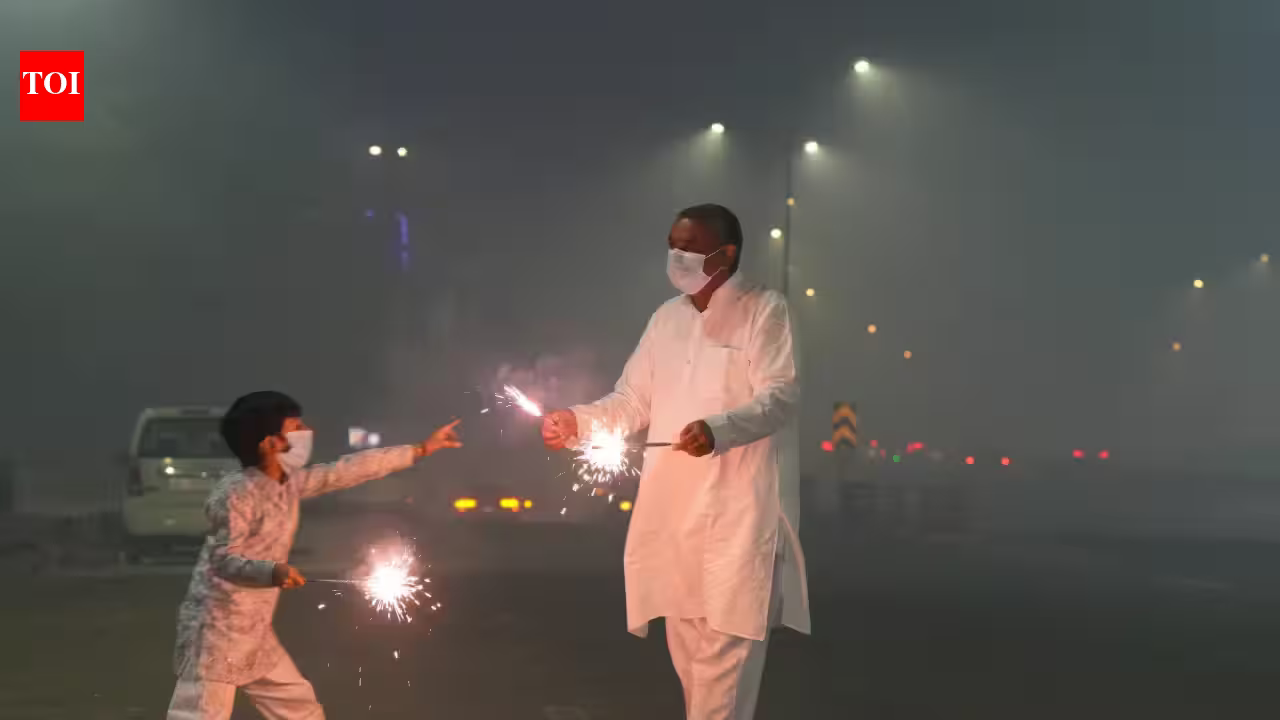
Delhi’s air quality reached a grim milestone this Diwali, recording its most hazardous levels in the last five years. On November 8, the city’s Air Quality Index (AQI) surged to 376 by 4:00 PM, marking the worst Diwali-day air quality since 2021. While the capital managed to dodge a record-breaking post-Diwali spike, the persistent “very poor” air quality levels continue to pose severe health risks to its millions of residents.
A Toxic Convergence of Factors
The build-up to this year’s festivities was particularly dire. November 7, the day before Diwali, experienced the worst pre-festival air quality since 2016, with an AQI of 369. Data from the Indian Institute of Tropical Meteorology (IITM) highlighted that firecrackers were the primary driver of this atmospheric decay, accounting for over 41% of the total pollution load on Chhoti Diwali.
The hazardous nature of the air was underscored by PM2.5 concentrations, which skyrocketed during the night of the festival. While the national 24-hour safety limit for PM2.5 is 60 µg/m³, several areas in Delhi reported readings exceeding 3,000 µg/m³ during peak hours. Analysts suggest that firecracker usage alone contributed to more than half of the PM2.5 levels residents were exposed to between 9:00 PM and 2:00 AM.
Meteorological “Luck” Prevents Worse Disaster
Despite the spike in emissions, Delhi narrowly avoided an even more catastrophic scenario due to an unexpected shift in weather patterns. As winter conditions set in, the city typically faces a “pollution cocktail” of local emissions and stubble burning from neighboring states. However, an approaching cyclone and western disturbance induced a rare wind reversal, pushing strong easterly winds into the region.
These winds, moving at speeds higher than the seasonal average, acted as a temporary ventilator, dispersing pollutants and preventing smoke from farm fires in Punjab and Haryana from overwhelming the city. Experts, including Gufran Beig of the National Institute of Advanced Studies, noted that Delhi was “very lucky” rather than cleaner, as the reprieve was purely a result of meteorological anomalies rather than successful pollution-control interventions.
Data Gaps and Future Risks
The monitoring process itself faced significant scrutiny as multiple air quality sensors went offline during peak pollution hours. Of the 60 monitoring stations across the capital, only 47 were able to contribute to the city’s average AQI on Diwali, sparking concerns over the transparency and accuracy of the reporting systems.
The underlying challenge remains the region’s failure to mitigate both persistent local emission sources—such as vehicular traffic—and recurring episodic events like crop residue burning. Anumita Roychowdhury of the Centre for Science and Environment (CSE) described the situation as a “toxic convergence,” warning that relying on wind shifts to clean the air is a precarious strategy. As the winter season progresses, the expected return of northwesterly winds threatens to bring back the smog, leaving the capital bracing for what remains an increasingly uncertain and hazardous environmental future.
Disclaimer: This content is auto-generated for informational purposes only.
Source: Read Original News