








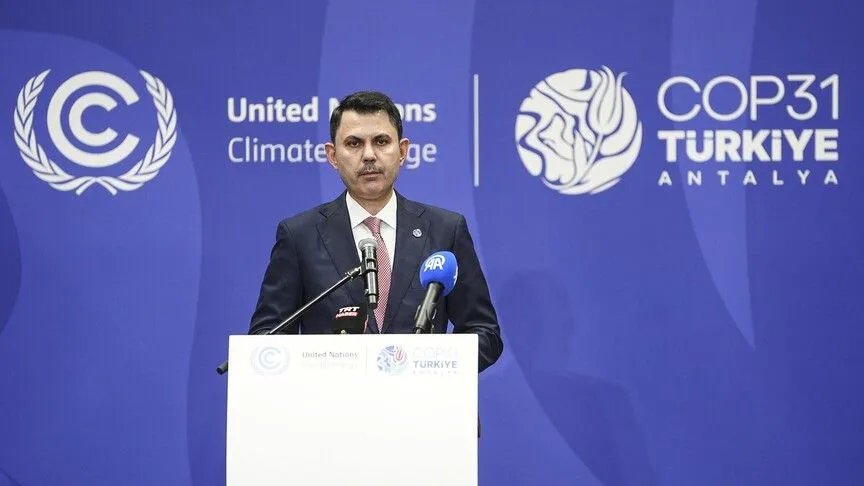
ANTALYA — On the opening day of the UN Climate Change Conference (COP31), Türkiye and Uzbekistan solidified their commitment to regional sustainability by signing a formal Memorandum of Understanding (MoU) focused on environmental protection. The agreement, signed in the southern Turkish city of Antalya, marks a strategic pivot toward deepening bilateral cooperation on some of the most pressing ecological challenges facing Central and Western Asia.
The pact was finalized following a high-level meeting between COP31 President and Turkish Minister of Environment, Urbanization and Climate Change, Murat Kurum, and Aziz Abdukhakimov, adviser to the President of Uzbekistan and chairman of the National Committee on Ecology and Climate Change. The agreement serves as a framework for both nations to synchronize their environmental policies, leverage shared expertise, and accelerate the implementation of green technologies.
The primary objectives of the memorandum include a multi-faceted approach to climate resilience. Both nations have pledged to intensify their efforts in combating climate change, a task that holds particular urgency for both the Anatolian peninsula and the arid landscapes of Central Asia. Specific areas of collaboration include the prevention of air and water pollution, the modernization of waste management systems, and the transition toward a circular economy—a model focused on minimizing resource consumption and waste through the continuous reuse of materials.
In a statement following the signing ceremony, Minister Kurum emphasized that the agreement provides a robust foundation for future diplomatic and technical exchanges. “With the Memorandum of Understanding on Cooperation in Environmental Protection that we signed following our meeting, we established a strong foundation for joint efforts in combating climate change, preventing air and water pollution, waste management, and the circular economy,” Kurum noted on social media. He further expressed optimism regarding the partnership, stating, “I hope this partnership, strengthened in Antalya, will benefit our countries and our shared future.”
For Uzbekistan, the partnership is a critical step in its ongoing national efforts to combat desertification and manage its water resources, which have been significantly impacted by regional shifts in climate. By aligning with Türkiye—which is currently leveraging its position as the host of COP31 to champion international climate action—Uzbekistan gains access to advanced waste management infrastructure and policy frameworks that can be adapted to its local landscape.
Conversely, the agreement reinforces Türkiye’s role as a regional leader in environmental diplomacy. By fostering cross-border cooperation, the Turkish government is signaling that climate mitigation cannot be achieved in isolation. The integration of circular economy principles into the bilateral agenda is particularly significant, as both nations look to decouple their economic growth from carbon-intensive resource extraction.
As COP31 continues in Antalya, the Türkiye-Uzbekistan pact serves as an early indicator of the conference’s broader goal: moving from high-level commitments to tangible, cross-border technical cooperation. While the memorandum sets the stage for future projects, the success of the agreement will ultimately depend on the implementation of joint monitoring systems and the sharing of best practices in environmental governance.
The signing is expected to trigger a series of technical workshops and expert exchanges between the two ministries, ensuring that the memorandum translates into measurable improvements in air quality standards and waste diversion rates in both countries. As the international community watches the proceedings in Antalya, this bilateral alignment underscores the necessity of regional alliances in the global effort to mitigate the catastrophic impacts of climate change.
Disclaimer: This content is auto-generated for informational purposes only.
Source: Read Original News