









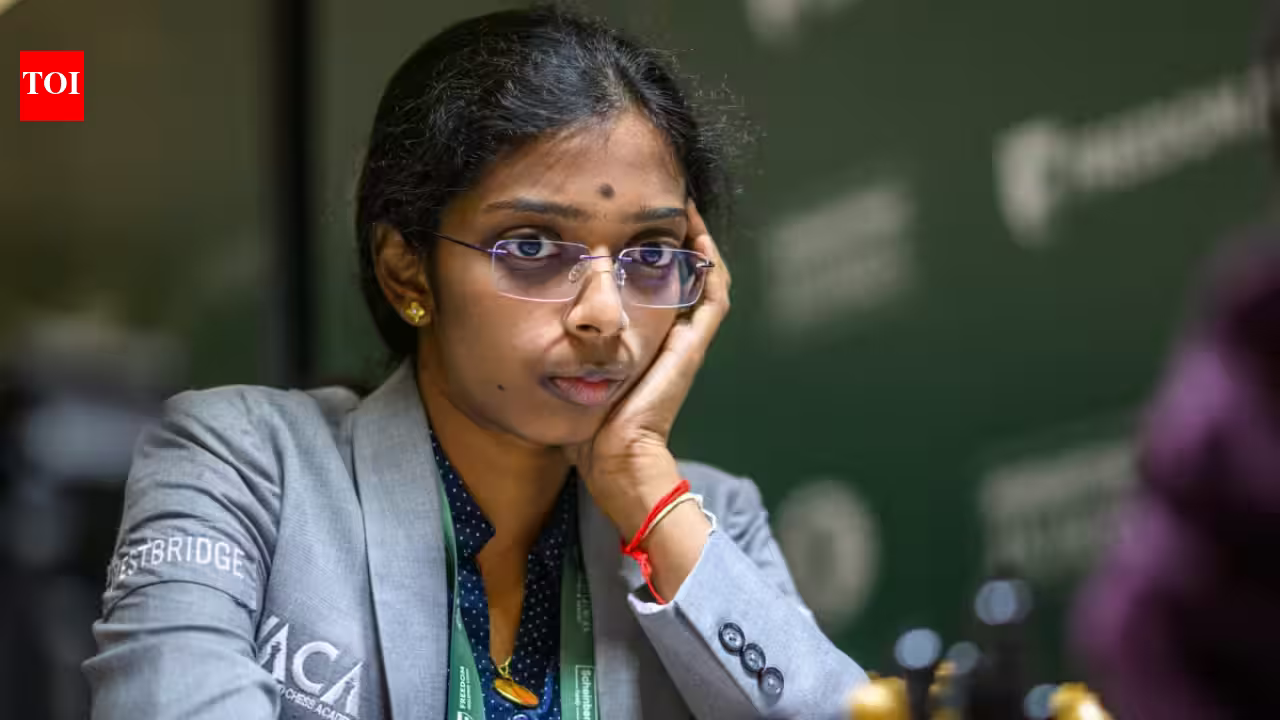
BUDAPEST — In a sport often defined by its rigid hierarchies and historical statistics, India’s Vaishali Rameshbabu shattered expectations at the inaugural Total Chess pilot, proving that the elite grandmaster circuit is far more permeable than the traditional rankings suggest.
As the tournament kicked off in Budapest, the primary narrative centered on how the two women in the 24-player field—Vaishali and Kazakhstan’s Bibisara Assaubayeva—would hold up against an unrelenting gauntlet of the world’s most feared tacticians. Vaishali didn’t just hold her own; she delivered a masterclass in giant-killing that sent shockwaves through the venue.
## Vaishali’s Statement of Intent
Vaishali’s campaign began with a bold declaration in the opening round, where she dismantled American Grandmaster Hans Niemann. If critics dismissed that victory as an opening-round anomaly, she silenced them emphatically in the third round by taking down four-time U.S. champion Wesley So.
To topple So—a player who arrived in Budapest riding the high of his fourth national title just two weeks prior—is a feat of immense psychological and technical merit. While Vaishali concluded the nine-round blitz phase with four points, placing her outside the immediate podium fight, her impact was palpable. She demonstrated that when the clock ticks down, the gap between the world’s top-ranked men and the elite women is narrowing at a rapid pace.
“It’s about seizing the moment,” sources close to the Indian camp noted. With the tournament transitioning into the highly anticipated group stages, the pressure will only intensify, but Vaishali has already gained the one thing every grandmaster fears their opponent might have: respect.
## Carlsen Remains the King of the Clock
While the spotlight shone brightly on the rising star of Indian chess, the throne remained occupied by the man who has spent the better part of a decade sitting upon it. Magnus Carlsen, the Norwegian world No. 1, navigated the nine-round blitz competition with the clinical precision that has become his trademark, finishing unbeaten with a score of 7/9.
Carlsen’s journey to the top of the leaderboard was not without its hurdles. He faced fierce opposition, notably from French Grandmaster Maxime Vachier-Lagrave, who secured second place with 6.5 points, and the perennial contender Levon Aronian, who took third with six.
The turning point for the Norwegian came in the final round, where he effectively neutralized Armenia’s Haik Martirosyan with the black pieces. With Vachier-Lagrave forced into a draw against Niemann, Carlsen’s victory was cemented, marking a dominant start to the $650,000 pilot event.
Beyond the prestige of the blitz trophy, the win carries immense strategic weight. Under the experimental Total Chess regulations, the opening blitz standings dictate tiebreak priority, influence knockout pairings, and grant high-finishers the luxury of choosing their preferred color in the decisive knockout games. Carlsen has effectively purchased himself a safety net before the tournament has even hit its stride.
Elsewhere, India’s Arjun Erigaisi provided the tournament with some of its most thrilling chess. His aggressive play saw him topple both Vachier-Lagrave and American powerhouse Fabiano Caruana. Though a final-round loss to Aronian saw him finish tied on 5.5 points alongside a crowded pack—including Caruana, Alireza Firouzja, and local hero Richard Rapport—Erigaisi’s performance reaffirmed that the next generation of Indian talent is ready to displace the old guard.
## The “Fast Classic” Test Awaits
With the blitz segment in the rearview mirror, the tournament shifts gears into the grueling “Fast Classic” format starting Wednesday. The 24 participants have been partitioned into four groups of six, facing a time control of 45 minutes with a 30-second increment per move. The scoring system—three points for a win and one for a draw—is designed to incentivize sharp, attacking play and discourage the “grandmaster draws” that occasionally plague classical events.
The grouping has set up several high-stakes narratives. Group C is a heavyweight division, featuring Carlsen alongside Anish Giri, Ian Nepomniachtchi, and the teenage sensation Abhimanyu Mishra. Meanwhile, Group B pits Caruana against the tactically gifted R. Praggnanandhaa and Richard Rapport.
However, all eyes will likely drift to Group D. This is where Vaishali and Assaubayeva will face their most grueling test yet, slotted against Vachier-Lagrave, Erigaisi, Niemann, and So. For Vaishali, the group stage is a crucible; she is now a marked target for the very players she bested in the blitz phase, who will undoubtedly be looking for retribution in the longer format.
As this pilot event aims to harmonize rapid, blitz, and classical formats into a cohesive world tour, the performance of the players in Budapest will serve as the blueprint for the future of professional chess. For now, the field remains wide open, the points are tight, and if the opening blitz rounds are any indication, the Total Chess experiment is poised to deliver one of the most unpredictable tournaments of the decade.
Disclaimer: This content is auto-generated for informational purposes only.
Source: Read Original News