







COP31: World Leaders Issue Final Warning on Fossil Fuel Dependence
As the 31st UN Climate Change Conference (COP31) gets underway in Turkey, a sense of profound urgency has gripped the assembly of 91 global leaders. With the shadow of climate catastrophe looming, the message from the summit is clear: the era of incrementalism must end if the world is to avoid an irreversible environmental collapse.
A Stark Reality for Vulnerable Nations
The conference opened with a sobering address from the President of the Marshall Islands, Hilda Heine. Representing a nation on the front lines of rising sea levels, Heine delivered a haunting assessment of the current trajectory, asserting that without radical intervention, the world as we know it will cease to exist. Drawing from personal observations of dying coral reefs in her home nation, she emphasized that exceeding the 1.5°C warming threshold is not merely a policy failure, but an existential threat to island nations.
Her sentiments were reinforced by Barbados Prime Minister Mia Mottley, who provided a blunt critique of the post-Paris Agreement landscape. Mottley pointed out that current international pledges are woefully inadequate. Even if all nations meet their existing commitments, the planet is on track for a 2.6°C temperature rise, a figure that would trigger catastrophic climate events across the globe.
Fossil Fuels in the Crosshairs
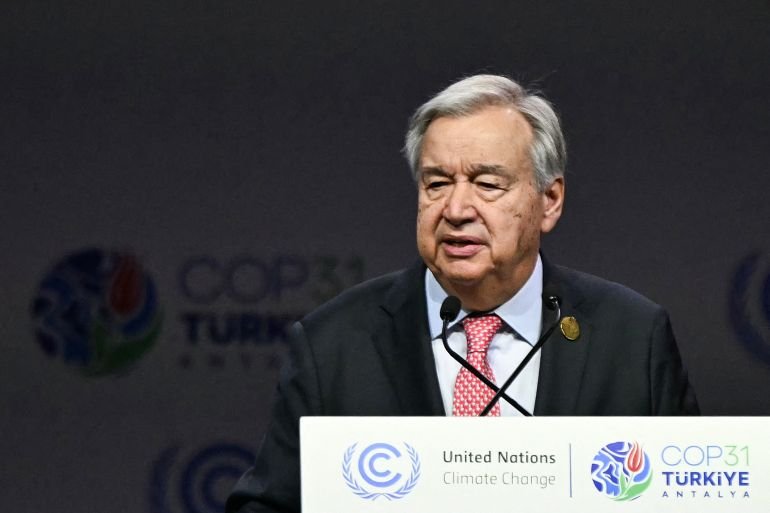
The debate reached a fever pitch when United Nations Secretary-General António Guterres launched a scathing attack on the fossil fuel industry. Guterres accused oil and gas conglomerates of stalling global progress by distorting scientific consensus and profiting from the very crisis they helped create.
“Fossil fuels must go the way of the dinosaurs,” Guterres declared, proposing that governments implement a windfall tax on the record profits of energy giants. He argued that these funds should be redistributed to support nations currently bearing the brunt of climate-induced disasters, such as extreme heatwaves and unprecedented flooding.
Internal Contradictions and Empty Rhetoric
Despite the gravity of the summit, the proceedings were not without irony. Turkish President Recep Tayyip Erdoğan, serving as a co-host, urged his counterparts to abandon empty promises in favor of tangible policy shifts. However, his calls for action were met with skepticism by environmentalists, particularly following his recent announcement regarding the discovery of new oilfields in Turkey. Similarly, Australian Prime Minister Anthony Albanese faced criticism for delivering a keynote speech that conspicuously failed to address the role of fossil fuels, drawing ire from activists who demand a clear roadmap for a clean energy transition.
The absence of top leadership from the United States and China—the world’s two largest emitters—has further complicated the atmosphere. Climate scientists, including Bill Hare, have expressed deep frustration at the disconnect between scientific warnings and the sluggish, often performative, pace of political decision-making.
The Path Forward
As deliberations continue in Turkey, the challenge of building a global consensus on phasing out fossil fuels remains the summit’s most formidable hurdle. The UN Environment Programme has issued a final caution: the window to prevent the most devastating effects of climate change is closing rapidly. For the leaders gathered at COP31, the conference represents more than just a diplomatic exercise; it is a critical juncture to choose between the preservation of our ecosystems or the long-term suffering of future generations. The consensus remains that unless nations move past their geopolitical interests and commit to an immediate, binding transition away from fossil fuels, the goals set out in Paris will remain out of reach.
Disclaimer: This content is auto-generated for informational purposes only.
Source: Read Original News