








As the COP31 climate conference enters its second week in Antalya, Turkey, a stark disconnect has emerged between the desperate financial pleas of vulnerable nations and the guarded, fiscally conservative stance of the world’s wealthiest economies. While small island states report being trapped in a “perpetual climate disaster recovery mode,” Western governments, preoccupied with domestic inflationary pressures and surging defense spending, have signaled that the era of aggressive climate funding may be stalling.
The atmospheric tension in Antalya reflects a broader global shift. Two years ago, wealthy nations pledged to triple climate finance for developing countries to $300 billion annually by 2035, with a broader goal of reaching $1.3 trillion in total public and private funding by the same date. However, those targets are already under intense scrutiny. Recent analyses suggest that current trajectories will leave the world approximately $840 billion short of the 2035 goal, as geopolitical instability and shifting political priorities divert capital elsewhere.
The fiscal fatigue of developed nations is palpable. With global military expenditure hitting an estimated $2.89 trillion in 2025, climate finance is increasingly being treated as a secondary priority rather than a national security imperative. The contrast was noted sharply by Marshall Islands President Hilda Heine during her address to the conference. “We are told there is no money, but as spending on war grows, the greatest security threat we face remains underfunded,” she stated. “I appeal to you: Find money for life, not death.”
The struggle is not merely about the total volume of money, but its accessibility. Small island nations have long argued that even when funds are theoretically available, the administrative hurdles imposed by multilateral lenders are insurmountable. Complex bureaucratic requirements often overwhelm the capacity of smaller states, leaving them unable to secure the support they require to build resilience.
In a move to streamline these processes, a coalition of multilateral development banks informed the COP31 assembly that they intend to standardize procedures by relying on each other’s assessments in co-financed projects. This, they hope, will reduce the burden of overlapping administrative cycles. However, critics argue that such technical fixes are insufficient if the core, underlying funding remains stagnant.
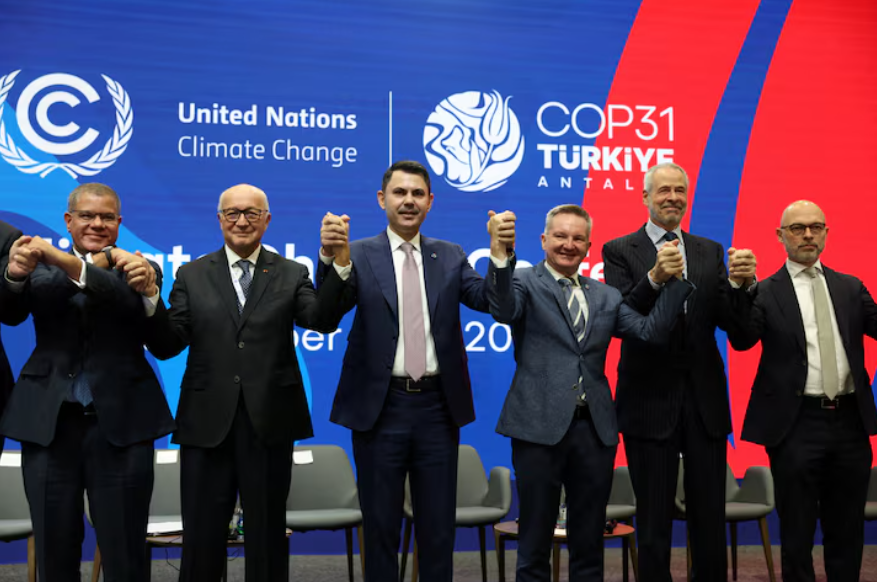
Host country Turkey and lead negotiator Australia, representing the COP31 presidency, have consciously pivoted away from pursuing new, headline-grabbing financial pledges. Instead, the focus has shifted toward the implementation of existing commitments and demanding that the current system become “faster, simpler, and fairer.”
The private sector, often cited as the necessary engine to bridge the funding gap, remains cautious. Private investors require clear regulatory frameworks, predictable energy costs, and de-risking mechanisms before committing capital to the energy transition. As HSBC Chief Sustainability Officer Julian Wentzel noted, the conference serves as a critical stage to build the confidence required for that capital to flow.
In the face of international inaction, some vulnerable nations are turning to creative financing to force the hand of global markets. The Bahamas, for instance, has committed $75 million to the restoration of seagrass meadows—a vital carbon sink—in an attempt to attract private investment into verified carbon projects. Meanwhile, the Solomon Islands has pledged $400,000 of its own limited budget, a symbolic gesture intended to shame wealthier nations into matching their commitment to leadership.
As the conference moves toward its conclusion, the reality remains grim for the nations on the front lines of the climate crisis. With fiscal space eroding and the cost of capital remaining high, the “global moment” that negotiators speak of is quickly passing, leaving developing nations to wonder if the international community still has the political willpower to honor its past promises.
Disclaimer: This content is auto-generated for informational purposes only.
Source: Read Original News