








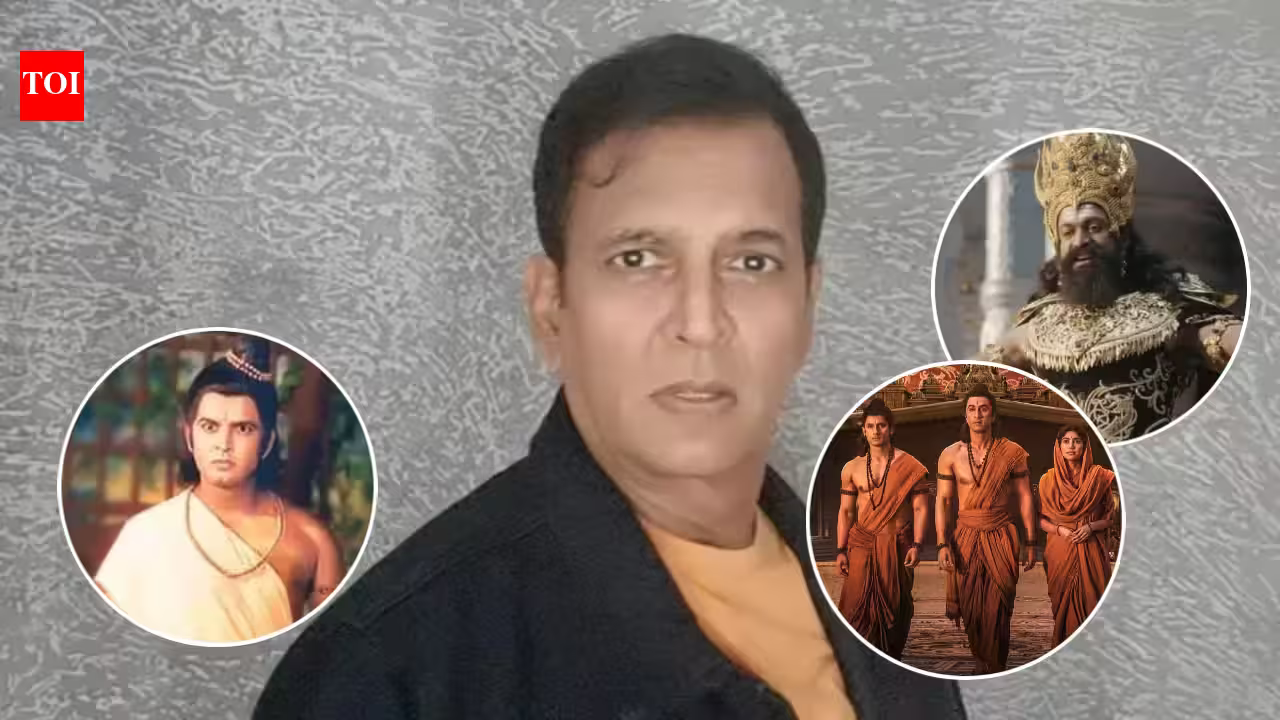
The enduring shadow cast by Ramanand Sagar’s 1987 Ramayan remains a hurdle that few modern adaptations can clear. As the cultural touchstone of a generation, that television series did more than just tell a story; it ingrained itself into the spiritual fabric of the Indian household. Now, as the industry grapples with bringing the epic to the big screen with all the bells and whistles of contemporary CGI, the debate regarding “reverence versus spectacle” has reached a fever pitch. The latest voice to chime in on this complex discourse is none other than Sunil Lahri, the man who immortalized the role of Lakshman, offering a critique that is as measured as it is poignant.
The Weight of a 39-Year Legacy
It has been nearly four decades since the original Ramayan graced our screens, yet its cultural potency has barely flickered. For Lahri, the longevity of the series isn’t a mystery; it is a byproduct of the genuine, unvarnished devotion poured into the project. Speaking to ANI, the veteran actor noted that the love audiences harbor for that version is unchanged by the passage of time.
“What we gave people when we did Ramayan in 1987, it has been 39 years since then,” Lahri remarked. “Even today, people have the same love and faith in their hearts.” This sentiment highlights the fundamental challenge facing the makers of the new Ramayana: Rise of a Legend: how do you replace a show that became a religious icon with a piece of commercial cinema? While the modern production boasts cutting-edge technology, it faces an uphill battle against the nostalgia and deep-seated emotional attachment that defines the public’s perception of the narrative.
Technical Brilliance Meets Narrative Hollows
One cannot critique the new adaptation without acknowledging the massive shift in production value. Lahri, who is well-versed in the limitations and the charms of 80s television production, was quick to commend the technical mastery displayed in the new film. He praised the cinematography, the scale of the sets, and the overall aesthetic polish—elements that were physically impossible to replicate during his tenure on the small screen.
However, he draws a sharp line between “looking good” and “feeling right.” While he admits that the cast delivered solid performances across the board, he felt that the film suffered from a lack of cohesiveness. “The film did not create an impact in its totality,” he stated, echoing a common critique that many high-budget mythological films face: when the visual effects take center stage, the soul of the story often gets pushed into the background.
The Missing Contrast: Ram vs. Ravana
Perhaps the most significant critique offered by Lahri concerns the characterization of the central binary of the epic. In a story defined by the struggle between light and dark, the contrast between the protagonist and antagonist is the heartbeat of the narrative. Lahri felt that the film failed to establish the divine aura of Lord Ram, which he considers essential for the audience’s spiritual engagement.
“When you go to watch a film and see divinity, or a god like Ram, who has done great things for humanity, and Ravan, the contrast between them was not visible,” he observed. “Ravan looked stronger, heavier and more powerful compared to Ramji.” This observation points to a structural concern: if the hero doesn’t embody the quiet, grounded strength expected of the divine, the conflict loses its stakes. If the villain feels like the most compelling force on screen, the moral compass of the narrative risks spinning out of control.
Yash and the Challenge of Casting
In an era where star power is often the primary driver of box office success, the performance of the antagonists and supporting characters becomes crucial. Lahri was particularly vocal about Yash’s portrayal of Ravana. He praised the actor’s performance, noting that he did justice to the gravity of the role. In fact, Lahri expressed that the fault did not lie with the actors—each performer, in his estimation, gave the role their best effort.
The issue, he suggests, is one of direction and intent. Even with a stellar cast—including Ranbir Kapoor as Rama and Sai Pallavi as Sita—the film seems to struggle with “spiritual connectivity.” For an audience that approaches the Ramayana with a sense of piety, a film that treats the story as a high-octane fantasy actioner might inevitably feel like it is missing a heartbeat.
A Hopeful Look Toward the Future
Despite his reservations, Lahri maintains a surprisingly magnanimous stance. He isn’t interested in tearing down the production; rather, he is interested in the growth of Indian cinema. He actively encouraged audiences to support the film, grounding his request in the practical reality of the industry. “I just want to say that people should go and watch Ramayana because the film needs to run,” he urged. “It is important because many people’s livelihoods are dependent on it.”
His hope is that the creative team will take the constructive criticism to heart for the planned sequel. He envisions a scenario where the lessons learned from this installment allow for a more balanced, resonant, and spiritually grounded conclusion. As the industry looks toward a 2028 release for the next part of this franchise, the bar has been set. The technical foundation is there; now, according to a veteran who lived the role, it is time to find the soul. If the producers can marry their massive budget with the emotional depth that Lahri insists is the key to the story’s success, the next installment might just find the balance that its predecessor missed.
Disclaimer: This content is auto-generated for informational purposes only.
Source: Read Original News