








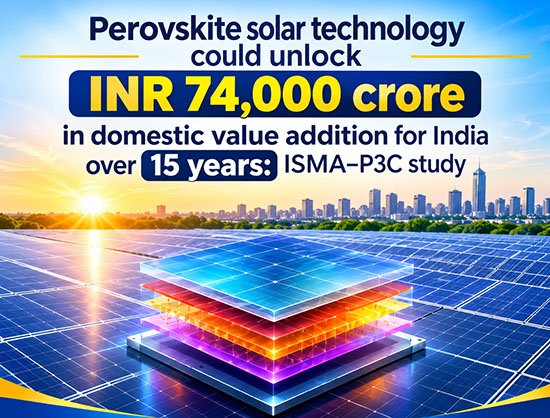
Perovskite Tech Set to Power India’s Solar Ambitions with INR 74,000 Crore Boost
November 18, 2026 | EI News Network
India’s solar manufacturing landscape stands on the precipice of a significant technological shift. A recent comprehensive study by the Indian Solar Manufacturers Association (ISMA) and P3C Technology and Solutions has unveiled that the adoption of perovskite solar technology could generate approximately INR 74,000 crore in domestic value addition over the next 15 years. Titled ‘Perovskite Solar: India’s Atmanirbharta Opportunity in Next Generation PV’, the report suggests this path could be the key to achieving true self-reliance in the renewable energy sector.
Bypassing Upstream Hurdles
While India has made commendable strides in expanding its solar cell production—bolstered by the Production Linked Incentive (PLI) scheme—the nation remains heavily reliant on global supply chains for critical upstream materials like polysilicon, ingots, and wafers. Perovskite technology offers a strategic workaround. By eliminating the necessity for the energy-intensive and import-heavy stages of silicon processing, Indian manufacturers could secure a more resilient domestic production route.
Beyond the supply chain advantages, the economic profile of perovskite manufacturing is compelling. According to the study, the capital expenditure required to establish a perovskite manufacturing facility could be 70–80 percent lower than that of conventional crystalline silicon lines. This lower entry barrier makes the technology an attractive prospect for both established players and emerging entrants in the renewable energy space.
Boosting Efficiency and Performance
The technological promise of perovskites extends to operational performance. Projections indicate that the technology could improve the Capacity Utilisation Factor (CUF) from 20 percent to 25 percent. Furthermore, it holds the potential to reduce the Levelised Cost of Energy (LCOE) by 30–40 percent. While experts emphasize that these figures require confirmation through long-term field validation, the potential to significantly lower the cost of power is a game-changer for India’s energy transition goals.
Charting the Path to Commercialization
To ensure a smooth transition, ISMA and P3C propose a phased rollout. The strategy begins with the deployment of single-junction perovskite cells, eventually progressing toward silicon-perovskite tandem cells. This approach is particularly advantageous as it allows manufacturers to integrate new perovskite layers with existing Tunnel Oxide Passivated Contact (TOPCon) infrastructure, effectively future-proofing current capital investments.
Amit Manohar, Secretary General of ISMA, emphasized that the industry has already built a strong foundation in backward integration. “Perovskite technology represents the logical next step in strengthening our domestic manufacturing capabilities,” he noted.
Supporting this vision, Sooraj Kumar, CEO of P3C Technology and Solutions, confirmed that the company is actively cultivating its own absorber chemistry and intellectual property. P3C modules are currently undergoing rigorous reliability testing at the National Institute of Solar Energy (NISE), signaling a move toward establishing the bankability of the technology.
Policy Framework and Future Roadmap
The transition will require more than just technical innovation; it demands a robust policy ecosystem. The study recommends that the government establish a two-tier category under the Approved List of Models and Manufacturers (ALMM) specifically for perovskite technology, contingent upon strict stability benchmarks. Additionally, calls for dedicated pilot funding from the Ministry of New and Renewable Energy (MNRE) and the Anusandhan National Research Foundation (ANRF) underscore the need for state-led research support.
By prioritizing sustained R&D, transparent techno-economic modeling, and strong industry-academic collaboration, India can pivot from being a major solar importer to a global leader in next-generation photovoltaic technology. If successfully executed, this transition will not only secure energy independence but also establish India as a global hub for high-tech, sustainable manufacturing.
Disclaimer: This content is auto-generated for informational purposes only.
Source: Read Original News