







Shadow Over Punjab: Drug Trafficking Evolves Amid Soaring Heroin Seizures
New Delhi: Despite extensive enforcement operations and years of high-profile anti-narcotics campaigns, Punjab continues to grapple with a persistent and escalating drug crisis. Recent data paints a grim picture of a state struggling to contain the influx of illicit substances, with traffickers increasingly leveraging cutting-edge technology to bypass traditional border security measures.
The severity of the situation has not gone unnoticed by the highest echelons of the judiciary. In May, the Supreme Court expressed deep alarm regarding the state of drug abuse in Punjab, specifically citing the tragic case of a mother who lost all five of her children to addiction. The court has called for urgent intervention from the Centre, urging both state and central agencies to shift their focus toward dismantling the complex, high-level syndicates that orchestrate this trade, rather than merely targeting low-level street peddlers.
Drones as a New Frontier for Smuggling
The most alarming development in the region’s narcotics landscape is the surge in drone-based smuggling. Border districts—including Amritsar, Tarn Taran, Ferozepur, and Gurdaspur—have become primary theaters for this new modality of trafficking.
Data from the Narcotics Control Bureau (NCB) illustrates an exponential increase in drone-linked incidents. While security forces intercepted only three such cases in 2021, that number exploded to 179 in 2024, followed by a further spike to 305 cases in 2025. While these statistics highlight the ingenuity of criminal networks, they also reflect a significant improvement in the surveillance capabilities of Indian security agencies, who are now better equipped to detect and neutralize aerial threats.
A Dominant Hub for Heroin
The sheer volume of narcotics intercepted in Punjab underscores its status as the epicenter of the national drug crisis. In 2025, India recorded a total of 3,567 kilograms of heroin seizures; of this, a staggering 2,086 kilograms—nearly 59 per cent—was recovered within Punjab.
This trend reflects a sharp upward trajectory over the last five years. In 2021, Punjab accounted for just 5.8 per cent of the national heroin seizure total. By 2022, that figure jumped to 29.8 per cent, before cementing its status above 44 per cent in 2023 and 2024. The data for 2025 indicates that for every ten kilograms of heroin seized across India, six are intercepted in Punjab.
Beyond Heroin: A Widespread Crisis
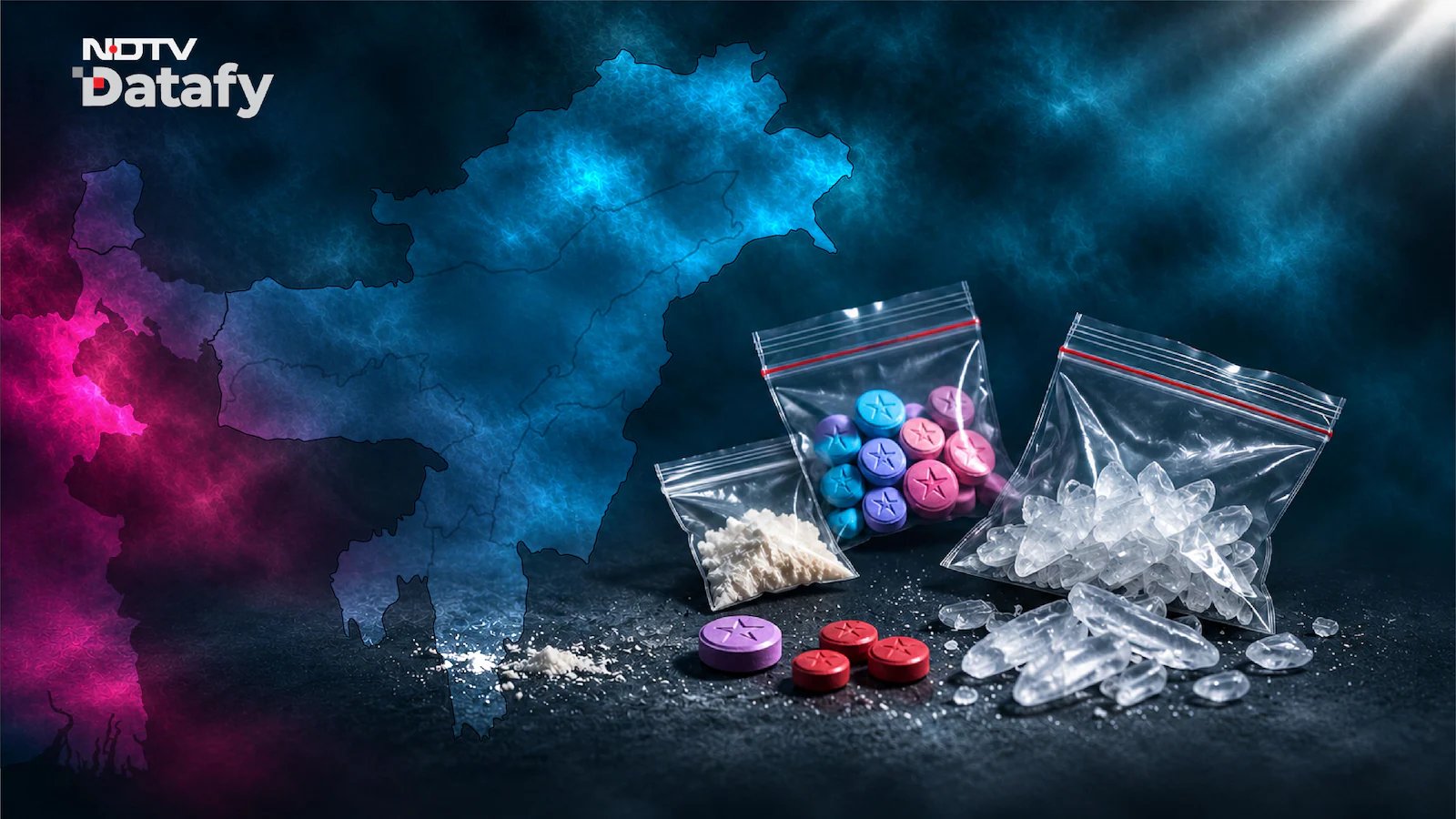
While heroin dominates the discourse, the drug menace in the state has diversified. Recent reports indicate that Punjab is responsible for nearly half (48.8 per cent) of all tablet-based narcotics seized nationwide and roughly one-third of the country’s codeine-based cough syrup seizures. Furthermore, the state accounts for over 20 per cent of all drug-related arrests in India, highlighting the depth of the local distribution networks.
As the 2027 Punjab Assembly elections approach, the drug epidemic has once again moved to the center stage of the political arena. For the residents of Punjab, the data serves as a stark reminder that until the nexus between high-level traffickers and modern smuggling technology is broken, the social fabric of the state will remain under immense pressure.
Disclaimer: This content is auto-generated for informational purposes only.
Source: Read Original News