









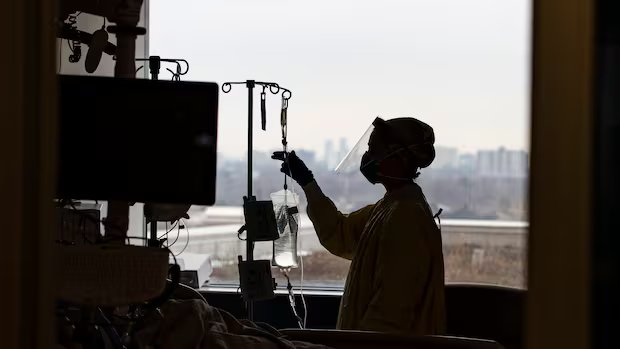
“Am I going to make the palliative patient comfortable? Am I going to try to save the drug user? Or am I going to get the naked and confused woman off the floor?”
This harrowing internal monologue, shared by an Ontario nurse identified only as “Jane,” captures the brutal, split-second triage decisions now defining the daily reality for hospital staff across the province. Her testimony is one of many featured in a sobering new report, We are in Survival Mode, released Monday by the Ontario Council of Hospital Unions (OCHU).
The report, co-authored by University of Windsor sociology professors James Brophy and Margaret Keith, compiles first-hand accounts from 14 nurses describing a healthcare system pushed to its breaking point. Nurses report being routinely overwhelmed by high-acuity patient loads, broken equipment, and an alarming surge in workplace violence. For many, the mental toll has shifted from manageable stress to “moral injury”—a profound psychological distress caused by the inability to provide the standard of care their patients need and deserve.
Brophy warns that the profession is reaching a critical tipping point. “We’re talking nurses that have been practising 15, 20, sometimes 30 years, who simply cannot tolerate it any longer,” Brophy said. “They’re looking to leave the profession.”
The data supports this grim assessment. A recent Nanos Research survey found that nearly half of Ontario nurses are considering leaving their jobs within the next year. Nationally, the exodus is already underway; a report from the Montreal Economic Institute noted that for every 100 nurses under the age of 35 who registered to practice in 2024, 34 did not renew their license. Experts project a staggering national shortage of 117,600 nurses by 2030.
For some, the risk to their professional license and personal wellbeing became too great. Kelsey Toney, a former emergency nurse from Milton, Ont., left the hospital setting after six years of feeling constantly overextended. “I felt like I was being asked to care for too many patients at once,” Toney said. “I wasn’t willing to have my licence put in jeopardy.”
In response, advocates are intensifying calls for mandated nurse-to-patient ratios. Angela Hodgson, chair of the RPN Committee for OCHU-CUPE, argues that setting a hard limit—such as the 1:4 ratio recently implemented in British Columbia—is essential to ensuring safety for both staff and patients.
“Everybody says, ‘nurses are angels and they’re heroes,’ and they put you on this pedestal, but we are humans and we can only handle so much,” Hodgson said.
While leaders like Canadian Nurses Association CEO Valerie Grdisa acknowledge that there is no “easy fix,” she emphasizes that the system requires a complete redesign, including increased investment in primary care and preventative measures to take the pressure off acute hospital settings. For now, however, those on the front lines say the status quo is unsustainable.
Disclaimer: This content is auto-generated for informational purposes only.
Source: Read Original News