







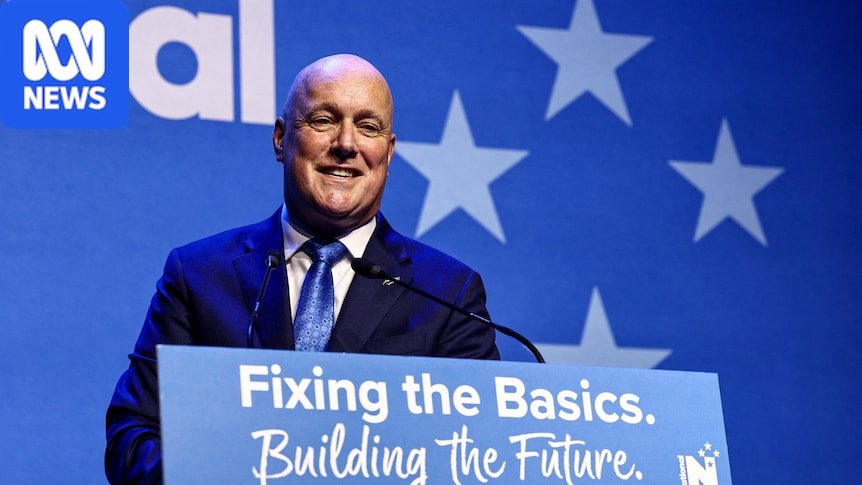
New Zealand Prime Minister Christopher Luxon faces a precarious path to retaining power after the Electoral Commission released final election results today, confirming his governing coalition has fallen one seat short of a parliamentary majority.
The final count, which processed approximately 400,000 special votes—including those from overseas and out-of-electorate voters—revealed a shift in the political landscape. The governing coalition, which initially appeared to hold a slim two-seat majority on election night, has been adjusted to 65 seats in the new parliament. With a majority requiring 66 seats, Mr. Luxon is now forced to seek a formal agreement with the centrist Opportunity party to secure his administration’s future.
The shift follows a late surge in support for minor parties, which saw the Green Party increase its tally to 17 seats, while the National Party’s share decreased. The final composition includes an “overhang” of 10 seats, a result of the National Party and Te Pāti Māori winning more electorate seats than their respective party-vote percentages would typically dictate.
For Opposition Leader Chris Hipkins, the results confirm there is no viable path back to power. Analysis shows that even with the support of the Opportunity party, a potential centre-left coalition involving Labour, the Greens, and Te Pāti Māori remains mathematically incapable of forming a government. Consequently, the focus of the nation is now squarely on the negotiations between Mr. Luxon and Opportunity leader Qiulae Wong.
Ms. Wong has signaled a willingness to talk, stating she is preparing to enter negotiations with the National Party, which holds the largest number of seats. However, she has maintained a firm stance on several key requirements. Notably, she has reiterated her refusal to support the existing three-party coalition if Winston Peters remains in his position as Foreign Minister.
Beyond cabinet personnel, Ms. Wong has set out a series of “bottom line” policy requirements, including stricter regulation of the lobbying industry, interventions in the supermarket sector, a new health sector strategy, and a firm commitment to the Paris Agreement on climate change.
“Our bottom lines are the minimum non-negotiables we require for a confidence and supply or a coalition deal,” Ms. Wong told reporters, adding that her party is also considering the possibility of remaining on the crossbench while providing the support necessary to ensure the government survives.
Analysts have warned that the stakes are exceptionally high. If Mr. Luxon is unable to reach an agreement with Ms. Wong, New Zealand may be forced back to the polls for a fresh general election. While the Electoral Commission confirmed it is prepared for such an eventuality, the political uncertainty has cast a shadow over the immediate future of the country’s leadership.
“Everyone is responsible for making sure we do everything we can to deliver a state of government,” Ms. Wong said. “It’s not just up to us.”
Disclaimer: This content is auto-generated for informational purposes only.
Source: Read Original News