









The Technical Constraints of GTA 6 Console Performance
Grand Theft Auto 6 is poised to be one of the most demanding titles in the history of interactive entertainment. When Rockstar Games officially confirmed a 30 FPS cap for the title across all console platforms, including the high-performance PlayStation 5 Pro, the announcement sparked significant debate regarding hardware limitations versus optimization priorities. For developers, a locked 30 FPS provides a stable foundation for the game’s complex physics engine, AI behaviors, and streaming architecture.
In modern game engines, particularly those as dense as the one powering GTA 6, many systems are tied to the frame rate—a concept known as delta time. When a game is programmed with a fixed delta time, the simulation speed is intrinsically linked to the frequency of the frames being rendered. If the frame rate is manually unlocked without adjusting the engine’s internal clock, the game effectively enters a fast-forward state, causing physics, vehicle handling, and character animations to break. Rockstar’s decision to enforce this cap was likely an architectural necessity rather than a stylistic choice, ensuring that every player experiences the world’s simulation exactly as the designers intended.
Modding Interventions and the Jailbreak Community
Despite the official technical barriers, the console modding community has begun to investigate the possibility of breaking these limitations. A recent development involving a jailbreak-exclusive patch for the PlayStation 5 has brought this topic into the spotlight. The patch, circulated within specialized forums, claims to remove the 30 FPS ceiling, allowing the game to target higher refresh rates.
However, this modification is not a true 60 FPS performance mode in the traditional sense. Instead, it utilizes a mechanism that ties the frame rate to half of the display’s refresh rate. To achieve anything approaching 60 FPS, a user must pair their jailbroken console with a 120 Hz display. The modification aims to bypass the delta time dependency that previously plagued early attempts to unlock frame rates on console hardware. By decoupling the game’s simulation speed from the rendered output, the modder claims to maintain consistent physics and animations even when the frame rate exceeds the 30 FPS limit.
Real-World Performance Results and Hardware Bottlenecks
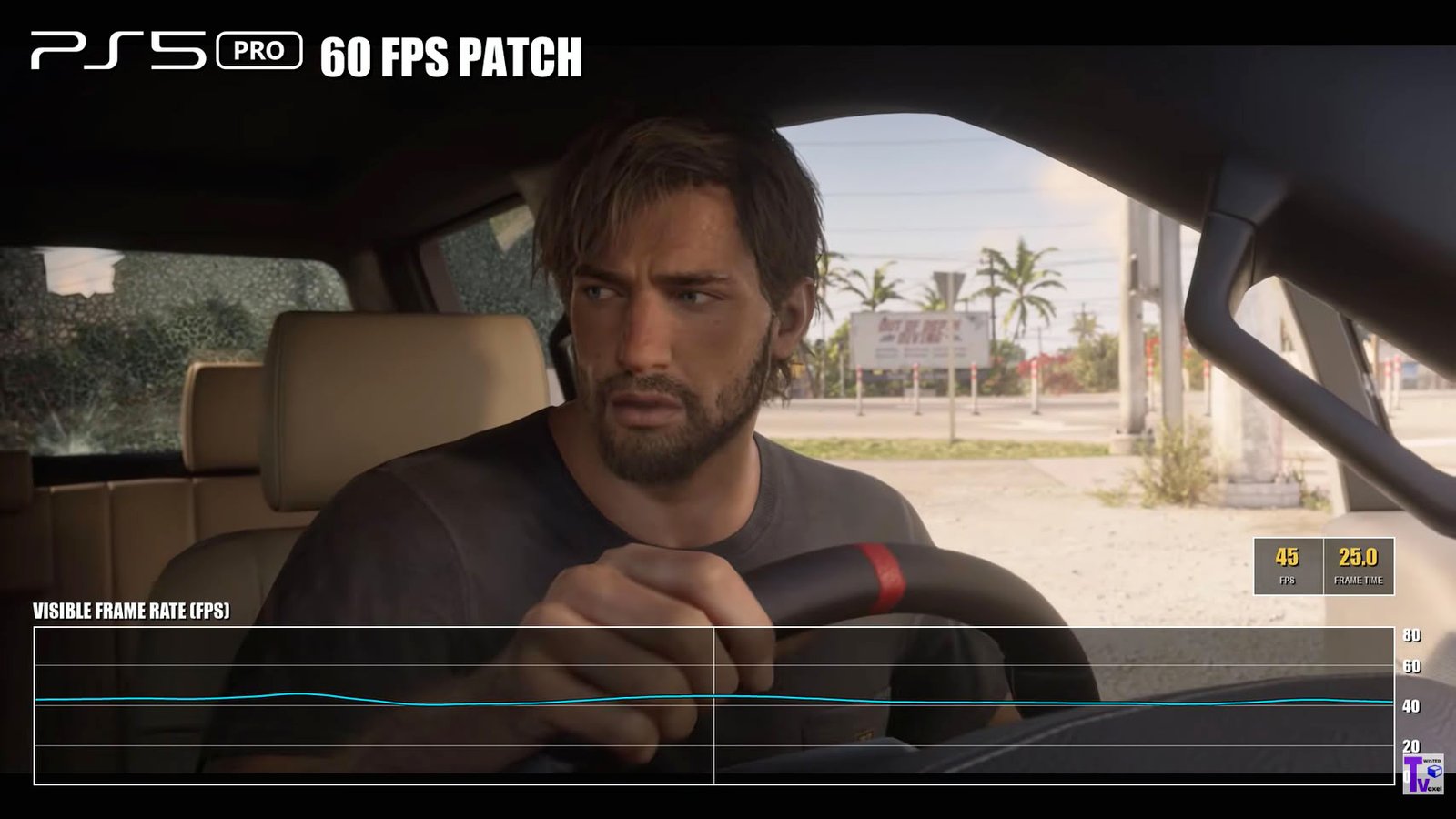
Testing the patch on high-end hardware reveals the complexities of console optimization. Footage captured on a PlayStation 5 Pro indicates that while the mod successfully bypasses the internal cap, the hardware struggle remains visible. Even with the restriction removed, the game frequently operates in the 40 to 50 FPS range, failing to maintain a locked 60 FPS.
The primary cause for this fluctuation appears to be a CPU bottleneck. GTA 6 is notoriously heavy on procedural generation, complex NPC routines, and high-fidelity traffic density—all of which place an immense burden on the console’s processor. While the PlayStation 5 Pro features a more capable GPU and superior ray tracing capabilities, the CPU performance only offers marginal gains over the base console. When the mod is applied to a standard PlayStation 5, the situation is even more precarious, with frame rates dipping into the mid-20s during high-intensity sequences, such as massive explosions or dense urban traffic. These results suggest that the game’s architecture is deeply optimized for the stability of 30 FPS, and forcing a higher output pushes the processor beyond its stable operational thresholds.
The Risks of Firmware Dependency
It is crucial to note that these unofficial modifications are restricted to a very narrow segment of the console ecosystem. These patches require a PlayStation 5 or PlayStation 5 Pro running specific, older firmware versions that possess known vulnerabilities. Modern consoles are frequently updated with security patches that disable these exploits, meaning the vast majority of the player base cannot access these mods even if they desired to.
Beyond the technical difficulty of implementation, there is the persistent risk of system instability. Running a title at frame rates not intended by the developers can lead to erratic behavior in memory management and data streaming. For the average user, the trade-off—sacrificing system security and official software updates for a stuttering, unstable frame rate—is largely impractical. These patches exist more as a technical exercise in reverse engineering than as a viable way to play the game.
Looking Toward Future Optimization
While the modding community continues to experiment, the conversation shifts to what Rockstar might deliver in official updates. Recent data mining efforts have highlighted that the game possesses a variety of graphics settings that are currently hidden from the user interface. These settings reveal a potential pathway for performance improvements on the PlayStation 5 Pro, particularly through adjustments to shadow maps, draw distances, and texture streaming.
The existence of these settings suggests that a “Performance Mode” or a more flexible graphics configuration could theoretically be achievable if the studio decides to prioritize throughput over absolute visual fidelity. However, Rockstar’s focus remains on maintaining a uniform experience across its target hardware. As the industry moves forward, the pressure to provide higher frame rates on console will only increase. Whether through official optimization patches or specialized hardware-specific profiles, the bridge between the 30 FPS standard and the 60 FPS desire remains a focal point for both developers and the persistent community of technical enthusiasts. For now, the hardware remains the ultimate arbiter, dictated by the rigorous demands of the most sophisticated game engine currently in development.
Disclaimer: This content is auto-generated for informational purposes only.
Source: Read Original News