






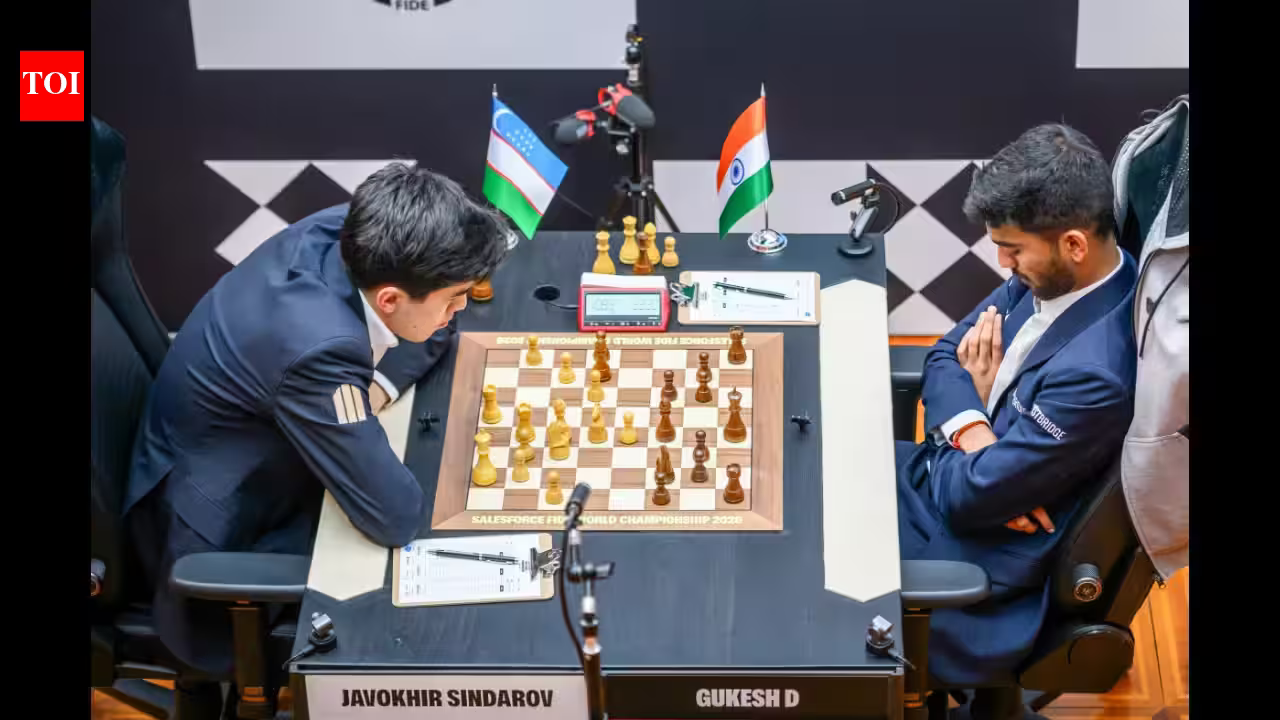
Chess prodigies Gukesh Dommaraju and Javokhir Sindarov are locked in a tactical stalemate that has captivated the global chess community, as the latest rounds of their championship clash prove that preparation and nerves are as vital as raw calculation. Through four intense classical encounters, the narrative has shifted from mere board presence to a psychological war of opening experimentation and defensive resilience.
## The Opening Laboratory: Gukesh’s Calculated Risks
In the high-stakes arena of elite chess, the opening is where the battle begins long before the players sit down at the board. Gukesh, the Indian grandmaster, has utilized the third and fourth games to demonstrate a level of creative depth that keeps his challenger under constant duress.
In Game 3, Gukesh reached into his repertoire to unveil the Rio de Janeiro Variation of the Berlin Defence. A notoriously solid yet complex setup, it signaled his intent to challenge Sindarov’s structural understanding rather than just his tactical sharpness. He followed this in Game 4 by deviating from standard lines in the Petroff Defence, deploying a rare, unconventional idea designed to force Sindarov out of his “comfort zone.”
These maneuvers aren’t merely stylistic; they represent a strategic push to force a breakdown in the Uzbek grandmaster’s preparation. By continuously changing the landscape of the board, Gukesh is testing the limits of Sindarov’s adaptability, effectively forcing him to solve complex puzzles in real-time.
## Sindarov’s Defensive Fortress
While Gukesh has been the primary architect of the game’s volatility, Javokhir Sindarov has been the quintessential bricklayer. Facing a barrage of novelties and aggressive opening schemes, the Uzbek player has shown a maturity that defies his age. His ability to navigate these unfamiliar positions with surgical precision has arguably been the defining feature of the match thus far.
Game 3 served as the ultimate litmus test for Sindarov’s composure. As the clock ticked down and the pressure mounted, he found himself in a precarious position, navigating severe time trouble against an elite opponent. Under the weight of the ticking clock—a scenario that has crumbled many grandmasters before him—Sindarov displayed iron-clad nerve. He defended with machine-like accuracy over a grueling 60-move span, eventually securing a hard-fought draw. It was a performance that underscored his status as a formidable challenger, proving he is more than capable of handling the tactical fire directed his way by the defending champion.
## Momentum and the Weight of the First Win
As the players head into the next phase of the championship, the atmosphere remains disciplined. With 10 classical games remaining, there is no immediate necessity for either player to abandon their strategic caution. In a format where a single slip can result in an insurmountable deficit, both Gukesh and Sindarov are acutely aware that the risks must be calculated and the opportunities carefully curated.
However, the “First Blood” narrative looms large over the proceedings. While the match remains deadlocked, the historical precedent in such encounters suggests that the first decisive victory—whether it comes from a lapse in concentration or a masterclass in endgame pressure—could trigger a massive momentum shift. A win would not only provide a point advantage but would psychologically force the trailing player to overextend in the subsequent rounds, potentially opening the door for a decisive run.
## What Lies Ahead in Game 5
Looking forward, the anticipation for Game 5 is palpable. Gukesh is expected to continue refining his opening preparations, hunting for that specific “concrete advantage” that has so far eluded him. His strategy will likely revolve around maintaining the pressure and testing if Sindarov’s defensive consistency has a breaking point.
Conversely, Sindarov is expected to maintain his current trajectory: a balanced, objective approach that prioritizes positional soundness while hunting for his own transition into an attacking posture. If he can continue to neutralize Gukesh’s preparation, the burden of proof may shift back to the Indian star to demonstrate that he has more than just novelties in his arsenal.
As the series progresses, the chess world continues to watch with bated breath. This is no longer just a contest of moves; it is a high-level chess match of endurance, intellect, and sheer mental fortitude. Whether the deadlock breaks in the next few days or continues deep into the final matches, one thing is certain: both Gukesh and Sindarov are playing at a level that redefines the standard for modern classical chess. The board is set, the pieces are in place, and the next move could well define the trajectory of the entire championship.
Disclaimer: This content is auto-generated for informational purposes only.
Source: Read Original News