








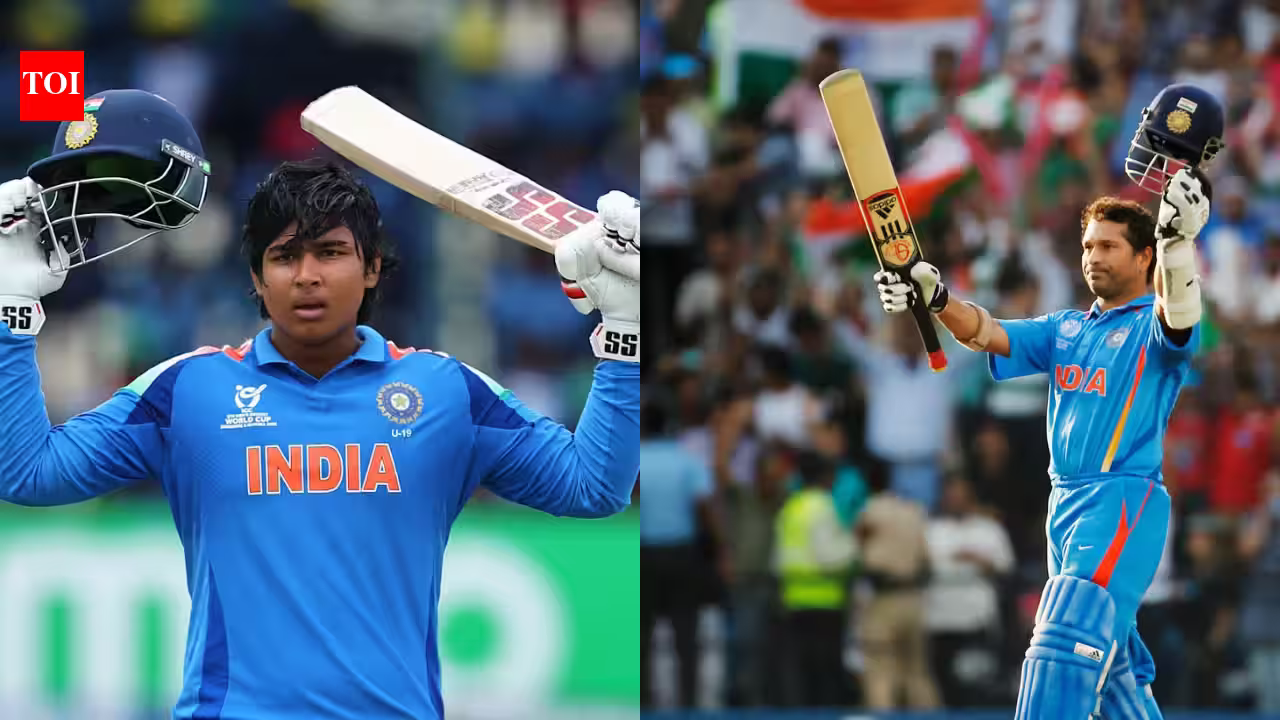
NEVER compare anyone with Sachin Tendulkar. That was the clear, unambiguous message delivered by former India captain Sourav Ganguly this week, as the cricketing world finds itself caught in a whirlwind of hype surrounding 15-year-old batting sensation Vaibhav Sooryavanshi.
As the teenage prodigy continues to shatter long-standing records, the inevitable chatter regarding his potential to reach the heights of the “God of Cricket” has reached a fever pitch. However, Ganguly, a man who saw Tendulkar’s brilliance from the non-striker’s end for over a decade, believes such comparisons are not only premature but fundamentally disrespectful to the sheer scale of the challenges Tendulkar overcame during his historic 24-year career.
The Benchmark of Greatness
Speaking at the ABP Infocom event, Ganguly dismantled the narrative that any newcomer can be equated to the maestro. He pointed specifically to the quality of opposition—an era of fast bowling and spin wizardry that modern batters rarely encounter in the same concentrated format.
“Just think about the bowlers he faced while scoring 100 international centuries,” Ganguly noted, his voice reflecting the gravity of the subject. “Wasim Akram, Waqar Younis, Shoaib Akhtar from Pakistan; Walsh, Ambrose and Bishop from the West Indies; McGrath, Brett Lee and Warne from Australia; Donald and Pollock from South Africa, and Steyn later on. Who did he not face? To score 100 centuries against such bowlers is truly unbelievable.”
Ganguly’s stance is a reminder that Tendulkar’s longevity was defined by his ability to master nearly every significant bowling threat in the history of the sport—a feat that transcends mere statistics and enters the realm of sporting mythology.
A Storm of Records: The Rise of Sooryavanshi
While Ganguly remains protective of the Tendulkar legacy, the excitement surrounding Vaibhav Sooryavanshi is undeniably grounded in hard numbers. The 15-year-old has taken the Indian domestic circuit by storm, most recently producing a performance that left the cricketing fraternity stunned.
In a high-stakes must-win encounter against UAE A, Sooryavanshi didn’t just play well; he dismantled the opposition with surgical precision. The youngster blazed his way to a breathtaking 204 off just 52 deliveries, effectively cementing his status as the fastest batter to reach a double century in List A cricket history.
His assault featured an astonishing 28 sixes—a world-record haul for a single professional innings—and seven boundaries. Perhaps even more impressively, he raced to his century in just 28 deliveries, eclipsing the previous List A record held by Australia’s Jake Fraser-McGurk.
The achievement drew praise from across the spectrum, including 1983 World Cup-winning captain Kapil Dev. “It feels great to see the wealth of talent we have today,” Kapil remarked. “A young boy comes along and sets a world record that has stood for 15 years. What more could you ask for?”
The “Dhoni” Lesson: From Instinct to Responsibility
In the same conversation, Ganguly took a trip down memory lane, reflecting on another young talent who once sent shockwaves through the system: MS Dhoni. Recounting his first glimpse of a long-haired, fearless wicketkeeper-batter in 2003, Ganguly painted a picture of a raw, instinctive talent that shares some parallels with the current buzz around Sooryavanshi.
“I went to Jamshedpur to watch Dhoni play in 2003,” Ganguly recalled. “I flew to Jamshedpur on a chartered flight and watched him at the Keenan Stadium. Dhoni scored a destructive century. Within just seven days, he started playing for the Indian team.”
Ganguly admitted that his initial reaction to the young Dhoni mirrored the famous sentiment shared by then-Pakistan President Pervez Musharraf during India’s tour of Pakistan. Musharraf had famously asked, “Where have you picked this guy from?” after watching Dhoni’s explosive hitting.
“Young Dhoni used to hit big shots. He was then a better batter with good instincts,” Ganguly observed. However, he offered a poignant reflection on how the burden of leadership and the weight of national expectation can evolve a player’s style. “As time passed, his responsibilities increased and his style of play changed. But somehow I liked the Dhoni of the old more because of his carefree nature and six-hitting abilities. He changed his natural game a lot later on and became more cautious in his approach.”
Looking Ahead
Ganguly’s assessment serves as both a warning and a template for the future. While the raw, carefree hitting of a talent like Sooryavanshi is exactly what keeps cricket fans invested in the sport, the path from “teenage sensation” to “legend” is fraught with the evolution of responsibility.
For now, the young Sooryavanshi will have to balance the suffocating weight of comparisons to the greatest of all time with the task of simply playing his natural game. Ganguly’s message, while stern, is essentially a call to let the boy grow—to enjoy the fireworks without expecting him to become a mirror image of the man who set the bar for the entire world. In the fast-paced, high-pressure world of Indian cricket, perhaps the best thing the public can do is stop looking for the “next Tendulkar” and start appreciating the arrival of the first Vaibhav Sooryavanshi.
Disclaimer: This content is auto-generated for informational purposes only.
Source: Read Original News