








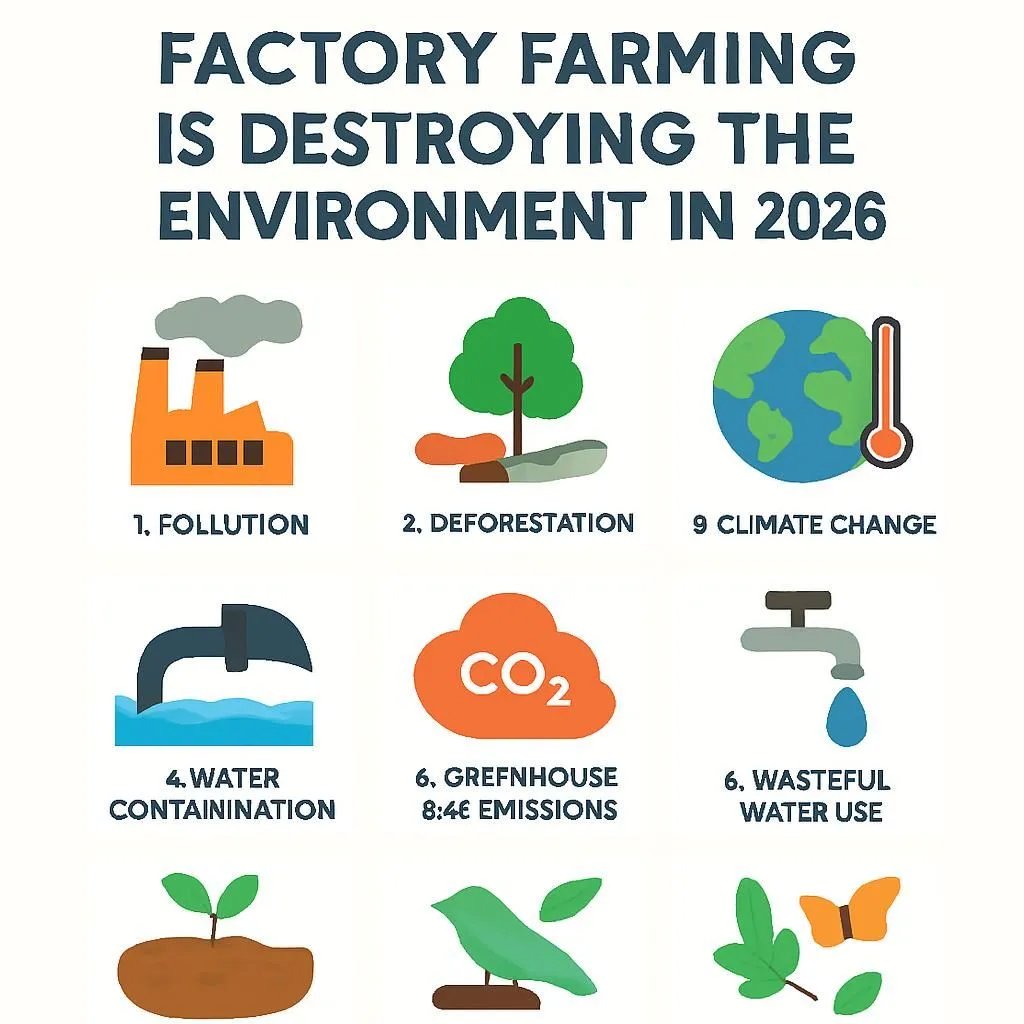
Industrial animal agriculture produces more greenhouse gas emissions than the entire global transportation sector combined. It consumes 70% of the world’s freshwater. It has driven more species extinctions than any other human activity. And it generates more untreated waste than the entire human population of the United States produces in a year. None of this is contested science. All of it is documented by the UN Food and Agriculture Organization, the EPA, and peer-reviewed research going back decades.
What is contested — or rather, strategically obscured — is the connection between these facts and individual food choices. The factory farming industry has spent enormous resources creating the impression that its environmental impact is an abstraction, something for governments and corporations to address, not individual consumers. That framing is convenient and inaccurate. Every person who reduces or eliminates animal product consumption directly reduces demand that sustains the industry.
Key Takeaways
- Animal agriculture is responsible for an estimated 14.5% of global greenhouse gas emissions according to the UN Food and Agriculture Organization — more than all transportation combined
- Factory farms in the US produce 500 million tons of animal waste annually — with no treatment infrastructure equivalent to what human waste requires
- 80% of Amazon deforestation is driven by animal agriculture — primarily cattle ranching and soy cultivation for animal feed
- Industrial livestock uses 80% of all US agricultural land while providing only 20% of the country’s calories
- Switching to a plant-based diet reduces an individual’s food-related carbon footprint by approximately 50%
1. Greenhouse Gas Emissions
Livestock and their associated feed production account for 14.5% of global greenhouse gas emissions — approximately 7.1 gigatonnes of CO2-equivalent per year according to FAO estimates. Cattle alone — for beef and dairy — contribute 65% of the livestock sector’s total. Methane from enteric fermentation is approximately 80 times more potent than CO2 over a 20-year period. The combined greenhouse gas footprint of a plant-based diet is roughly half that of an omnivorous diet.
2. Water Consumption
Industrial agriculture uses approximately 70% of the world’s freshwater withdrawals, with livestock production the dominant driver. A single dairy cow requires 40–50 gallons of water per day. The crops grown to feed factory-farmed animals require up to 43 times more water than roughage-based feeding. Producing one pound of beef requires approximately 1,800 gallons of water. One pound of lentils requires 700 gallons. Water scarcity is accelerating globally — agriculture’s share of that stress is not a future problem.
Animals raised for food in the US produce approximately 130 times more waste than the entire human population — and almost none of it is treated. Factory farm waste lagoons routinely leak or are sprayed onto surrounding land, carrying excess nitrogen, phosphorus, antibiotics, hormones, and bacteria into waterways. This runoff causes algal blooms that deplete oxygen and create dead zones. Agricultural runoff is among the leading causes of water quality problems in US rivers and streams according to the EPA. This runoff ultimately reaches tap water supplies — a concern compounded by the EPA’s 2025–2026 rollback of PFAS limits, which reduces protections against industrial chemical contamination that runs alongside agricultural Pollution. A quality water filter is one practical household step — see our best BPA-free water filter pitchers 2026.
4. Deforestation
Animal agriculture drives approximately 80% of Amazon deforestation — primarily through cattle ranching and soy cultivation for animal feed. The Amazon has already crossed tipping points in some areas, meaning sections of the forest are now emitting more carbon than they absorb — a direct consequence of agriculture-driven deforestation.
5. Biodiversity Loss
A 2021 study identified land-use conversion for meat production as the primary driver of global biodiversity loss. Habitat destruction for grazing and feed crop production threatens thousands of species. The scale of the problem is difficult to overstate: 96% of mammalian biomass on Earth is now humans and their livestock. Wild mammals account for just 4%.
Factory farms release approximately 400 different gases into the atmosphere, including methane, nitrous oxide, ammonia, and hydrogen sulfide. Communities near concentrated animal feeding operations — disproportionately low-income communities of color — experience elevated rates of respiratory illness and asthma. The CDC has documented mental health deterioration among people living near factory farms, attributed to persistent foul air and the stress of an unresolvable environmental condition.
7. Antibiotic Resistance
Approximately 80% of all antibiotics sold in the United States are used in livestock — not to treat sick animals, but as a routine growth promoter and disease prevention measure in crowded factory farm conditions. The WHO identifies antimicrobial resistance as one of the greatest global health threats, with drug-resistant infections already causing over 1.2 million deaths annually. Factory farming’s antibiotic use is a primary accelerant.
8. Ocean Dead Zones
Agricultural runoff carrying nitrogen and phosphorus from manure and synthetic fertilizers flows into rivers and ultimately into coastal waters. The resulting algal blooms consume all available oxygen, creating hypoxic dead zones where marine life cannot survive. The Gulf of Mexico dead zone varies between 6,000 and 7,000 square miles annually. There are over 400 similar dead zones in ocean waters globally.
What You Can Do — Starting at Home
The most direct lever available to any individual is dietary choice. Beyond diet, household chemical choices compound factory farming’s water and Pollution impact. Conventional laundry detergents and cleaning products contain synthetic surfactants, phosphates, and chemical fragrances that enter waterways and add to the burden of agricultural runoff already degrading water quality. Switching to plant-based, biodegradable alternatives reduces your household’s contribution to that system. Here are our verified 2026 picks — all vegan, cruelty-free, and certified biodegradable.
1. Earth Breeze Laundry Detergent Sheets — Best Overall
Earth Breeze sheets are plastic-free, fragrance-free, hypoallergenic, and fully biodegradable — dissolving completely in hot or cold water with zero residue. Each sheet replaces a full load’s worth of liquid detergent, and the cardboard packaging is 100% recyclable. No plastic jug, no synthetic fillers, no animal testing. Certified vegan and cruelty-free. Over 30,000 Amazon reviews with a 4.4-star average. The honest flaw: some reviewers find sheets slightly less effective on heavily soiled work clothes — for those loads, a second sheet solves it. Around $20 for 60 loads.
2. Seventh Generation Free & Clear Laundry Detergent — Best Liquid
Seventh Generation Free & Clear uses plant-derived cleaning agents with no synthetic fragrances, dyes, or optical brighteners — all ingredients are disclosed on the label, which is not standard in the industry. EPA Safer Choice certified, USDA Biobased certified, cruelty-free and vegan. Effective on a wide range of fabrics including sensitive skin and baby clothing. The honest flaw: the plastic bottle is recyclable but not eliminated — if zero-plastic is the goal, step up to Earth Breeze sheets. Around $18 for 66 loads.
3. Molly’s Suds Original Laundry Powder — Best Concentrated
Molly’s Suds is made from just five ingredients — sodium carbonate, sodium bicarbonate, magnesium sulfate, coconut-derived surfactant, and peppermint essential oil. EWG Verified, fragrance-free option available, vegan and cruelty-free. One bag does 70 loads and the cardboard packaging is compostable. Particularly effective in hard water where some plant-based detergents underperform. The honest flaw: the peppermint scent version can be strong — opt for the unscented if sensitive to fragrance. Around $18 for 70 loads.
For more verified plant-based and eco-friendly laundry picks see our full best natural laundry detergents of 2026 roundup — every product verified cruelty-free, vegan, and biodegradable.