








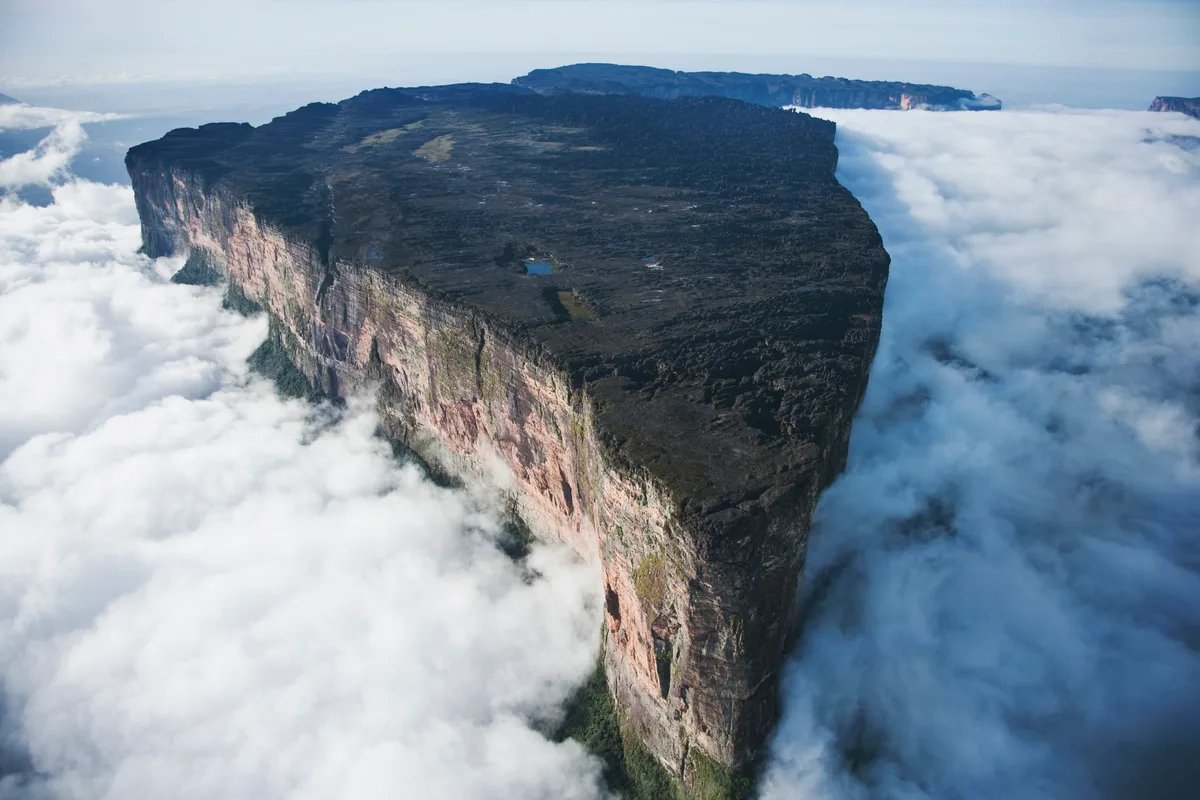
Few places evoke a sense of wonder quite like South America’s tepuis. These enormous, flat-topped mountains rise hundreds and sometimes even thousands of metres from the steaming forest floor into the sky. Often surrounded by a swamp of cloud, they look as if they are floating.
These vast, solid structures comprise some of the oldest rocks on Earth. Geologists believe the sandstone from which they are made was formed 1.7–2 billion years ago.
There are dozens of tepuis. Perhaps the most impressive, at least from a size point of view, is Mount Roraima.
Found on the border of Brazil, Venezuela and Guyana, Mount Roraima is the highest of all the tepuis. At its southern edge, this 14km-long, 5km-wide colossus reaches an elevation of 2,810m. It’s no wonder the word tepui translates as ‘house of the gods’ in the language of the Indigenous Pemon people.
Because of the great age of the tepuis, along with the near-vertical walls, their tops have become isolated ecosystems. As a result, numerous endemic species now live on them, including frogs, mice, insects and carnivorous plants.

One of Mount Roraima’s most intriguing species is a type of sundew known as Drosera kaieteurensis.
This carnivorous plant – which is covered in tiny hairs and a thick, sticky substance – uses its vivid red colour and sugar-coated leaves to attract its prey. Once ensnared, the sundew dissolves its victim before absorbing its nutrients.

Top image credit: Connect Images/Getty Images | Drosera kaieteurensis image credit: Philipp Weigell/ Creative Commons Attribution 3.0 Unported
More amazing wildlife stories from around the world