








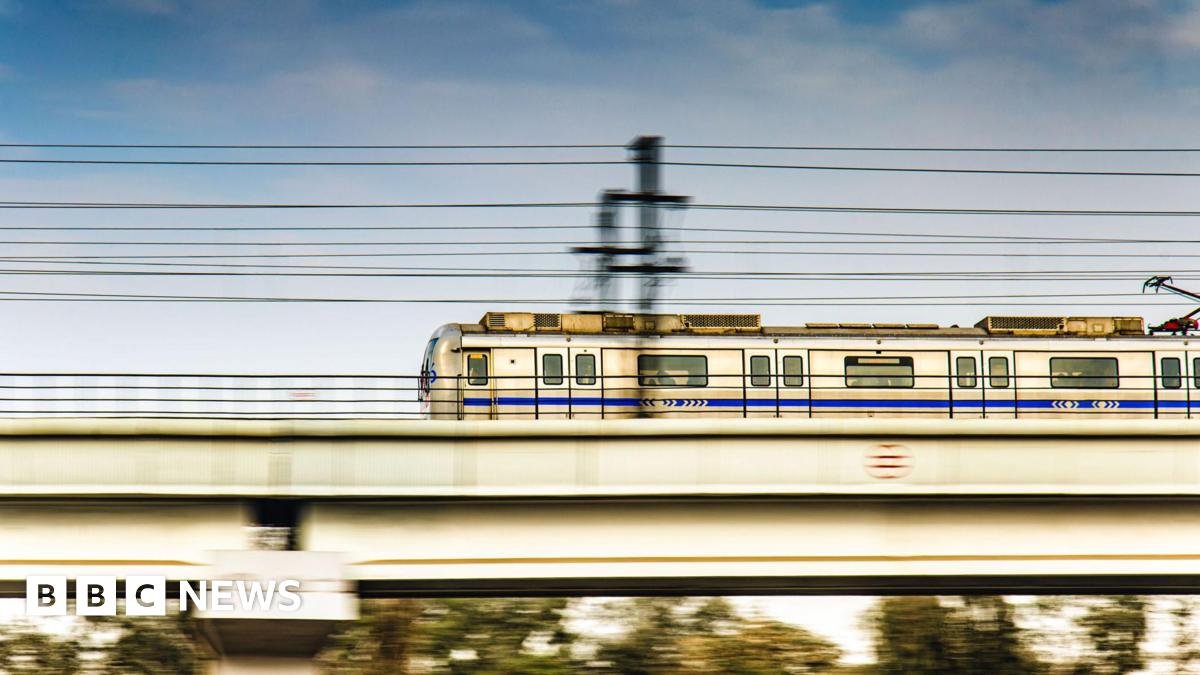
So why has metro travel struggled in a country where car ownership is still low and other public transport systems are overcrowded and overstretched?
It’s a confluence of factors starting with consultants often inaccurately projecting potential demand, says Verma.
“It is a complex task [to project demand], and figures are sometimes exaggerated to show the project is economically viable,” he said.
He added that forecasts were often made based on “offered capacity” on the trains – such as a certain number of coaches, or frequency times for trains. In many cases these have never been realised.
For instance, in Bengaluru, peak-hour train frequency on the busiest line is five minutes or more, while on a newer line, it goes up to 25 minutes.
Similarly, the number of coaches on many trains is only between three and six, whereas the busiest metro rail systems in the world typically operate with nine coaches and a frequency of a train every minute-and-a-half, according to the Sustainable Transportation Lab.
Affordability, or the lack of it, is another important factor.
A single journey on the Aqua line costs 10-70 rupees (£0.08- £0.56). A three-month unlimited travel pass on the local Mumbai suburban railway is significantly cheaper at 590 rupees.
“In Indian metro systems, the integrated journey cost can consume 20% of income for lower-income workers, above the global benchmark of 10-15%,” says Rane.
Verma notes that there has been an increasing proclivity to reduce subsidies, which may not necessarily be a good idea in a price-sensitive country like India.
This was borne out by citizens’ demonstrations after Bengaluru metro hiked fares last year and ridership dropped some 13% after the hike, as per data , externalcollated by Greenpeace.
“Even the London Tube till today is heavily subsidised. Because there is a purpose. You are trying to provide sustainable mobility and decongest the city,” says Verma. [Despite the subsidies, London’s Tube is still among the most expensive public transport systems in the world.]
Other issues that keep demand suppressed are poor network planning and last-mile connectivity.
“People will switch to public transport only when waiting times are as low as possible,” Nandan Dawda, a Fellow at ORF’s Urban Studies programme, told the BBC.
In India, a big problem is the lack of enough feeder buses to handle last-mile connectivity, he says.
Transit times between two lines are also often high, and unwieldy.
At Hauz Khas station in Delhi, for instance, it can take almost 15-20 minutes to transfer from one line to another.
“Institutional disaggregation” is an impediment to solving this, says Dawda. Various metro lines and bus networks even in a single city are run by different operators who often work in silos.
“There needs to be better operational integration between them,” he adds.