






Countries that have yet to ratify the Escazú Agreement remain among the most dangerous places in the world for land and environmental defenders. As COP4 shifts focus from framework building to implementation, States need to turn commitments into action

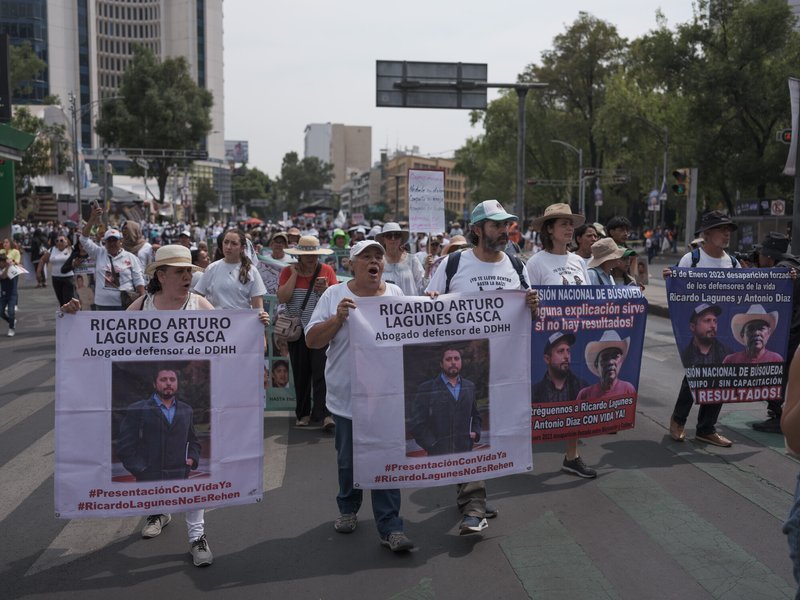
Family members of Ricardo Arturo Lagunes Gasca, a renowned human rights lawyer, during a protest for disappeared people on Mother’s Day in the centre of Mexico City. Luis Rojas / Panos Pictures / Global Witness
To date, 24 countries have signed and 19 have ratified the Escazú Agreement. Yet many of the countries that have not yet ratified it are some of the most dangerous in the world for land and environmental defenders.
According to Global Witness data, Brazil, Guatemala and Peru – all which have not ratified the Escazú Agreement – rank among the countries with the highest number of documented killings and forced disappearances of land and environmental defenders since the Agreement entered into force in April 2021.
Between April 2021 and the end of 2024, Global Witness documented 93 killings and forced disappearances in Brazil, 29 in Guatemala and 15 in Peru.
Expanding the ratification of the Escazú Agreement, especially in high-risk countries, remains critical to strengthening its regional impact and protecting defenders.
What is the Escazú Agreement?
Adopted in 2018 and in force since 2021, the Escazú Agreement is a landmark treaty for the protection of the environmental, including defenders. It is structured around three core pillars:
- Access to environmental information
- Public participation in environmental decision-making
- Access to justice in environmental matters, including the right to a healthy and sustainable environment
The Agreement is the first legally binding treaty to include specific provisions on the protection of environmental defenders.
Article 9 obliges participating countries to guarantee the rights of individuals and groups defending environmental rights by stating that “[e]ach Party shall guarantee a safe and enabling environment for persons, groups and organizations that promote and defend human rights in environmental matters, so that they are able to act free from threat, restriction and insecurity.”
Attacks against defenders since Escazú entered into force
Global Witness has documented killings and forced disappearances against land and environmental defenders since 2012, consistently identifying Latin America as the worst affected region. In 2024, 82% of our documented cases occurred in the region and from 2012 to 2024 ,72% of documented reprisals were in Latin America.
Since the Agreement entered into force, there has been no clear reduction in attacks against defenders – emphasising the importance of moving into implementation of the Agreement’s protections.
México, for example, an early ratifier of the Agreement, continues to see high levels of attacks against defenders.
In Ecuador, we are concerned by impacts that shrinking civic space and increased criminalisation can have on defenders, as reported by Civicus.
Between April 2021 and the end of 2024, 561 killings and disappearances were recorded in Latin America – equivalent to nearly three defenders killed or disappeared each week.
This rate is consistent with levels observed before the Agreement entered into force, highlighting the need for effective implementation.
For the same period, those communities with the highest number of documented attacks include Indigenous Peoples (44%), small-scale farmers (27%), Afro-descendant communities (5%) and lawyers (1%), and others directly linked to land and environmental defence.

A sign that says “Fuera Minera” (“go away mining”) in Catamarca, Argentina, the main setting of our new documentary, White Gold. Sarah Pabst / Global Witness
Attacks are concentrated in areas rich in natural resources, where extractives industries are the main drivers of violence. Mining is the sector behind around 11% of attacks in this period.
The violence is rooted in structural root cases such as access to land, and those most exposed to environmental harm are often the least able to access decision-making spaces on climate, land and development.
Some of the defenders most at risk are those resisting deforestation. Logging drove at least seven of the cases we documented in 2024 in Latin America, making it the second-largest industry driver of attacks in the region.
The Escazú Agreement, through its pillars of access to information, public participation and access to justice, must provide a platform to reduce deforestation while protecting those on the front lines of forest protection.
Threats, criminalisation and surveillance
While lethal attacks are the most extreme form of violence faced by defenders, non-lethal attacks such as threats, criminalisation and surveillance often precede them and impact an even wider range of people.
According to the ALLIED Hidden Iceberg report, in 2024 – the year that Global Witness documented 142 lethal attacks worldwide – ALLIED recorded 1,155 non-lethal attacks, with threats being the most common form of attack.
We have already seen examples of how the Escazú Agreement can be used as a tool to address violence against defenders and support specific cases.
Last year, the Committee to Support Implementation and Compliance of the Escazú Agreement deployed an emergency system for the first time in relation to the disappearance of the Mapuche Indigenous Leader, Julia Chuñil.

Family members and friends of Julia Chuñil display a banner that reads: “Where is Julia Chuñil?” on the land where she was last seen. Tamara Merino / Global Witness
The committee concluded that there was evidence of intimidation, threats and stigmatisation against Julia’s family, and therefore decided to activate its rapid response mechanism to urge the Chilean State to act to take immediate precautionary measures to ensure the safety of Chuñil’s relatives.
After the communication of the committee, three relatives of Julia Chuñil were arrested for the crime in what we have defined as an act of criminalisation against them. Assessing the impact of these actions requires a participatory review process.
An active civil society is the cornerstone for the Escazú Agreement’s success. In Latin America and the Caribbean, strong civil society networks contribute to improved monitoring of attacks, though underreporting persists due to fear of reprisals.
The Escazú Agreement has the potential to strengthen transparency and security conditions and reduce data gaps.
Escazú COP4: From framework to implementation
The fourth Conference of the Parties to the Escazú Agreement (COP4), to be held in the Bahamas from 21-24 April 2026, needs to mark a shift from institutional development to implementation.
While previous Escazú COPs focused on establishing governance structures, COP4 is expected to prioritise putting the agreement into practice.
There are 10 decision points identified for this COP. Key ones include:
- Parties reporting on implementation of roadmaps
- Participation in a voluntary fund
- Participation in decision-making processes related to projects and activities
- Access to justice in environmental matters, sharing good practices and establishing an ad-hoc working group
- Cooperation to support implementation of the Agreement
COP4 also represents a critical moment for defenders and advancing the Action Plan on Human Rights Defenders in Environmental Matters, adopted at COP3 in 2024. The years 2025 and 2026 were designated for developing a regional diagnosis of the situation faced by defenders.
One key issue we will be checking, once the assessment report is published, is what data on attacks the different countries provide. A report by the Representatives of the Public under the Agreement is expected to further document risks and challenges faced by defenders.
The COP4 agenda includes key institutional decisions as well as substantive items, such as strengthening participation in environmental decision-making, advancing access to justice and enhancing cooperation with other international mechanisms.
In this context, greater attention is needed on the practical measures that meaningful participation requires in practice: ensuring that defenders can access decision-making spaces safely and on their own terms, with adequate funding, accompaniment, translation and protection from reprisals.
This is not a merely logistical concern, but a political condition for effective environmental governance and accountability.

Indigenous People stage a peaceful protest outside the main entrance to COP30 on 14 November 2025, in Belém, Brazil. The protest was organised by Conselho Indígena Tapajós e Arapiuns. Fernanda Frazão / Global Witness
Given the scale of violence against defenders, COP4 is an important opportunity to demonstrate how the Agreement can deliver tangible outcomes. Early signals of how States intend to contribute to the Action Plan on Human Rights Defenders in Environmental Matters will be particularly important in assessing political commitment to implementation.
Accessibility to COPs remains a concern. Hosting COP4 in the Bahamas presents financial and logistical barriers for many frontline defenders, particularly those from remote and under-resourced communities, underscoring the need for targeted support to ensure inclusive participation.
Guaranteeing representation and facilitating the participation are essential for the success of the Agreement.
What success at COP4 looks like for environmental defenders
Although the Escazú Agreement is still relatively new, this COP will be crucial to accelerating its implementation phase. Its effectiveness will depend not only on broader ratification, but also on robust national implementation that delivers real protection for land and environmental defenders.
Priority areas include:
- Expanding ratification, particularly among countries with high levels of violence against defenders
- Strengthening national implementation mechanisms, with direct participation of civil society and affected communities
- Advancing thematic initiatives, such as the Gender Action Plan and Action Plan on Human Rights Defenders on Environmental Matters
- Ensuring sustained and adequate funding for civil society participation in the Agreement, while supporting participation models that recognise defenders as political actors and decision-makers. This includes defender-led, consent-based approaches
The Agreement’s emphasis on inclusivity, including gender and intergenerational perspectives, positions it as a pioneering framework for environmental governance. But its impact will ultimately be determined by whether States translate commitments into concrete actions.

Sônia Guajajara, Brazil’s minister for Indigenous Peoples, at an event in the blue zone at COP30, Belém, Brazil. Fernanda Frazão / Global Witness
This includes ensuring that defenders get not just formal recognition, but also the practical conditions to exercise leadership, shape agendas, and participate safely and effectively in climate and environmental governance spaces at national, regional and international levels.
The success of the Agreement can have impacts beyond Latin America and the Caribbean. Escazú is increasingly seen as a model for other regions, with civil society actors in Africa and Asia exploring similar frameworks and closely monitoring its progress.
A successful COP4 can help set the direction for the next phase of implementation and strengthen regional and global efforts to prevent violence against land and environmental defenders.
Global Witness remains committed to supporting the effective implementation of the Escazú Agreement and with active and meaningful civil society participation at its core.