







Germany’s electricity system is entering a decisive transition period, with the country targeting greenhouse‑gas neutrality by 2045. At the same time, the conventional generation fleet is shrinking: Germany’s last three nuclear power plants were shut down on 15 April 2023, and the Coal Phase‑out Act provides for the last coal-fired power station to close no later than 2038.
Policy targets imply a power system dominated by intermittent renewables by 2030. Under the Renewable Energy Sources Act (EEG) 2023, Germany aims for at least 80% of gross electricity consumption from renewables by 2030, with an expansion path of 215 GW solar PV and 115 GW onshore wind (among others). As weather‑dependent generation rises and baseload capacity declines, maintaining adequacy through periods of low renewables availability becomes increasingly challenging, driving the need for reliable dispatchable capacity.
This is the policy context for the government’s evolving security‑of‑supply toolkit. In January 2026, the Federal Ministry for Economic Affairs and Energy (BMWE) announced an agreement in principle with the European Commission on key parameters for implementing the power plant strategy (Kraftwerksstrategie). In parallel, the Bundestag has described plans to work towards a technology‑neutral capacity mechanism intended to be operational by 2028.
In this paper we assess what impact long-duration energy storage (LDES) could have on the cost of firm dispatchable capacity required to ensure security of supply in a high-renewables German power system.
Methodology
We run a capacity adequacy model to calculate residual load and therefore required firm capacity with and without varying durations of battery energy storage (BESS) in the dispatchable capacity mix. The model is based on ECO STOR’s open-source Dunkelflaute Dashboard optimisation framework and represents a 2030 German system with renewable buildout aligned to EEG 2023 targets.
The model uses five years of historic weather and demand data (2020 – 2024). This data is used to set solar PV, onshore wind and offshore wind (RES) generation profiles and demand profiles, though with volumes scaled to match 2030 targets. Residual load is defined as load net of baseload and renewables, where baseload is provided by biomass and hydropower.
We model a sensitivity with firm capacity provided only by gas plants and several sensitivities with a mixture of gas plants and BESS. In the mixed gas and BESS sensitivities, battery dispatch is optimised to reduce peak residual load and therefore required gas capacity. Installed BESS power capacity is fixed; only energy capacity is varied from 2-hour duration to 10-hour in steps of 2 hours. The analysis focuses on the German system in isolation; cross-border power flows and internal grid constraints are not modelled. As a result, the analysis captures the adequacy value of storage but does not reflect potential additional system benefits from storage located at transmission-constrained areas, such as reducing curtailment and redispatch volume.
Key adequacy outputs include firm capacity required to meet residual load, the energy supplied by that capacity, and the extent to which BESS displaces gas plant capacity. Using these outputs, we calculate an “all-in” annual cost metric which includes annualised CAPEX recovery, fixed operating and maintenance (O&M) costs and variable costs (fuel and charging costs). This is the full economic cost of meeting residual load in the model with new‑build resources. It is not intended as a forecast of future contract payments under the power plant strategy or a capacity market, since new‑build plants are expected to participate in standard market revenue streams. We therefore focus on the relative cost impacts of introducing BESS to the dispatchable mix.
Fuel costs in the modelling are based on a gas price of approximately €32/MWh (Dutch TTF early-2026 levels) and a carbon price of €126/tCO₂, consistent with published EU ETS outlooks for 2030.
Results: Battery dispatch
In the model, BESS primarily shaves residual‑load peaks. It charges during hours of RES surplus and low residual load, and discharges during the highest residual‑load hours. We quantify how effectively BESS reduces required firm capacity using effective load carrying capacity (ELCC), which measures the amount of fully reliable capacity that storage can replace.
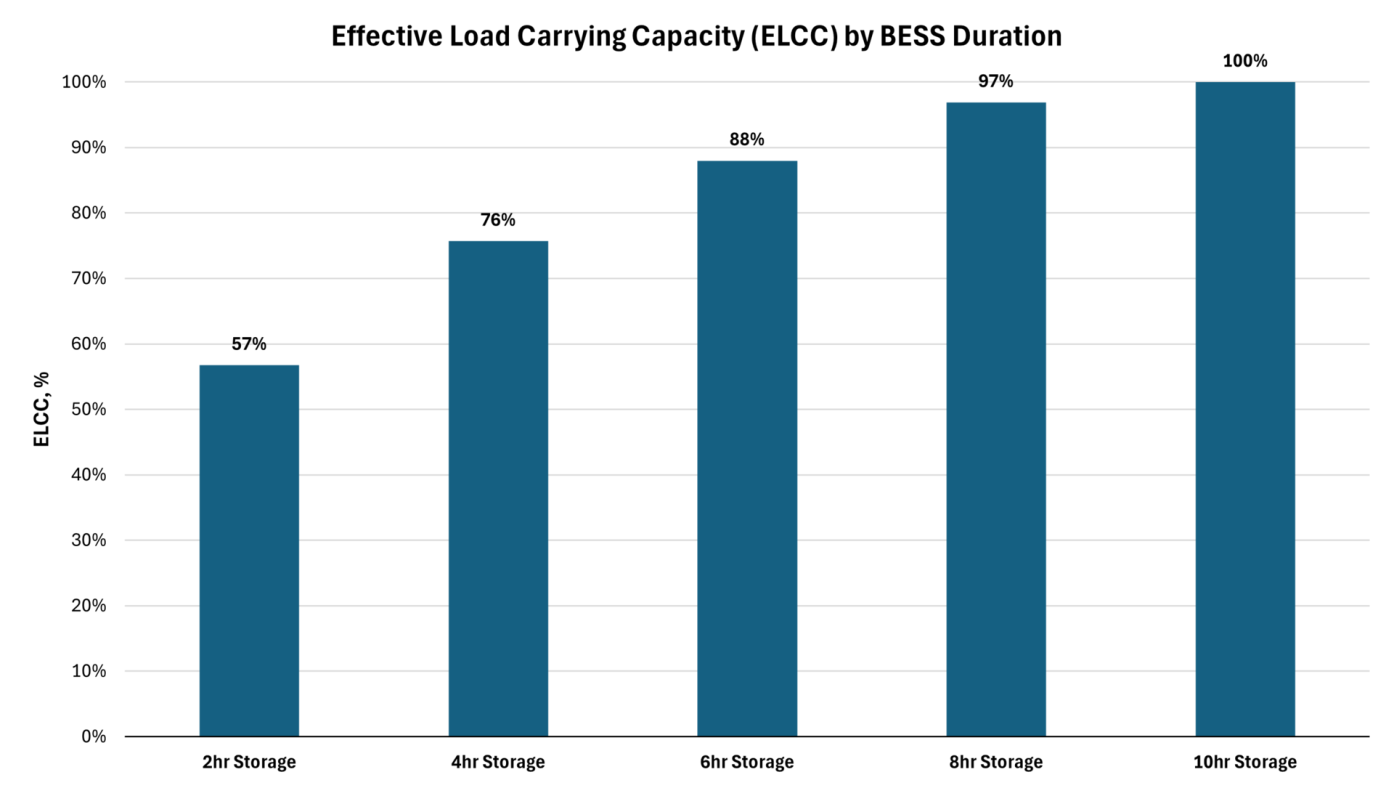
ELCC increases with duration, rapidly at first and then with diminishing returns, from 57% for 2‑hour systems to 88% for 6‑hour systems, then 97% and 100% for 8‑ and 10‑hour systems. This is because longer-duration systems can sustain discharge through periods of high residual load that shorter-duration systems cannot fully cover. An ELCC of 100% means each megawatt of BESS provides the same firm capacity contribution as one megawatt of fully reliable generation in the adequacy model; it does not imply that storage meets all peak demand.

Figure 1: ELCC by BESS Duration
These ELCC results are the average across the five weather years studied. Importantly, the longest-duration systems show consistent results across the full sample: 10-hour ELCC reaches 100% in all five years, while 8-hour ELCC remains above 90% in every year. Shorter durations show greater year-to-year variation.
ELCC affects the economic value of storage duration. In the natural gas case, the resulting cost savings stabilise around 8-hour duration (Figure 2); under higher‑cost fuels such as hydrogen, the economic case for extended duration increases (Figure 3).
Results: Natural gas
We first calculate the adequacy cost of meeting all residual load with natural gas-fueled power plants and then allow BESS to replace a portion of that gas capacity and quantify the cost difference.
Introducing BESS lowers the adequacy cost per kW of firm capacity procured, with savings improving with duration. For 2-hour duration BESS, the cost saving per kW of firm capacity procured is around €7/kW per year, rising to around €12/kW per year for 8-hour BESS. In percentage terms, this is a 1.5% (2-hour) to 2.6% (8-hour) reduction in total adequacy cost relative to the gas-only baseline.

Figure 2: Percentage Cost Saving by BESS Duration – Natural Gas
For the 12 GW of firm capacity set to be procured under the power plant strategy, this equates to annual savings of roughly €90 million per year (2-hour) to €140 million per year (8-hour). Between 2030 and 2050, well within the service life of contemporary LFP BESS, that is on the order of €2 – 3 billion of avoided adequacy cost compared to the gas-only sensitivity (at today’s typical financing assumptions).
These savings, though modest in percentage terms, would be material in an adequacy procurement framework. A reduction of around €12/kW per year represents a meaningful share of typical capacity remuneration levels observed in European capacity markets and indicate that a cost‑minimising adequacy strategy for Germany is likely to include a portfolio of conventional gas capacity and multi‑hour BESS. As fuel prices rise or become more volatile, the economic value of storage increases further, a dynamic explored in the hydrogen-to-power sensitivity below.
Results: Hydrogen-to-power
Germany aims to become carbon-neutral by 2045, by which time gas plants procured under the power plant strategy and subsequent capacity markets are expected to run on zero‑carbon hydrogen sources such as blue hydrogen (steam reforming with carbon capture) or green hydrogen (electrolysis powered by RES). BMWE expects this switch to happen earlier, around 2035.
Hydrogen is considerably more expensive than natural gas, so this fuel transition has major implications for adequacy costs and therefore the potential value of including BESS. We test this by considering an upper bound for hydrogen cost by 2030 of €5.5/kg (the lower end of current green hydrogen production costs) and a lower bound of €4.0/kg (in-line with the current cost of grey hydrogen production).
The result is that BESS becomes materially more valuable. At the lower bound, BESS reduces adequacy costs by €18/kW per year (2-hour) to €42/kW per year (8-hour and 10-hour). At the upper bound, this becomes €25/kW per year (2-hour) to €63/kW per year (10-hour), indicating that the increased hydrogen cost now offsets the jump in CAPEX from 8-hour to 10-hour BESS.
In percentage terms, this is a 1.9% to 4.4% cost reduction relative to hydrogen-only at the lower bound and 2.0% to 4.9% at the upper bound.

Figure 3: Percentage Cost Saving by Bess Duration – Hydrogen-to-Power
For 12 GW of firm capacity, this equates to an annual cost saving of €220 – 500 million (lower bound) and €300 – 750 million (upper bound). In addition to its value in the natural gas case, longer-duration BESS acts as an effective hedge against hydrogen price risk.
Germany’s emerging security‑of‑supply framework will be judged on keeping reliability high at the lowest possible cost as renewables scale and conventional capacity declines. This analysis shows that multi‑hour BESS materially reduces the cost of meeting adequacy needs by reducing the volume of dispatchable gas capacity required and exposure to high and uncertain fuel costs. The implication for procurement design is clear: including longer‑duration BESS alongside gas is a least‑regrets way to reduce security‑of‑supply costs.
Authored by Sam Secher and Andrew Pimm.
Sam Secher is a System Modelling Engineer at Envision Energy, working on battery storage modelling and with experience in power market policy, system planning and investment advisory.
Dr Andrew Pimm is Head of Modelling and Simulations at Envision Energy, leading the development of tools for system sizing, performance guarantees, and simulation analysis.