






EU envoys are set to endorse a global net-zero shipping accord ahead of a week of closed-door negotiations at the International Maritime Organization on Friday – a move that risks placing Brussels on a direct collision course with Washington.
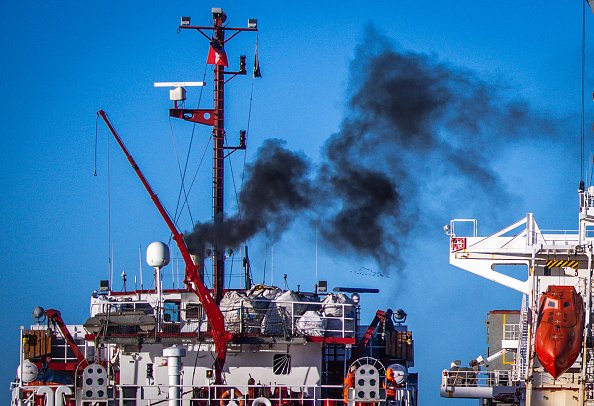
Cargo shipping – the bedrock of modern commerce – accounts for roughly 3 per cent of global greenhouse-gas emissions, owing in part to the vast, two-storey engines that power container vessels and tankers, which run on some of the dirtiest crude oil derivatives, known as bunker fuel.
The IMO – a London-based UN body – provisionally agreed last April on a “net-zero framework” (NZF) that would place a price on shipping emissions, incentivising a shift towards cleaner, low-carbon fuels.
Yet on the eve of a final vote in October, Donald Trump threatened sanctions against any country or official backing the proposal. With support from Greece and Cyprus, Washington succeeded in derailing what the US State Department dismissed as a “European-led neo-colonial export of global climate regulations”.
By exerting pressure on wavering states, the US transformed what had been a majority in favour of the deal into support for a one-year freeze – buying time for opponents to dilute or dismantle the framework.
The EU, wary of further straining ties with the White House, kept a relatively low profile in the aftermath. But ahead of next week’s talks, Washington has reiterated in a note to delegations that it remains “strongly opposed” to the NZF, aligning itself with Russia and other petrostates calling for its abandonment. This time, Brussels appears less inclined to acquiesce.
Entrenched positions
On Friday, national envoys are expected to authorise the European Commission to press ahead with the green shipping agenda – a step that would steer EU negotiators into increasingly choppy waters.
“The positions between the US, Russia and Saudi Arabia on one side, and the EU, Brazil and many Pacific states on the other, are entrenched,” said Lukas Leppert, an observer at the German environmental group NABU.
Last year, the White House threatened tariffs against dissenters and warned that officials supporting the NZF could face personal sanctions. Initially, Brussels sought to bridge the divide by adjusting the proposal. Over time, however, the tone shifted.
After months of tariff threats, social media broadsides and geopolitical tensions – including rhetoric around Greenland – European officials appear to have hardened their stance.
Some policymakers have looked to Mark Carney as a model, citing his firm response to similar US pressure. “It is clear: in recent years, the US has lost international trust in climate policy,” Leppert said.
Felix Klann of Transport & Environment argued that Brussels must now assert itself more forcefully: “The EU today must not be afraid to affirm its ambitious position.”
A retreat in the making?
Despite renewed resolve, Europe’s push could falter in the IMO’s negotiation rooms, where influence correlates closely with the size of national shipping fleets. Major decisions require backing from states representing more than half of global tonnage.
Panama and Liberia – which together account for nearly 40 per cent of global shipping capacity – alongside Japan have tabled alternative proposals ahead of the talks.
Whereas the EU’s stance last year amounted to NZF or nothing, negotiators may now have greater latitude to compromise. A proposal to be endorsed on Friday would empower the EU delegation to amend the framework in order to avert defeat and avoid a repeat of last year’s US-backed obstruction.
In its current form, officials acknowledge, the NZF risks being voted down – particularly as former allies show signs of wavering.
Beijing vacillates
China, once a key supporter of the NZF alongside the EU, sided with Washington in last year’s vote and has yet to signal its position. “The role China ultimately plays could make all the difference,” Leppert observed.
Some Commission officials expect Beijing to align again with the US, having consistently opposed provisions requiring polluting ships to pay for emissions. Others suggest China will simply position itself on the winning side.
Europe’s best option is to seek a middle ground between the NZF and the alternative proposals, one observer said, adding that Friday’s mandate would provide the necessary flexibility.
Domestic divisions
Internal divisions within the bloc further complicate matters. Greece, Italy and Malta have cautioned against adopting an overtly confrontational stance towards Washington.
Other member states, meanwhile, support a global deal for more pragmatic reasons – viewing it as leverage against the EU’s own, more costly carbon pricing regime for maritime fuels.
France has indicated that an agreement at the IMO could open the door to revisiting the bloc’s maritime carbon tax, potentially easing tensions among member states.
Within the Commission, however, officials in the climate directorate remain wary of a diluted global accord that could undermine EU policy. Led by climate commissioner Wopke Hoekstra, some would prefer no deal to a weak one.
“We stand firmly behind the shared objective of putting global shipping on a path towards net-zero emissions by 2050,” a Commission spokesperson said.
France entices ‘recalcitrant’ EU countries to back IMO green shipping deal
If the EU can push through a global Net-Zero Framework at the International Maritime Organisation…
3 minutes

(rh, mk)