






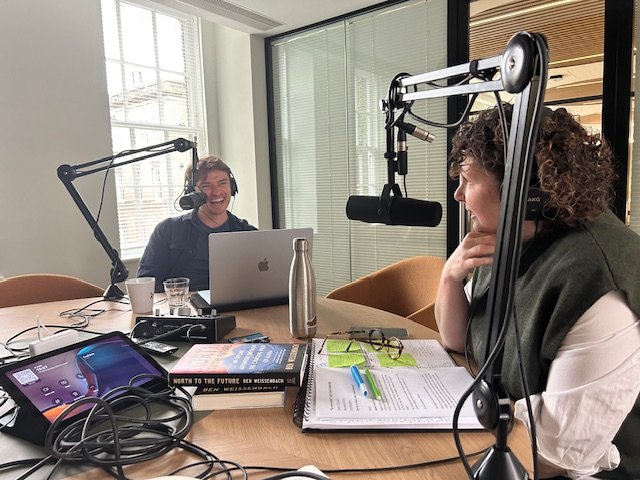
Stephen Lezak and Ben Weissenbach explore how to lead in an overpressured, overcrowded media environment
I think we also need to be able to tell stories that aren’t really about fear or guilt, but are also about open to a diversity of different experiences and futures and that are trying to provide information rather than maybe corral people towards a course of action.
Ben Weissenbach
Two Gates Cambridge Scholars debate how to lead in a 24/7 media environment in the latest edition of the So, now what? Gates Cambridge podcast.
Stephen Lezak [2019] and Ben Weissenbach [2023], both PhDs in Polar Studies, talk to host Catherine Galloway about writing, reporting and trying to keep climate change onto a constantly shifting and overcrowded news agenda.
Stephen’s book The Longest Night, Coming Home in the Age of Apocalypse, is out next year. Published by Atria Books, it takes the long view on the climate crisis, weaving together historical and present-day realities for the indigenous communities of rural Alaska, who are already living in the future of a changing planet. Alongside his writing, including for various broadsheet newspapers, Stephen has advised two US presidential campaigns on climate policy and acted as an expert reviewer for the UN’s Intergovernmental Panel on Climate Change.
Ben is author of North to the Future, an offline adventure through the changing wilds of Alaska. It was published last year by Grand Central Publishing and was named one of the 10 best science books of 2025 by Smithsonian Magazine.
Continuities of life
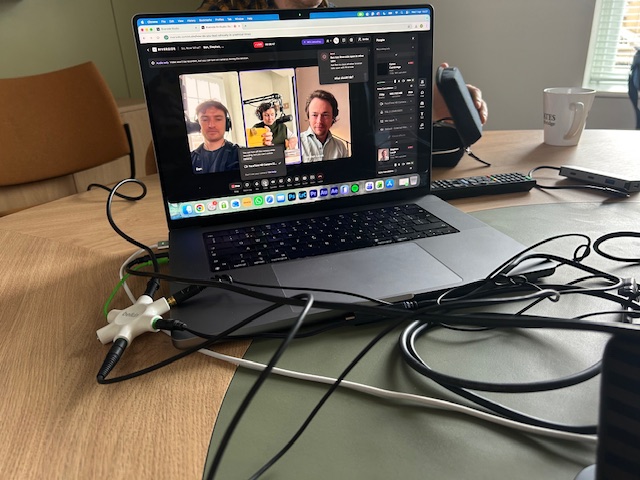 The podcast begins with a discussion of whether what editors are looking for in a story has changed in such a turbulent news world. Stephen says he finds that editors are “hungry right now for stories that feel a little more timeless and a little more eternal”, something surprising. He says there is an interest in exploring other times in history when people have felt a sense of existential dread and understanding how they lived through that.
Ben agrees that readers are looking for something different from the gloom, guilt and despair that much of the coverage of climate change entails. It’s not that it isn’t important to shine a light on what’s happening, he says, but he adds: “I think we also need to be able to tell stories that aren’t really about fear or guilt, but are also about open to a diversity of different experiences and futures and that are trying to provide information rather than maybe corral people towards a course of action.”
He speaks about his motivation for writing his book and how his travels around Alaska that he describes in it showed him “a different way of being with our surroundings that maybe reveals some of the continuities” of life.
The two discuss the ways that the media environment incentivises a particular pace of narrative and a particular kind of story. Ben said: “The primary mode now is really short stories that are gonna compete in an algorithmic environment.”
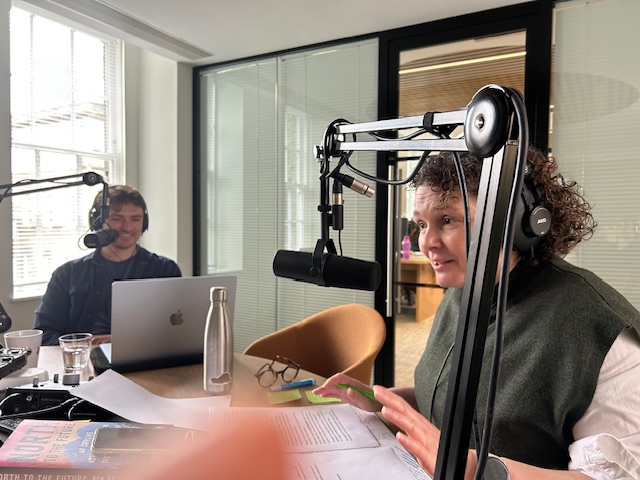 They speak about the privilege of having one foot in academia with the time it allows to really build trust and dig into a story and the other in journalism and writing. That means they can explain the nuance of stories and stand out by being different from the mainstream. They talk about long form writing, about the craft of storytelling, and about podcasts and other formats for covering stories in greater complexity than short news stories allow.
The conversation also covers how the legacy media can differentiate itself from TikTok and the like, the writing process and the importance of focusing on the beauty of nature. Stephen says: “There’s a chapter in my book which is about taking seriously what climate change might be like from the point of view of a sled dog. Not in a, you know, kind of animated way, although there is a moment of dog dialogue, but really actually asking ourselves if we take ourselves out of this very human desire to make meaning out of everything, what does it just feel like to go outside of our own built world?”
The podcast can be found here.
*The next and last episode of the series will be out at the end of May and is a discussion between Ana Rojo Fierro [2024] and Usama Javed Mirza [2022] on how to lead for hope.