









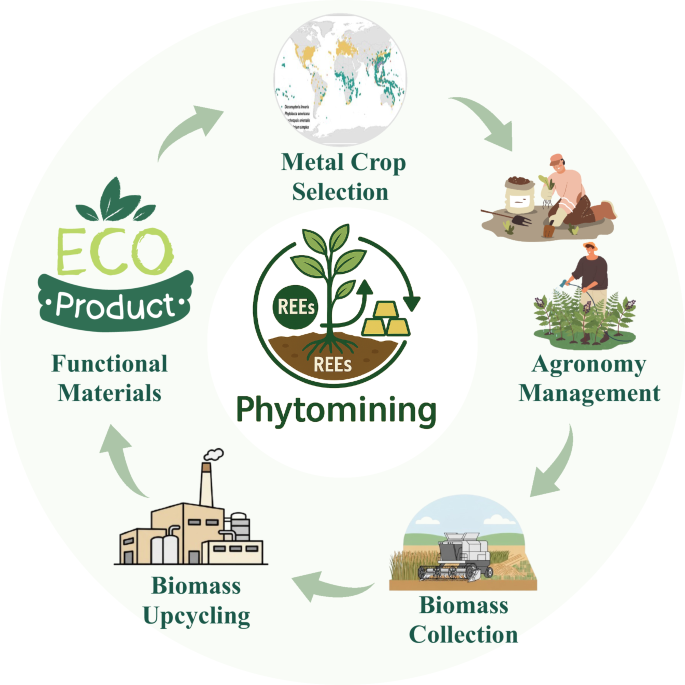
Rare Earth Elements (REEs) are critical components in the low-carbon economy and high-tech industries. However, rapid depletion of high-grade reserves and geopolitical concerns have triggered a supply crisis, driving the need for innovative technologies to extract REEs from unconventional sources. Phytomining, which employs hyperaccumulator plants (“REE crops”) to concentrate REEs from soil into harvestable biomass, offers a sustainable supplementary source. However, its commercial deployment faces two major barriers: inadequate yields of high-REE biomass and the lack of viable processes to recover REEs from the complex biomass. Herein, we propose a strategic framework to advance REE phytomining. Firstly, our approach involves selecting location-specific REE crops such as the fern Dicranopteris linearis, which is abundant in (sub)tropical regions and does not require deliberate planting or intensive agronomic management to maximize phytoextraction efficiency. Secondly, we identify the up-cycling of REE-enriched biomass into products (e.g., fertilizers and catalysts) as a lever to improve the commercial viability of phytomining, beyond the conventional route of hydrometallurgical REE separation. Environmental and economic analyses indicate that this route could produce millions of tons of low-carbon, plant-based REE materials annually. Realizing this potential requires a transition from labs to fields and from research to application, necessitating multidisciplinary, cross-sector collaboration.