









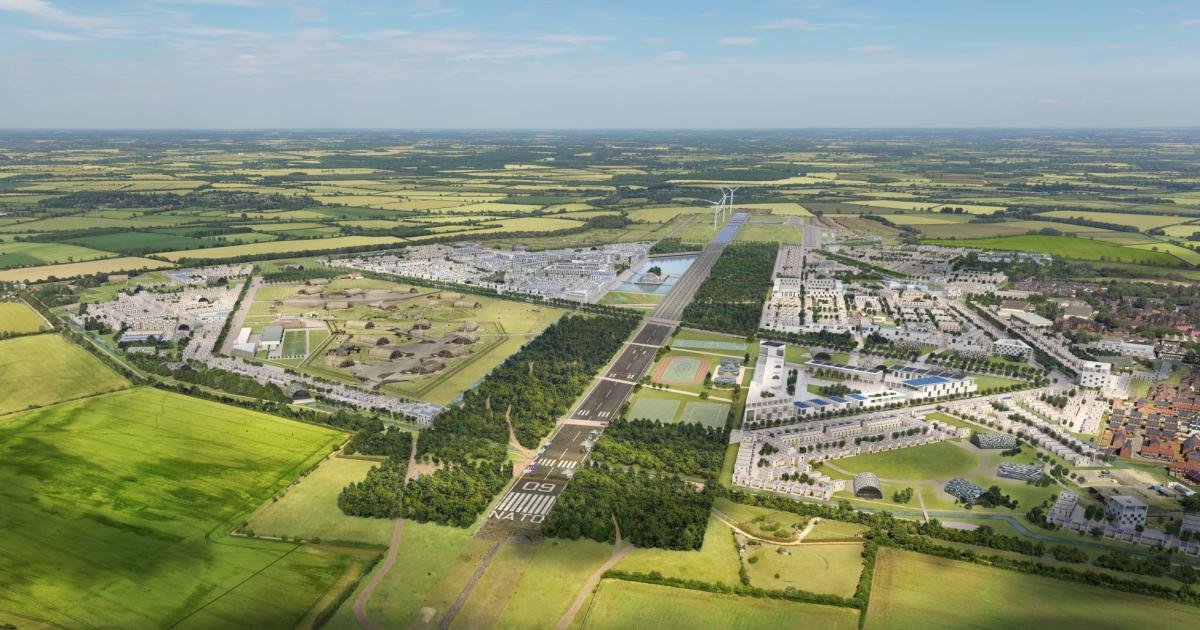
The former RAF Upper Heyford base, which is earmarked for a major housing development, is under scrutiny due to high levels of per-and poly-fluoroalkyl substances (PFAS) ‘forever chemicals’.
These chemicals are linked to cancers, thyroid disease and fertility problems and are commonly associated with fire-fighting foams, which would have been used there when the site was operational from 1918 to 1994.
A national-scale preliminary overview study, published in Chemosphere, showed the elevated levels in the surface water at the Leys Farm Ditch test site, a tributary of Gallos Brook which is around 4km away from former airbase.
Despite this, development is already underway, with 1,200 of the proposed homes built over the past 15 years as part of a £5 billion project, led by Dorchester Living.
The Environment Agency, which is responsible for protecting and improving the environment in England, provides advice on applications to ensure no development has an adverse effect on the environment.
It said: “[We] are currently unable to support the development at Heyford Park as the application doesn’t demonstrate the risk of pollution to water quality from wastewater and drainage can be managed safely.”
While housing plans have since been reduced, with 9,000 of the homes removed from the government’s new towns scheme, these could still be built if approved by Cherwell District Council.
READ MORE: Plans for one of the largest data centres in UK near M40
However, the Environment Agency said any link between the development and PFAS would be for the planning authority.
It added: “The Environment Agency judges the application, rather than evidence against it or in favour from a third-party. To that end, testing from nearby watercourses wouldn’t form part of our advice. However, if we were to see the risk of pollution managed safely, we might reconsider our advice.”
Cherwell District Council said: “We will give careful consideration to all the material issues raised by local residents in determining the application and that will include taking the advice of technical consultees where required.
“However, we will not reach our conclusions until a report on the proposed development is presented to the council’s planning committee.”
Oxfordshire County Council supports the position of the Environment Agency.
It said: “While the county council plays a key role in the development planning process, these specialised bodies are responsible for ensuring that land is safe for human health and that groundwater is protected from contamination.”