







Instead of working against the environment, researchers suggest environmental sensors become a part of it.
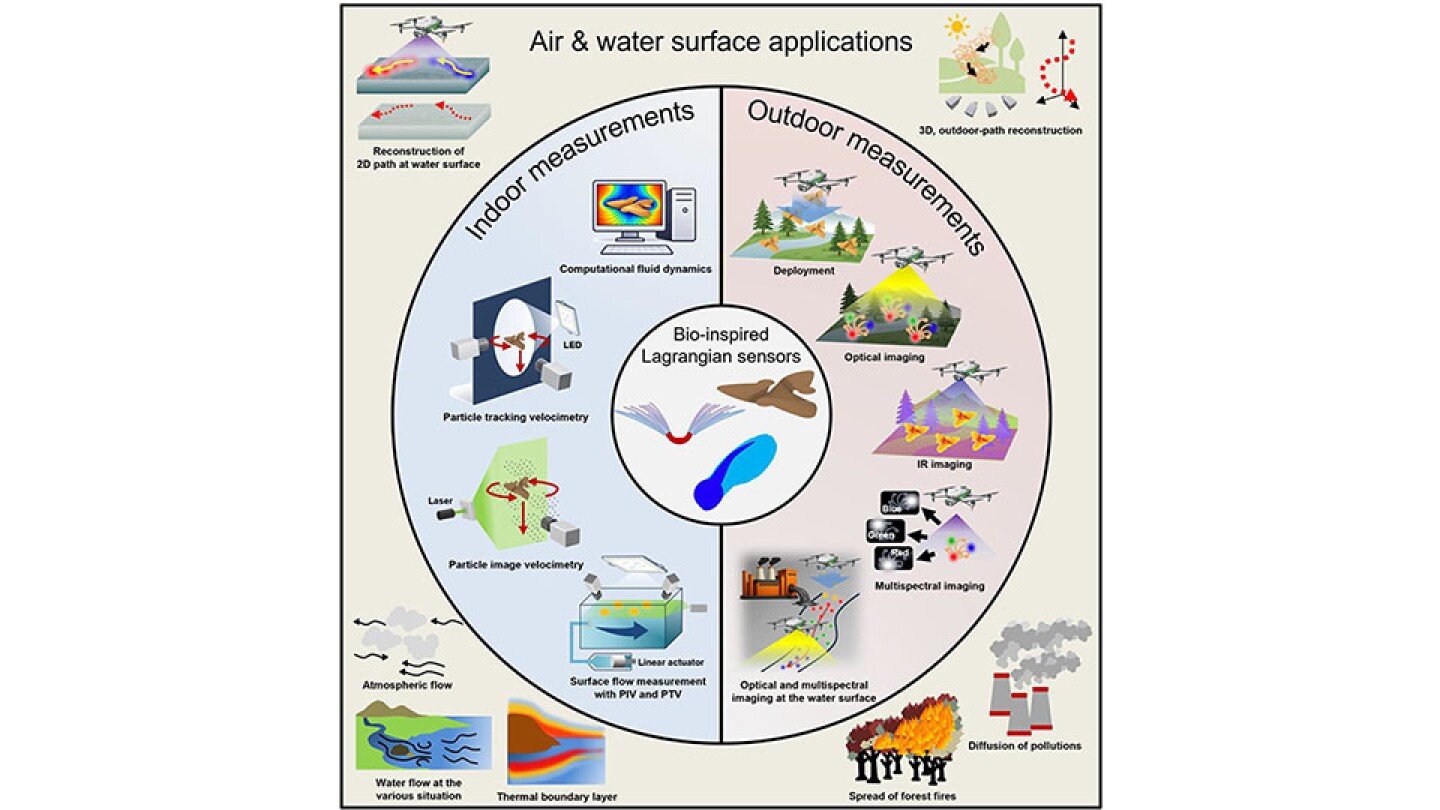
As climate change accelerates and environmental disasters intensify, there is a need for real-time environmental monitoring beyond the limits of what conventional sensors can provide. Seeds offer a natural way to disperse through wind and water and trace atmospheric flows, especially into otherwise inaccessible regions. Baik et al. looked to these organic systems as potential inspiration for passive environmental monitoring systems.
“This work is motivated by a simple idea: Instead of forcing sensors into the environment, let them move with it,” said author Jin-Tae Kim.
Tracking how pollutants spread and mapping atmospheric turbulence and ocean currents are just a few of the many important applications that rely on monitoring fluid flow and transport. By adding functionalities to seed-inspired, biodegradable sensors — like changes in color within certain conditions — researchers can easily optically study these mechanisms without creating electronic waste or using excessive energy.
The key challenge for these types of bioinspired sensors is determining how to use the data at scale. Though the devices themselves can be simple, lightweight, and biodegradable, they require tools like drones or cameras to read out their data, and extracting meaningful information out of this data requires careful tracking and calibration. More importantly, however, they reflect a move toward sustainable technologies that work alongside the physics of the environment.
“These sensors don’t resist the environment; they become part of it. By exploiting fluid-structure interactions, they act as flow-following observers, turning motion itself into a source of information,” Kim said. “This enables a fundamentally different way of sensing: one that is distributed, adaptive, and naturally aligned with environmental dynamics.”
Source: “Physics of passive, bioinspired lagrangian sensors for environmental monitoring,” by Un-Seong Baik, Janghun Ko, John A. Rogers, and Jin-Tae Kim, APL Engineering Physics (2026). The article can be accessed at https://doi.org/10.1063/5.0326061 .