









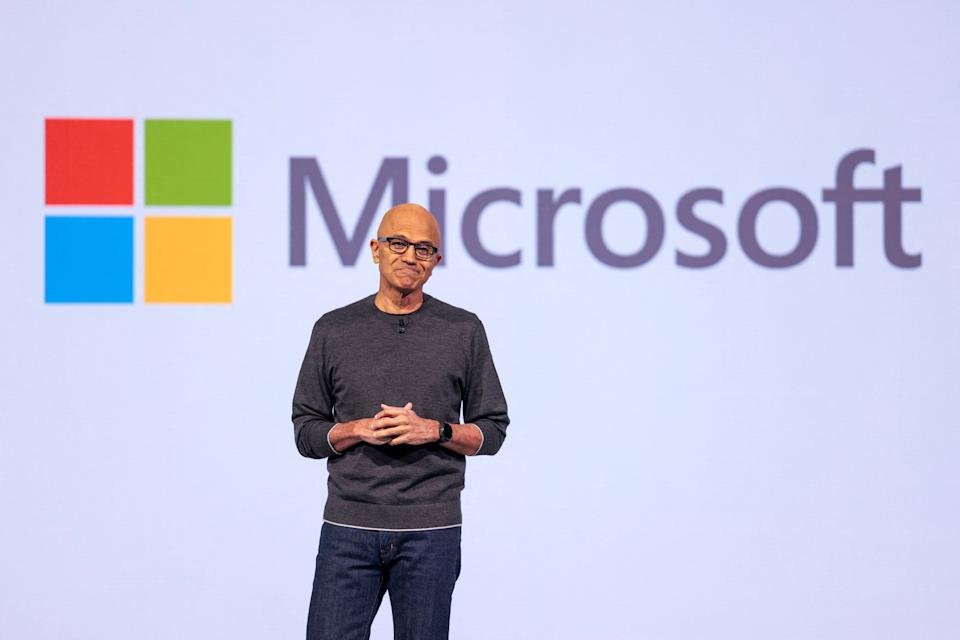
Microsoft (MSFT) reported its third quarter results after the bell on Wednesday, beating analysts’ expectations on the top and bottom lines, and said its AI business now has a $37 billion annual revenue run rate, up 123% year over year.
Shares of the company fell, however, after company said it anticipates Q4 capital expenditures of $40 billion, and said capex for the calendar year 2026 would reach $190 billion. The company’s previous forecasts had annualized AI investment at closer to $150 billion.
Despite that, Microsoft will continue to be capacity-constrained through 2026. Microsoft stock fell as much as 5% on Thursday following the report.
For the quarter, Microsoft saw earnings per share (EPS) of $4.27 on revenue of $82.89 billion. Wall Street was anticipating EPS of $4.04 on revenue of $81.46 billion, based on Bloomberg analyst consensus estimates.
It also said it has remaining performance obligations of $627 billion, up 99% year-over-year, with a weighted-average duration of 2.5 years. Excluding OpenAI, RPO was up about 26%, which is more in line with season averages.
The company’s Productivity and Business Processes segment generated $34.7 billion, slightly above the projected $34.48 billion, while its Intelligent Cloud business reported revenue of $34.68 billion. Wall Street was looking for $34.31 billion.
Microsoft said its Copilot service now exceeds 20 million paid seats, up from the 15 million the company reported in Q2.
Ahead of earnings, Microsoft provided Wall Street with an update on its highest-profile AI relationship on Monday, saying that it reworked its agreement with OpenAI (OPAI.PVT) and will no longer have to make revenue-sharing payments to the AI startup, while OpenAI will continue making payments to Microsoft.
But the tech giant has also lost exclusive access to OpenAI’s intellectual property and AI models. Though it will still have access, OpenAI can also share its data with other companies. OpenAI will also be able to serve its products across cloud partners, rather than just on Azure.

On the PC front, Microsoft’s More Personal Computing segment saw sales of $13.2 billion compared to expectations of $12.64 billion.
The PC industry is dealing with the impact of the global memory shortage caused by the worldwide data center build-out.
That’s forcing some manufacturers to raise PC prices or eliminate certain low-cost models, cutting into overall sales. According to the International Data Corporation, global PC shipments are expected to fall 11.3% this year.
On capital expenditures, Microsoft said it spent $31.9 billion in Q3, with two-thirds of that going to assets, including GPUs and CPUs.