








Spirit Airlines is no more … and now the blame game begins


Budget airline Spirit Airlines (FLYYQ) is no more, and the fallout is just beginning.

After years of financial turbulence, Spirit Airlines officially ceased all operations at 3 a.m. ET Saturday night, marking the end of one of America’s most recognizable budget carriers. The airline’s collapse came after a blocked merger attempt, a bankruptcy filing, and a failed government bailout.

Invest in Gold

Powered by Money.com – Yahoo may earn commission from the links above.

Spirit passengers holding tickets were notified that their flights would not operate, with Spirit directing customers to seek refunds through the bankruptcy process — a slow and uncertain process. Spirit’s full cessation meant no automatic rebooking on partner carriers.

Stranded passengers were largely on their own, though other airlines, such as United (UAL), American (AAL), and Delta (DAL), offered price-capped fares for Spirit passengers.

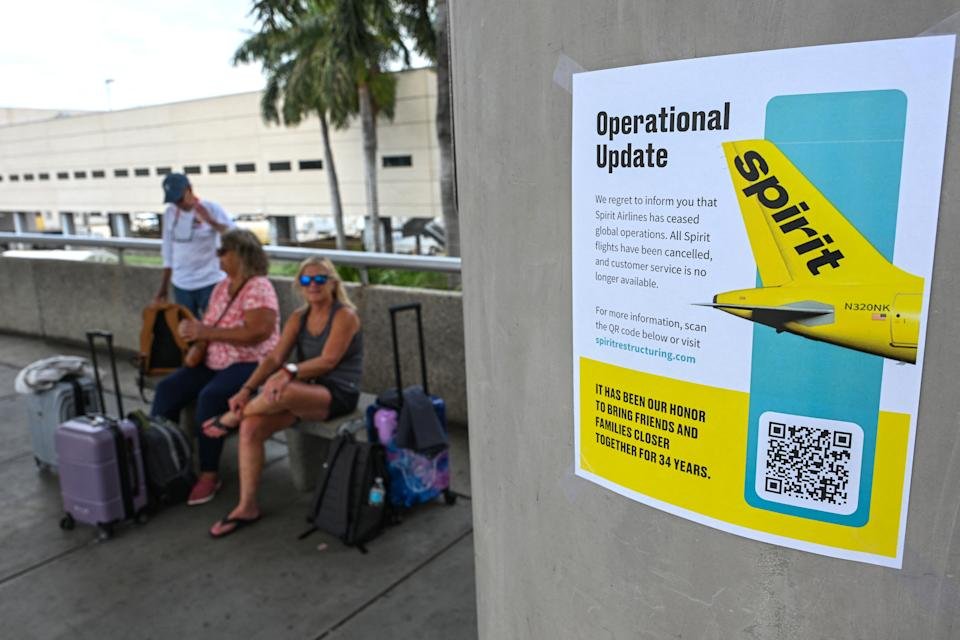
A Spirit Airlines message for customers is seen on a pamphlet after the company ceased global operations at Fort Lauderdale-Hollywood International Airport in Fort Lauderdale, Florida, on May 2, 2026. US air carriers mobilized Saturday to help passengers and crew members stranded by the overnight shutdown of Spirit Airlines, after last-minute talks with creditors and the White House collapsed. The budget airline known for its bright yellow planes succumbed to crushing fuel prices and announced in the early hours of Saturday that "all flights have been canceled, and customer service is no longer available" as it "started winding down its global operations, effective immediately." (Photo by GIORGIO VIERA / AFP via Getty Images)
A Spirit Airlines message for customers on a pamphlet after the company ceased global operations at Fort Lauderdale-Hollywood International Airport in Fort Lauderdale, Florida, on May 2, 2026. (GIORGIO VIERA / AFP via Getty Images) · GIORGIO VIERA via Getty Images

Spirit’s downfall was long in the making. The airline had long operated on razor-thin margins as an ultra-low-cost carrier, relying on high passenger volume and various fees to offset low fares.

When JetBlue (JBLU) proposed a $3.8 billion acquisition of Spirit in 2022, many saw it as a lifeline — a deal that would allow Spirit’s business to survive with economies of scale provided by a merger with JetBlue’s low-fare operations.

But the Biden administration argued the merger would eliminate a key source of low-cost competition and harm consumers, and sued to block the deal. In January 2024, a federal judge sided with the government, ruling the merger anticompetitive, and JetBlue walked away.

Spirit Airlines’ counter is passed by an airport employee after the airline’s shutdown on Saturday, May 2, 2026 at Hartsfield-Jackson Atlanta International Airport in Atlanta. (AP Photo/Jeff Amy)
Spirit Airlines’ counter is passed by an airport employee after the airline’s shutdown on Saturday, May 2, 2026 at Hartsfield-Jackson Atlanta International Airport in Atlanta. (AP Photo/Jeff Amy) · ASSOCIATED PRESS

With that door closed and Spirit unable to restructure its debt or secure a new partner, the airline filed for Chapter 11 bankruptcy protection in November 2024.

The US-Israeli war with Iran hastened Spirit’s demise, as surging fuel prices crushed Spirit’s margins, cash position, and ability to operate. A White House-orchestrated $500 million bailout fell through as well, as Spirit’s bondholders balked at being placed behind the government’s debt claims.

Over the weekend, the blame game heightened. Transportation Secretary Sean Duffy directly blamed the Biden DOJ’s decision to block the JetBlue merger for Spirit’s ultimate collapse.

WASHINGTON, DC - APRIL 17: U.S. Secretary of Transportation Sean Duffy speaks at the Semafor World Economy 2026 summit on April 17, 2026 in Washington, DC. The summit brings together business leaders and tech CEOs for discussions on economy, artificial intelligence and business trends. (Photo by Alex Wong/Getty Images)
Secretary of Transportation Sean Duffy speaks at the Semafor World Economy 2026 summit on April 17, 2026, in Washington, D.C. (Alex Wong/Getty Images) · Alex Wong via Getty Images

“The Joe Biden-Pete Buttigieg administration and DOJ tanked that deal,” Duffy said on ABC’s “This Week.” “Immediately after that, they filed for bankruptcy.”

Duffy also ruled out a bailout for low-cost carriers like Frontier and Avelo.

Critics countered that Spirit’s underlying business model was unsustainable regardless of the merger, and that the airline was on a troubled trajectory long before the DOJ intervened. Even JetBlue’s founder reportedly said the airline was in trouble, suggesting a merger could have backfired.


Spirit — in addition to not hedging fuel costs and pushing the limits with aggressive pricing — has itself to blame for its demise, as well as deals it did not pursue: Spirit bailed on a merger with Frontier Airlines (ULCC) in order to pursue a deal with JetBlue. As Frontier is smaller than JetBlue, a deal with Frontier may have passed antitrust muster.

Former Biden assistant AG Jonathan Kanter suggested just that this morning in an interview with CNBC, claiming a Spirit-Frontier merger would have been approved.

What the blame game doesn’t do is revive Spirit Airlines, meaning Americans suffering through an affordability crisis lost one more option for budget travel.

Pras Subramanian is Lead Transportation Reporter for Yahoo Finance. You can follow him on X and on Instagram.

Click here for the latest technology news that will impact the stock market

Read the latest financial and business news from Yahoo Finance


Source link

Leave a Reply

Your email address will not be published. Required fields are marked *