









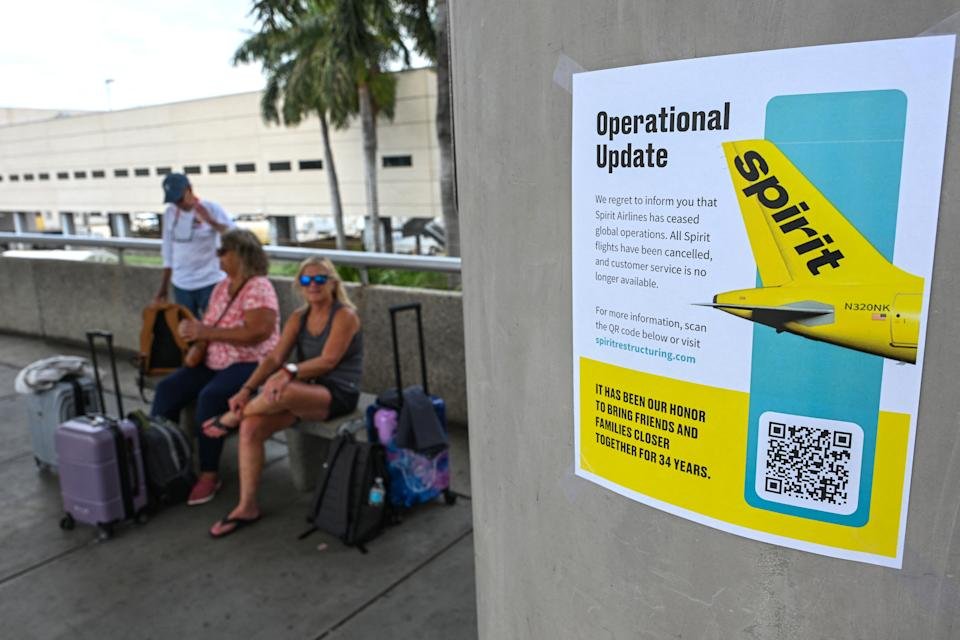
Budget airline Spirit Airlines (FLYYQ) is no more, and the fallout is just beginning.
After years of financial turbulence, Spirit Airlines officially ceased all operations at 3 a.m. ET Saturday night, marking the end of one of America’s most recognizable budget carriers. The airline’s collapse came after a blocked merger attempt, a bankruptcy filing, and a failed government bailout.
Invest in Gold
Spirit passengers holding tickets were notified that their flights would not operate, with Spirit directing customers to seek refunds through the bankruptcy process — a slow and uncertain process. Spirit’s full cessation meant no automatic rebooking on partner carriers.
Stranded passengers were largely on their own, though other airlines, such as United (UAL), American (AAL), and Delta (DAL), offered price-capped fares for Spirit passengers.

Spirit’s downfall was long in the making. The airline had long operated on razor-thin margins as an ultra-low-cost carrier, relying on high passenger volume and various fees to offset low fares.
When JetBlue (JBLU) proposed a $3.8 billion acquisition of Spirit in 2022, many saw it as a lifeline — a deal that would allow Spirit’s business to survive with economies of scale provided by a merger with JetBlue’s low-fare operations.
But the Biden administration argued the merger would eliminate a key source of low-cost competition and harm consumers, and sued to block the deal. In January 2024, a federal judge sided with the government, ruling the merger anticompetitive, and JetBlue walked away.

With that door closed and Spirit unable to restructure its debt or secure a new partner, the airline filed for Chapter 11 bankruptcy protection in November 2024.
The US-Israeli war with Iran hastened Spirit’s demise, as surging fuel prices crushed Spirit’s margins, cash position, and ability to operate. A White House-orchestrated $500 million bailout fell through as well, as Spirit’s bondholders balked at being placed behind the government’s debt claims.
Over the weekend, the blame game heightened. Transportation Secretary Sean Duffy directly blamed the Biden DOJ’s decision to block the JetBlue merger for Spirit’s ultimate collapse.
“The Joe Biden-Pete Buttigieg administration and DOJ tanked that deal,” Duffy said on ABC’s “This Week.” “Immediately after that, they filed for bankruptcy.”
Duffy also ruled out a bailout for low-cost carriers like Frontier and Avelo.
Critics countered that Spirit’s underlying business model was unsustainable regardless of the merger, and that the airline was on a troubled trajectory long before the DOJ intervened. Even JetBlue’s founder reportedly said the airline was in trouble, suggesting a merger could have backfired.